
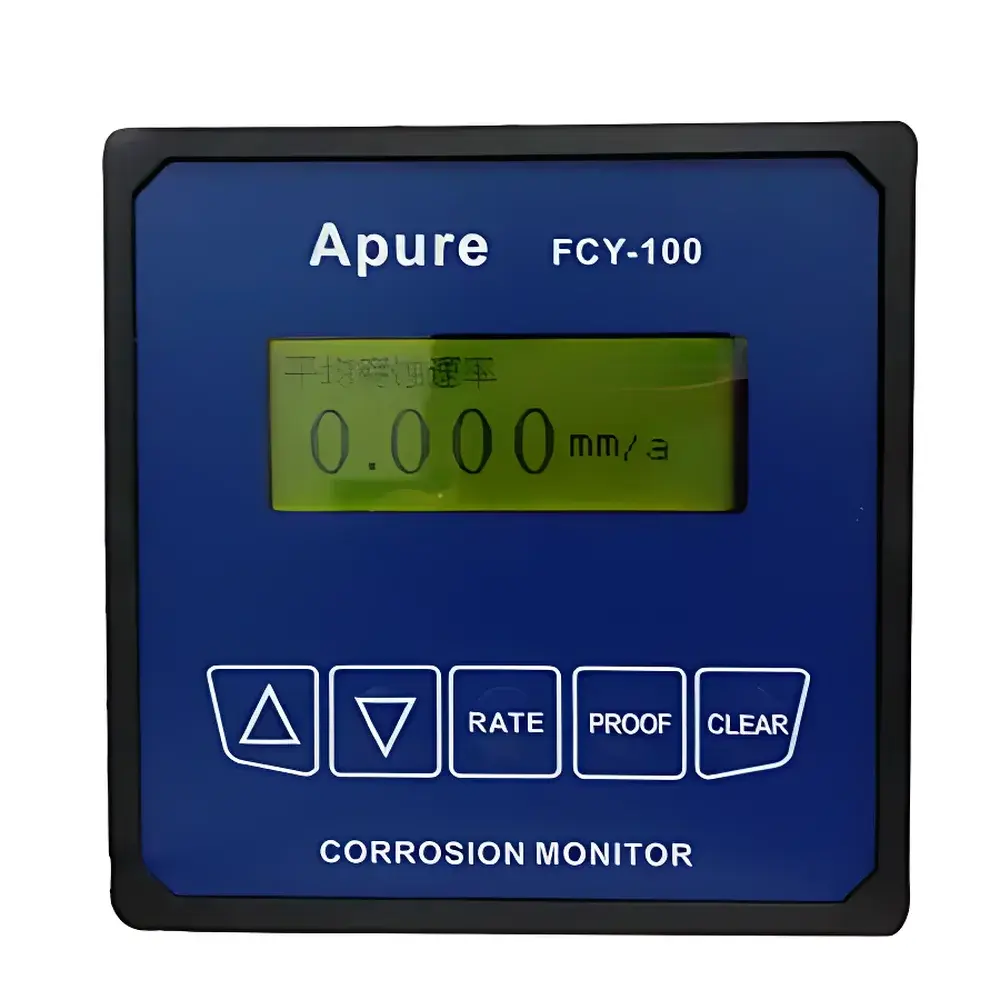
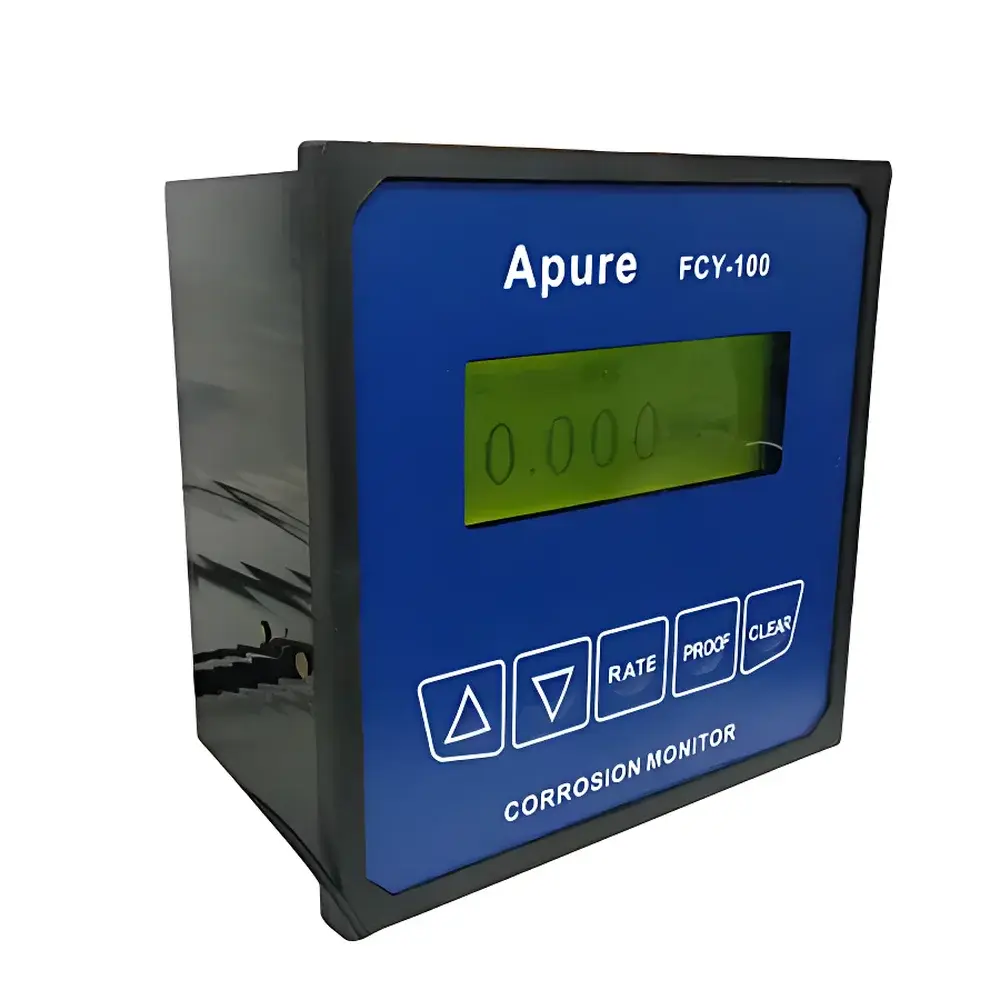
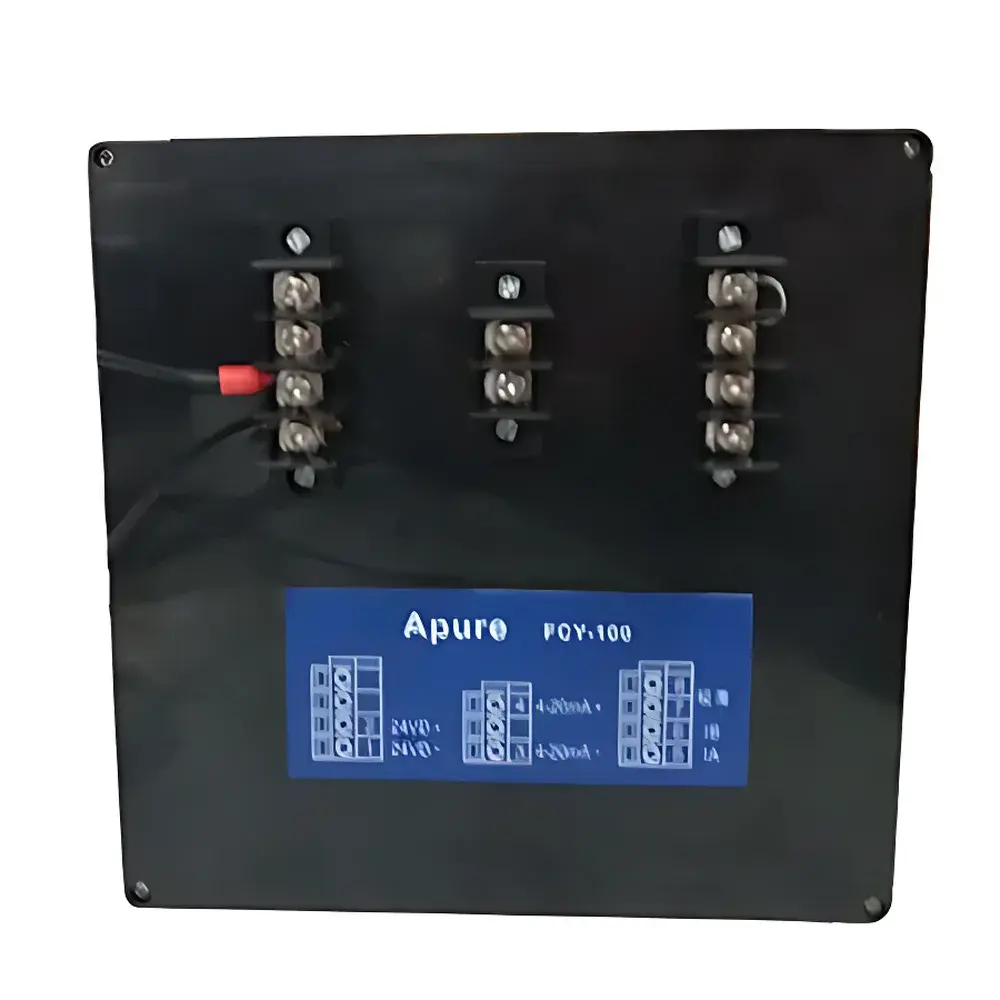
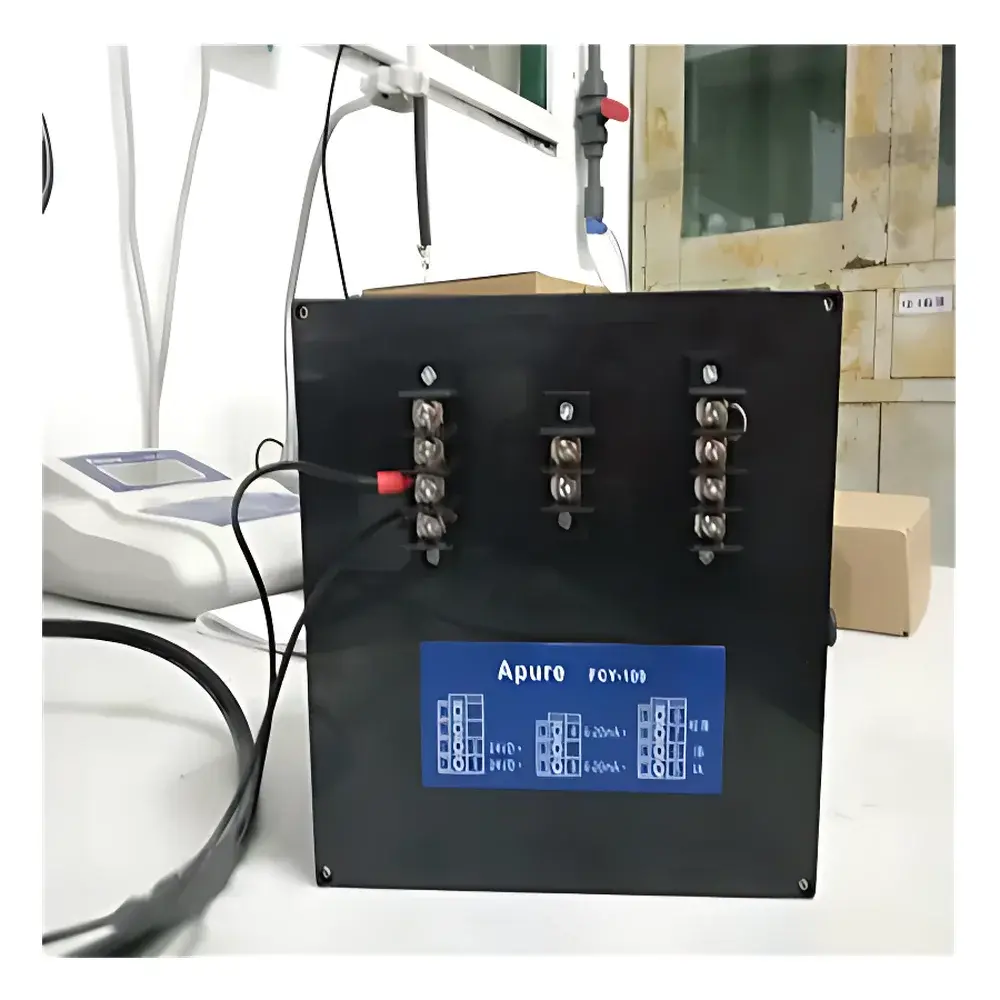
Apure FCY-100 Industrial Online Corrosion Rate Monitor
| Brand | Apure |
|---|---|
| Origin | Shanghai, China |
| Manufacturer Type | OEM Manufacturer |
| Country of Origin | China |
| Model | FCY-100 |
| Price | USD 605 (converted from ¥4,250 at 1 USD ≈ ¥7.03) |
| Display | 192×64 dot-matrix LCD |
| Enclosure | Panel-mount housing |
| Power Supply | 24 VDC, 0.5 A |
| Power Consumption | ≤10 W |
| Measurement Range | 0.001–1.000 mm/a |
| Accuracy | ±0.001 mm/a |
| Response Time | 1 min |
| Output Signal | Isolated 4–20 mA current loop |
| Protection Rating | IP65 |
| Dimensions (H×W×D) | 144×144×90 mm |
| Panel Cutout | 138×138 mm |
| Weight | 0.8 kg |
| Operating Temperature | 0–50 °C |
| Relative Humidity | <85% RH (non-condensing) |
| Magnetic Interference | Minimal ambient magnetic fields beyond Earth’s geomagnetic field |
Overview
The Apure FCY-100 Industrial Online Corrosion Rate Monitor is an electrochemical corrosion monitoring instrument engineered for continuous, real-time assessment of metal loss rates in aqueous industrial process environments. It operates on the principle of linear polarization resistance (LPR), a well-established electrochemical technique standardized in ASTM G59 and ISO 17475 for non-destructive, in-situ corrosion rate quantification. By applying a small potential perturbation (±10 mV) around the open-circuit potential and measuring the resulting current response, the FCY-100 calculates instantaneous corrosion current density (icorr) and converts it to penetration rate (mm/a) using Faraday’s law and material-specific constants (e.g., density, equivalent weight). Its embedded single-board microcontroller performs real-time signal conditioning, temperature compensation (via integrated Pt100 sensor input), and digital filtering to ensure stable output under fluctuating flow or conductivity conditions—critical for applications in cooling water systems, boiler feedwater circuits, desalination plants, and chemical processing loops.
Key Features
- Panel-mounted 144 × 144 mm DIN enclosure with IP65-rated front panel, suitable for installation in control rooms or near process skids exposed to splashing or dust.
- 192 × 64 pixel monochrome LCD with high-contrast backlighting, supporting multilingual menu navigation (English interface standard) and real-time display of corrosion rate, OCP, temperature, and system status.
- Object-oriented menu architecture enables intuitive configuration without technical documentation—parameters such as electrode calibration offset, averaging time, and alarm thresholds are accessible via four-directional keypad.
- Galvanically isolated 4–20 mA analog output compliant with NAMUR NE43, enabling direct integration into DCS, PLC, or SCADA systems with built-in diagnostics (e.g., 3.6 mA under fault, 22 mA for sensor failure).
- Low-power design (≤10 W) ensures compatibility with centralized 24 VDC plant power distribution; no external power supply required.
- Factory-calibrated LPR probe interface supports standard two-electrode (working + reference) or three-electrode configurations (with auxiliary counter electrode), compatible with stainless steel, carbon steel, copper alloy, and duplex stainless steel probes.
Sample Compatibility & Compliance
The FCY-100 is validated for use in conductive aqueous media with electrical conductivity ≥50 µS/cm—covering freshwater, recirculated cooling water, treated boiler feedwater, and mildly aggressive chemical streams (pH 4.0–10.5). It does not support non-conductive fluids (e.g., hydrocarbons, solvents) or highly aerated/degassed systems where oxygen diffusion limitations dominate kinetics. The instrument conforms to electromagnetic compatibility requirements per IEC 61326-1 (industrial environment), safety standards IEC 61010-1 (measurement category II), and carries CE marking. While not intrinsically safe, optional ATEX-certified probe variants (Zone 2, II 2G Ex db IIB T4 Gb) are available upon request. Data integrity meets GLP-aligned practices: all configuration changes and calibration events are timestamped and stored in non-volatile memory for audit trail generation.
Software & Data Management
The FCY-100 operates autonomously without PC dependency. All operational parameters—including zero/scale calibration coefficients, alarm setpoints (high/low limits), damping factor (1–60 s moving average), and temperature compensation slope—are configurable via front-panel interface. The device logs up to 30 days of hourly-minimum/maximum/average corrosion rate values internally (circular buffer); historical data export requires optional USB-to-RS485 adapter and Apure Configuration Utility (Windows-based, free download). No cloud connectivity or remote firmware update capability is provided—consistent with OT security best practices for legacy control system integration. Audit logs comply with FDA 21 CFR Part 11 principles when used in regulated water treatment validation protocols (e.g., USP <1231>, EP 2.2.42).
Applications
- Real-time corrosion rate trending in HVAC cooling towers to optimize biocide and corrosion inhibitor dosing schedules.
- Monitoring carbon steel pipeline degradation in district heating return water systems.
- Verification of passivation efficacy in stainless steel pharmaceutical water loops (PW/WFI) per ASME BPE guidelines.
- Baseline corrosion assessment during commissioning of new heat exchangers or condensers in power generation facilities.
- Long-term integrity management of offshore platform seawater injection lines (when paired with titanium or super duplex probes).
FAQ
Does the FCY-100 require periodic recalibration with reference electrodes?
Yes—annual verification against a certified LPR reference cell (e.g., Apure CRK-1) is recommended; field zero-check using shorted electrodes is supported.
Can it interface with Modbus RTU or HART protocols?
No—the FCY-100 provides only isolated 4–20 mA output. For digital communication, Apure offers the FCY-200 series with RS485/Modbus RTU option.
What is the minimum fluid conductivity for reliable measurement?
50 µS/cm at 25 °C; below this, signal-to-noise ratio degrades, increasing uncertainty beyond ±0.002 mm/a.
Is temperature compensation automatic?
Yes—when a Pt100 RTD is connected to the dedicated terminal block, the unit applies ASTM G102-compliant temperature correction to polarization resistance values.
How is electrode fouling detected?
A sustained deviation (>15%) between measured OCP and historical baseline, coupled with rising polarization resistance variance, triggers a maintenance alert on the LCD.
Related Products




