
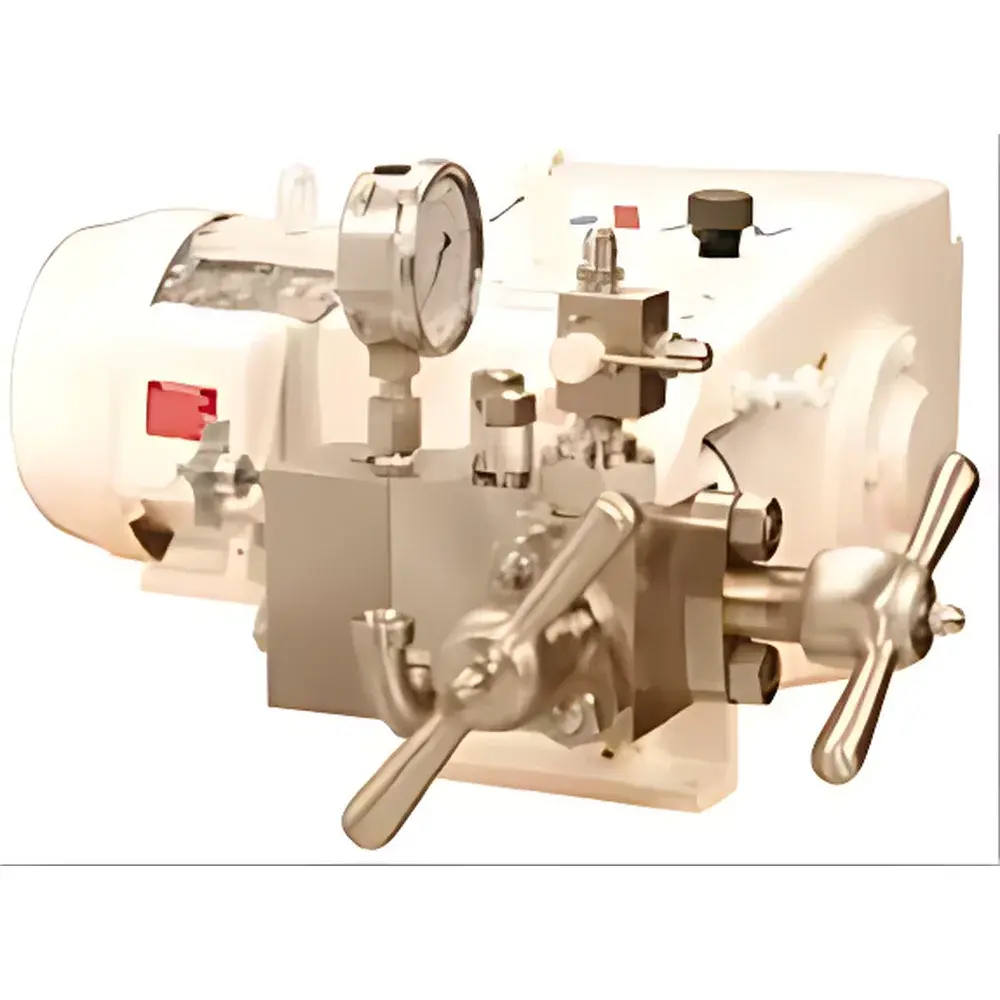
APV 15MR Pilot-Scale High-Pressure Homogenizer
| Brand | APV |
|---|---|
| Origin | Germany |
| Model | APV-15MR |
| Instrument Type | High-Pressure Homogenizer |
| Max Operating Pressure | 690 bar (10,000 psi) |
| Adjustable Pressure Range | 0–690 bar (manual handwheel control) |
| Flow Rate | 57 L/h |
| Sample Inlet Particle Size Limit | ≤500 µm |
| Power Supply | 380 V / 50 Hz |
| Motor Power | 2.2 kW (3 hp) |
| Dimensions (W×D×H) | 914 × 610 × 965 mm |
| Weight | 159 kg |
| Drive Mechanism | Gear-driven (not belt-driven) |
Overview
The APV 15MR Pilot-Scale High-Pressure Homogenizer is an engineered solution for scalable, reproducible particle size reduction and emulsification in pharmaceutical, food, dairy, and fine chemical development workflows. Based on the proven APV high-pressure homogenization principle—utilizing controlled cavitation, shear, and impact forces generated by forcing fluid through a narrow valve orifice at pressures up to 690 bar—the 15MR delivers consistent sub-micron dispersion critical for lipid-based formulations (e.g., parenteral fat emulsions), nanoemulsions, stabilized dairy systems, and functional ingredient suspensions. Designed as a true pilot-scale bridge between lab-scale R&D and full production, its mechanical architecture mirrors that of industrial APV homogenizers, eliminating scale-up uncertainty and enabling direct process transfer validation under GLP/GMP-aligned conditions.
Key Features
- Two-stage homogenizing valve system optimized for sequential pressure drop and secondary refinement—enabling tighter particle size distribution (PSD) control and enhanced stability in multi-phase systems such as intravenous fat emulsions and flavor oil-in-water dispersions.
- Gear-driven transmission mechanism ensures high torque delivery, minimal maintenance, and long-term operational stability—eliminating belt slippage, tension loss, or lubricant contamination risks associated with belt-driven alternatives.
- Manual handwheel pressure adjustment provides precise, repeatable control across the full 0–690 bar range—supporting method development, DoE studies, and batch-to-batch consistency without reliance on pneumatic or electronic controllers.
- Integrated plunger lubrication and external cooling water circuit enable continuous 24-hour operation—critical for extended stability trials, accelerated aging studies, or pilot batches requiring uninterrupted throughput.
- Full CIP (Clean-in-Place) and SIP (Sterilize-in-Place) compatibility: all wetted surfaces—including valve seats, plungers, and product pathways—are constructed from electropolished 316L stainless steel and designed to withstand repeated steam sterilization cycles per ASME BPE and FDA-compliant protocols.
- No compressed air dependency: motor-driven hydraulic intensifier eliminates moisture ingress, oil carryover, or pressure fluctuation issues common in air-powered systems—ensuring robust performance in regulated environments where air quality control is impractical.
Sample Compatibility & Compliance
The APV 15MR accommodates viscous, particulate-laden, and thermally sensitive feeds—with inlet particle size tolerance up to 500 µm—making it suitable for pre-homogenized suspensions, crude emulsions, and cell lysates prior to final nano-sizing. Its construction meets current Good Manufacturing Practice (cGMP) requirements per FDA 21 CFR Parts 210/211 and EU Annex 1 for sterile and non-sterile manufacturing. All contact materials comply with USP Class VI and EC 1935/2004 food-contact regulations. The unit is manufactured under ISO 9001:2015 quality management systems and certified to CE safety standards (EN 61000-6-2, EN 61000-6-4, EN 60204-1), supporting audit readiness for regulatory submissions including ANDA, BLA, and EFSA dossiers.
Software & Data Management
While the APV 15MR operates as a standalone mechanical system without embedded digital controls, its pressure calibration points, flow rate, temperature monitoring ports (optional), and valve wear indicators are fully compatible with external data acquisition systems. Users may integrate analog pressure transducers, flow meters, and PLC-based SCADA platforms to generate ALCOA+ compliant records—including time-stamped pressure logs, cycle counts, and maintenance timestamps—meeting FDA 21 CFR Part 11 requirements when paired with validated electronic signature and audit trail software. Standard documentation includes IQ/OQ protocols aligned with ASTM E2500 and ISPE GAMP5 guidelines.
Applications
- Pharmaceutical development: Preparation of injectable lipid emulsions (e.g., propofol analogs), nanosuspensions, siRNA-loaded liposomes, and vaccine adjuvant dispersions.
- Dairy & beverage R&D: Standardization of milk fat globule size, stabilization of protein-fortified juices, and texture optimization in plant-based dairy alternatives.
- Fine chemicals & cosmetics: Production of transparent microemulsions for fragrance delivery, pigment dispersion for color cosmetics, and polymer nanoparticle synthesis.
- Materials science: Exfoliation of 2D materials (e.g., graphene oxide), ceramic nanoparticle slurries, and conductive ink formulation.
- Biotechnology: Cell disruption of yeast and bacterial cultures for intracellular protein recovery, followed by post-lysis clarification.
FAQ
What is the maximum allowable feed viscosity for the APV 15MR?
The unit is rated for feed viscosities up to 5,000 cP at 20°C when using appropriate pre-filtration and temperature-controlled feed tanks.
Can the 15MR be integrated into a closed-loop recirculation system?
Yes—its inlet/outlet port configuration (1.5″ tri-clamp) supports seamless integration with buffer tanks, heat exchangers, and inline particle analyzers via sanitary tubing.
Is third-party validation support available for GMP installation?
APV-certified field service engineers provide IQ/OQ execution, including pressure transducer calibration traceability to NIST standards and material certification documentation.
How often does the two-stage valve require replacement under continuous operation?
Valve lifetime averages 500–800 operating hours at 690 bar, depending on abrasive content; wear monitoring is performed via baseline pressure drop measurement and acoustic emission analysis.
Does the unit meet explosion-proof requirements for solvent-based processing?
Standard configuration is non-spark-proof; however, ATEX Zone 2 or Class I Div 2 variants with purged enclosures and intrinsically safe instrumentation are available upon request.



