
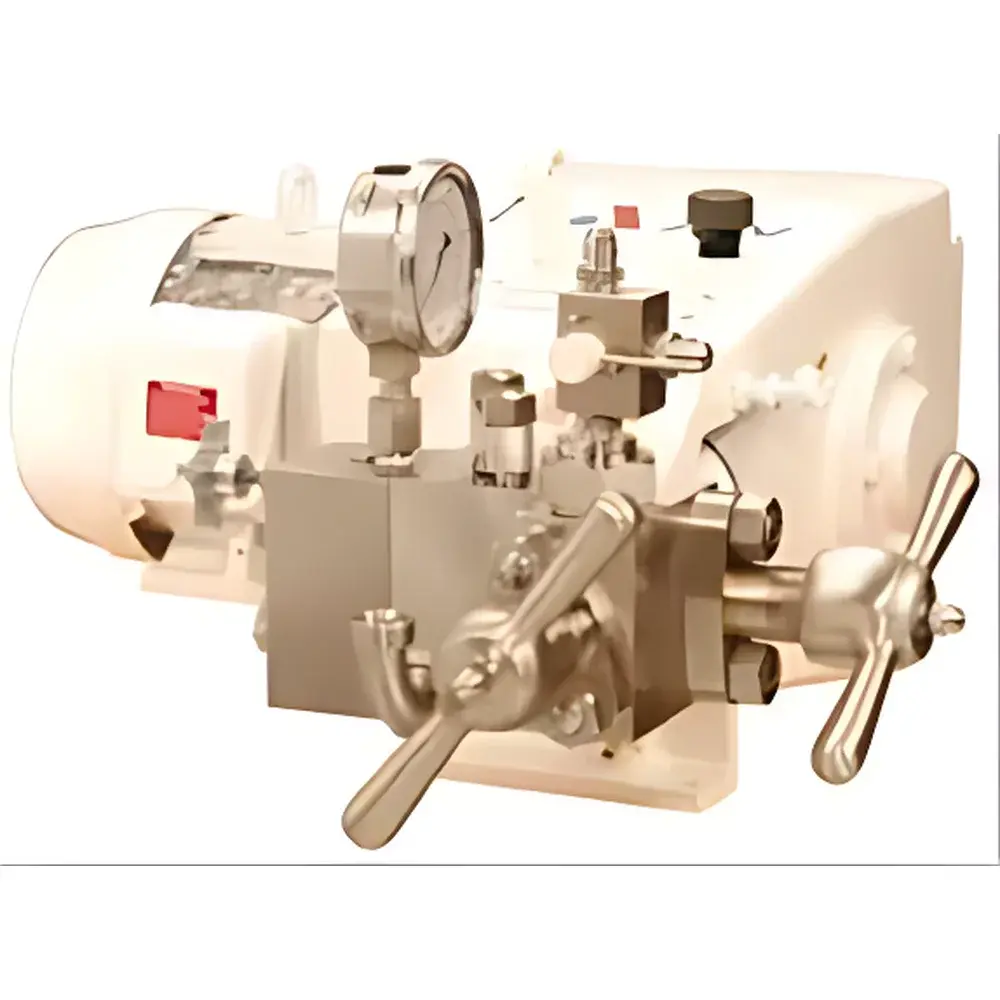
APV 31MR Pilot-Scale High-Pressure Homogenizer
| Brand | APV |
|---|---|
| Origin | Germany |
| Model | APV-31MR |
| Instrument Type | High-Pressure Homogenizer |
| Max Operating Pressure | 240 bar (3,500 psi) |
| Adjustable Pressure Range | 0–240 bar |
| Flow Rate | 117 L/h |
| Sample Inlet Particle Size Limit | ≤500 µm |
| Power Supply | 380 V / 50 Hz |
| Motor Power | 2.2 kW (3 hp) |
| Dimensions (W×D×H) | 914 × 610 × 965 mm |
| Weight | 159 kg |
| Drive Mechanism | Gear-Driven |
Overview
The APV 31MR Pilot-Scale High-Pressure Homogenizer is an engineered solution for scalable process development in pharmaceutical, food, dairy, and fine chemical applications requiring controlled particle size reduction, emulsification, and cell disruption. Based on the proven APV high-pressure homogenization principle—utilizing controlled adiabatic compression, turbulent shear, cavitation, and impact forces within a precisely engineered dual-stage valve—the 31MR delivers reproducible sub-micron dispersion stability and narrow particle size distributions. Designed as a true pilot-scale bridge between laboratory R&D and full-scale manufacturing, its mechanical architecture mirrors that of industrial production units, eliminating scale-up uncertainty. The system operates without compressed air or pneumatic components, relying instead on a robust gear-driven electric motor to power the high-pressure piston pump—ensuring consistent pressure delivery, eliminating moisture contamination risks associated with air compressors, and supporting uninterrupted 24-hour operation under thermal management via integrated piston lubrication and external water-cooling circuits.
Key Features
- Dual-stage homogenizing valve geometry optimized for high-efficiency droplet breakup and solid particle deagglomeration across viscous and non-Newtonian formulations.
- Manually adjustable handwheel pressure control enabling precise, continuous pressure setting from 0 to 240 bar—critical for method development and process parameter optimization.
- Gear-driven transmission system (not belt-driven), ensuring high torque transfer, minimal maintenance, and long-term mechanical stability under sustained load.
- FDA-compliant wetted materials—including 316L stainless steel valves, ceramic or tungsten carbide impact zones, and EPDM or FKM elastomers—certified for CIP (Clean-in-Place) and SIP (Steam-in-Place) compatibility per ASME BPE and EU GMP Annex 1 requirements.
- Integrated piston lubrication and external water-cooling loop enabling continuous duty cycle operation without thermal drift or performance degradation.
- Compact footprint (914 × 610 × 965 mm) with modular design—supports both standalone benchtop use and seamless integration into pilot-scale processing lines.
Sample Compatibility & Compliance
The APV 31MR accommodates a broad range of feedstocks, including but not limited to lipid-based nanoemulsions (e.g., parenteral fat emulsions), dairy matrices (raw milk, cream, whey protein concentrates), fruit juice suspensions, polymer dispersions, pigment slurries, and biopharmaceutical lysates. Feed particle size must not exceed 500 µm to prevent valve clogging and ensure uniform stress distribution. All fluid-contact surfaces comply with ISO 9001:2015 certified manufacturing practices and meet U.S. FDA 21 CFR Part 11 expectations for audit-trail-capable process documentation when paired with validated control software. The unit conforms to CE Machinery Directive 2006/42/EC and carries full electrical safety certification per EN 60204-1. Design documentation supports regulatory submissions under ICH Q5C, Q5D, and USP <1151> for sterile and non-sterile dosage forms.
Software & Data Management
While the base 31MR operates via analog pressure regulation, it is fully compatible with optional digital control modules offering real-time pressure logging, flow rate monitoring, temperature tracking at critical junctions (inlet/outlet), and event-triggered data capture. When integrated with validated SCADA or MES platforms, the system supports electronic batch records compliant with 21 CFR Part 11—including user authentication, electronic signatures, and immutable audit trails. Data export formats include CSV and XML for downstream statistical process control (SPC) analysis using JMP, Minitab, or Python-based quality analytics pipelines. Firmware updates are delivered via secure USB interface with version-controlled release notes traceable to internal change control procedures.
Applications
- Development and validation of intravenous fat emulsions (IVFE) and nanostructured lipid carriers (NLCs) per USP <729> light scattering requirements.
- Standardized milk homogenization trials for functional dairy product innovation (e.g., high-protein beverages, lactose-free formulations).
- Scale-down modeling of commercial homogenization processes for GMP-compliant tech transfer to contract manufacturing organizations (CMOs).
- Rheological conditioning of polymer nanocomposites prior to extrusion or spray drying.
- Cell lysis and inclusion body recovery in microbial fermentation workflows—enabling consistent yield and purity profiles across development batches.
- Stabilization of flavor oil emulsions for beverage and confectionery applications meeting shelf-life specifications under accelerated stability protocols (ICH Q1A).
FAQ
What is the maximum inlet particle size the APV 31MR can handle without risk of valve blockage?
The recommended maximum particle diameter is 500 µm. Pre-filtration or coarse milling is advised for particulate-laden feeds.
Does the 31MR support automated pressure ramping or only manual adjustment?
The standard configuration uses a calibrated handwheel for manual pressure setting. Optional digital controllers enable programmable pressure ramps and hold profiles.
Is the unit suitable for aseptic processing environments?
Yes—when equipped with SIP-compatible gaskets and validated sterilization cycles, the 31MR meets requirements for aseptic intermediate hold steps in bioprocess development.
How does the gear-driven mechanism improve reliability compared to belt-driven alternatives?
Gear drives eliminate slippage, deliver higher torque at low speeds, reduce alignment sensitivity, and extend service intervals—critical for long-duration pilot runs under variable load conditions.
Can CIP/SIP validation protocols be performed on-site by the end user?
Yes—documentation includes CIP/SIP cycle templates, thermocouple placement guidelines, and acceptance criteria aligned with ASTM E2858 and ISPE Baseline Guide Volume 4.



