
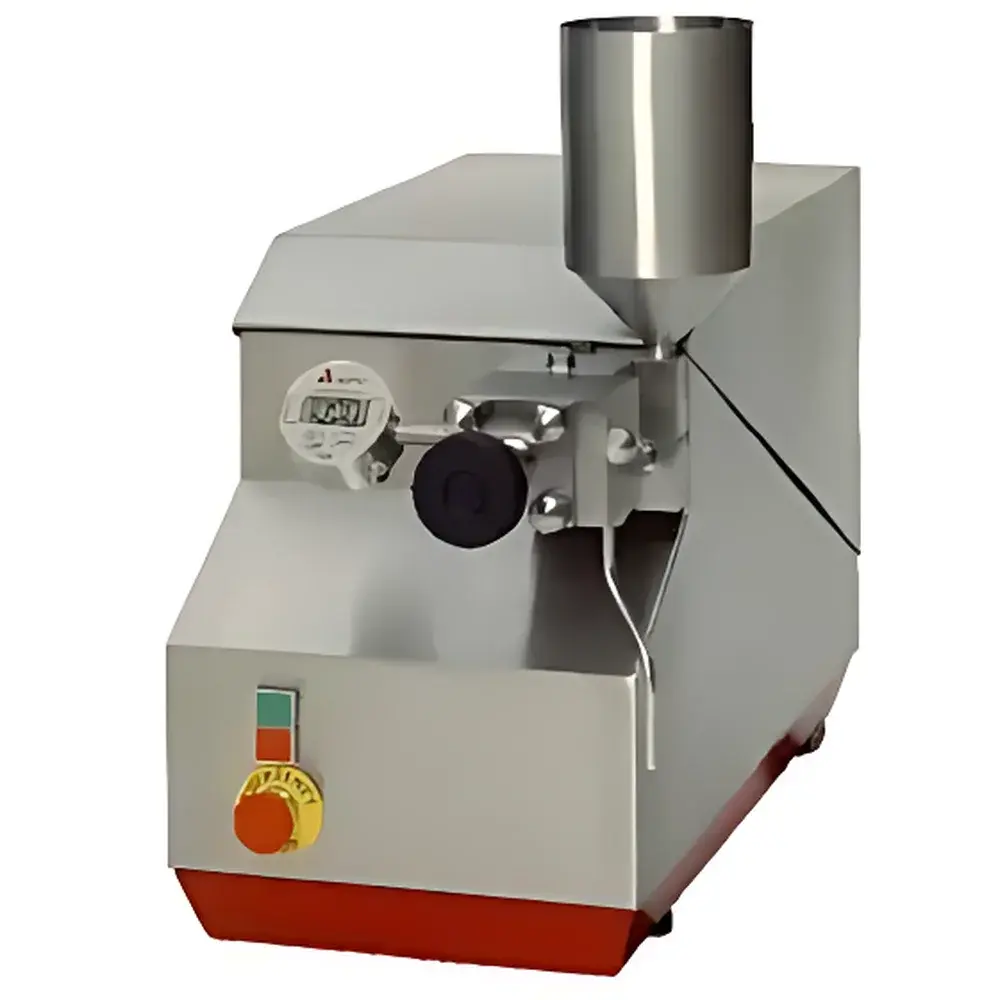
APV APV-1000 Pilot-Scale High-Pressure Homogenizer
| Brand | APV |
|---|---|
| Origin | Germany |
| Model | APV-1000 |
| Instrument Type | High-Pressure Homogenizer |
| Maximum Operating Pressure | 1000 bar |
| Flow Rate | 22 L/h |
| Pressure Adjustment | Manual (handwheel), continuous 0–1000 bar |
| Homogenization Valve | Dual-stage SEO ceramic valve (zirconia-toughened ceramic alloy) |
| Inlet Particle Size Limit | ≤500 µm |
| Operating Temperature Range | Ambient to 100 °C |
| Power Supply | 380 V / 50 Hz |
| Power Consumption | 3 kW |
| Noise Level | 50 dB(A) |
| Dimensions (W×H×L) | 370 × 620 × 818 mm |
| Weight | 105 kg |
| Cooling & Lubrication | Integrated plunger cooling and lubrication system |
| Display | Digital pressure and temperature readout with overpressure alarm |
| Compliance | Designed for GLP-compliant R&D environments |
Overview
The APV APV-1000 Pilot-Scale High-Pressure Homogenizer is an engineered solution for scalable, reproducible nano- and micro-scale dispersion, emulsification, and cell disruption under precisely controlled high-pressure conditions. Based on the principle of turbulent shear, cavitation, and impact forces generated by forcing fluid through a narrow, geometrically optimized valve at pressures up to 1000 bar, the APV-1000 delivers consistent sub-100 nm particle size distributions in lipid-based formulations—including liposomes, fat emulsions, solid lipid nanoparticles (SLNs), nano-suspensions, and microemulsions. Its robust mechanical architecture—derived directly from APV’s industrial homogenizer lineage—ensures structural integrity during extended operation, enabling uninterrupted 24-hour pilot runs without thermal drift or valve degradation. Unlike pneumatic or air-driven systems, the APV-1000 employs direct electric motor drive, eliminating compressed-air moisture ingress that could compromise sample sterility, valve performance, or pump longevity.
Key Features
- Dual-stage SEO ceramic homogenization valve constructed from zirconia-toughened ceramic alloy—exhibiting >6× longer service life compared to tungsten carbide or high-density hard metal alternatives under identical processing loads.
- Manual handwheel pressure regulation offering continuous, fine-grained control across the full 0–1000 bar range—critical for method development, DoE studies, and process transfer from lab to pilot scale.
- Integrated plunger cooling and oil-lubrication system, mirroring production-grade thermal management to sustain stable operating temperatures and prevent seal fatigue during prolonged cycles.
- Digital front-panel display showing real-time homogenization pressure and sample outlet temperature, coupled with audible/visual overpressure alarm for operator safety and protocol adherence.
- Low-noise operation at ≤50 dB(A), compliant with ISO 7779 and EU Directive 2006/42/EC for laboratory equipment noise emission limits—suitable for shared research facilities and cleanroom-adjacent environments.
- No compressed air dependency: eliminates risk of condensate contamination, microbial carryover, or pressure instability inherent in pneumatically actuated systems.
Sample Compatibility & Compliance
The APV-1000 accommodates a broad spectrum of biological and synthetic feedstocks: mammalian and insect cell suspensions (e.g., Vero, CHO, Sf9), microbial cultures (E. coli, Pichia pastoris, Hansenula, Mycobacterium), plant tissues, algal biomass, pollen, and viscous pharmaceutical pre-formulations (e.g., soybean oil–lecithin–water systems). Feedstock inlet particle size is limited to ≤500 µm to ensure valve integrity and laminar flow stability. The system supports GMP-aligned workflows via traceable pressure logging (when integrated with external data acquisition), meets mechanical safety requirements per EN 61000-6-2/-4 (EMC), and aligns with material compatibility standards for pharmaceutical contact surfaces (USP Class VI, FDA CFR 21 Part 11–ready when paired with validated software). Its design facilitates cleaning validation (CIP-compatible geometry) and supports audit readiness for GLP and ISO 17025-accredited laboratories.
Software & Data Management
While the APV-1000 operates as a standalone instrument with analog pressure/temperature feedback, it features standardized 4–20 mA and RS-485 interfaces for integration into centralized SCADA or LIMS platforms. When connected to APV’s optional HomoControl™ data logger (sold separately), users obtain time-stamped, tamper-evident records of pressure profiles, temperature excursions, run duration, and alarm events—fully compliant with 21 CFR Part 11 requirements for electronic records and signatures. All logged data are exportable in CSV or PDF format for inclusion in regulatory submissions (e.g., IND, MAA, BLA dossiers) and internal quality reviews.
Applications
- Pharmaceutical R&D: Liposome encapsulation optimization, nanostructured lipid carrier (NLC) formulation, sterile fat emulsion manufacturing (e.g., Intralipid®-type products), and nucleic acid delivery system development.
- Bioprocessing: High-yield intracellular protein extraction from recombinant yeast and bacterial expression systems; scalable lysis of filamentous fungi and thermosensitive mammalian cells.
- Food & Nutraceuticals: Cold-sterilized juice stabilization, dairy emulsion refinement, and bioactive compound nanoencapsulation (e.g., curcumin, resveratrol).
- Materials Science: Graphene oxide dispersion, quantum dot suspension, and ceramic nanoparticle deagglomeration for advanced coatings and battery slurries.
FAQ
What is the maximum allowable feed viscosity for the APV-1000?
The system is rated for aqueous and low-to-medium viscosity suspensions up to 500 cP at 25 °C. Higher viscosities require pre-dilution or upstream rotor-stator pre-homogenization.
Can the APV-1000 be used for sterile processing?
Yes—when equipped with sterilizable wetted-path components (e.g., SS316L valves, silicone-free seals) and validated using SIP protocols, it supports aseptic batch processing under ISO 5 conditions.
Is the ceramic valve replaceable in-house?
Yes—the SEO ceramic valve assembly is field-replaceable using standard torque tools and APV’s documented maintenance procedure (Ref. Manual Rev. 4.2); no specialized calibration equipment is required.
Does the APV-1000 support variable flow rate control?
Flow rate is fixed at 22 L/h at nominal pressure (1000 bar); however, effective throughput can be modulated via dilution, recirculation loops, or duty-cycle scheduling without compromising homogenization efficiency.
How does the APV-1000 compare to microfluidics-based homogenizers for liposome sizing?
Unlike microfluidic devices limited to mL/min throughput and prone to clogging with particulate feeds, the APV-1000 achieves statistically representative batch homogenization at liter-scale volumes while maintaining narrow PDI (<0.1) in final dispersions—making it the preferred platform for translational formulation development.



