
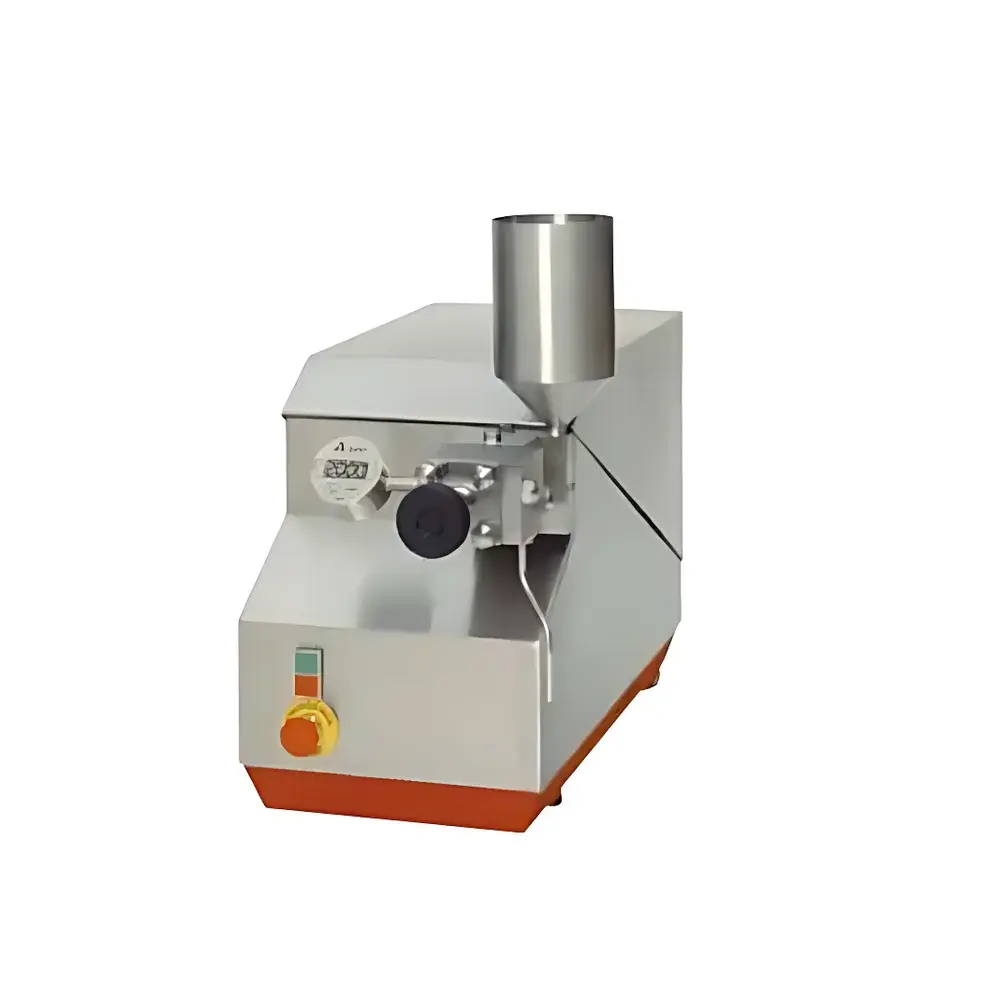
APV APV-2000 High-Pressure Homogenizer
| Brand | APV |
|---|---|
| Origin | Germany |
| Model | APV-2000 |
| Instrument Type | High-Pressure Homogenizer |
| Dimensions (W×D×H) | 370 × 620 × 818 mm |
| Processing Capacity | 11 L/h |
| Fluid End Materials | Duplex Stainless Steel Compression Head, Ceramic Plunger, Cobalt Alloy PVB Valves with Tungsten Carbide Seats |
| Control Interface | Digital Pressure & Temperature Display, Overpressure Alarm, Emergency Stop, Integrated Current-Limiting Safety Circuit |
| Housing | Polished Stainless Steel, CIP/SIP-Compatible, Modular Frame Design |
Overview
The APV APV-2000 High-Pressure Homogenizer is a benchtop-scale, precision-engineered system designed for reproducible cell disruption, nanoemulsion formation, and colloidal dispersion under controlled high-pressure conditions. Operating on the principle of microfluidic shear, cavitation, and impact forces generated by forcing liquid samples through a narrow, precisely engineered homogenization valve at pressures up to 2,000 bar (29,000 psi), the APV-2000 delivers consistent mechanical lysis across diverse biological and industrial matrices. Its design bridges laboratory-scale development and full-scale manufacturing—experimental protocols established on the APV-2000 scale directly translate to APV’s industrial homogenizers without scaling artifacts, fulfilling critical requirements for process transfer in biopharmaceutical upstream processing, nutraceutical formulation, and advanced material synthesis.
Key Features
- Robust fluid-end architecture constructed from duplex stainless steel compression heads, offering exceptional resistance to corrosion, fatigue, and chemical degradation under sustained high-pressure operation.
- Ceramic plunger with integrated cooling and lubrication channels ensures thermal stability and extended service life during continuous operation.
- Double-sided interchangeable cobalt alloy PVB valves paired with tungsten carbide seats provide high wear resistance and precise flow control across wide viscosity and particulate load ranges.
- Digital pressure and temperature monitoring with real-time display enables precise process documentation and deviation detection—fully compatible with GLP/GMP data integrity standards.
- CIP (Clean-in-Place) and SIP (Sterilize-in-Place) capability supports aseptic operation in regulated environments; stainless steel feed funnel and hygienic quick-connect outlet facilitate rapid changeover and validation.
- Modular polished stainless steel housing allows tool-free access to internal components for routine maintenance, inspection, and cleaning—reducing downtime and supporting audit readiness.
Sample Compatibility & Compliance
The APV-2000 accommodates a broad spectrum of sample types including Gram-negative bacteria (e.g., E. coli), yeasts (Saccharomyces cerevisiae), filamentous fungi, mammalian suspension and adherent cells, plant and algal biomass (e.g., Chlorella, Haematococcus, Arthrospira), and tissue homogenates. Its chemically inert fluid path meets USP Class VI and FDA 21 CFR Part 11 readiness for electronic records—when paired with validated software logging. The system complies with IEC 61000-6-2 (EMC immunity) and IEC 61000-6-4 (EMC emission) standards, and its safety architecture—including dual overpressure cutoffs, emergency stop circuitry, and thermal overload protection—conforms to EN 61000-1-2 and EN ISO 13857.
Software & Data Management
While the APV-2000 operates via an embedded digital control panel, it supports optional integration with APV’s Homogenizer Control Suite (v4.2+), enabling automated pressure ramping, multi-step protocols, timestamped event logging, and export of CSV-formatted process data. Audit trails include operator ID, parameter setpoints, actual pressure/temperature profiles, and alarm history—fully traceable for regulatory submissions. Data files are SHA-256 hashed and stored with immutable timestamps, satisfying ALCOA+ principles (Attributable, Legible, Contemporaneous, Original, Accurate, Complete, Consistent, Enduring, Available) required under FDA and EMA guidance.
Applications
- Reproducible lysis of microbial and eukaryotic cells for intracellular protein, nucleic acid, and metabolite extraction—validated for use in ISO 15189-accredited clinical labs.
- Nanoparticle formulation for lipid nanoparticles (LNPs), polymeric micelles, and exosome isolation workflows requiring narrow PDI (<0.15) and sub-100 nm modal diameters.
- Stabilization of oil-in-water and water-in-oil emulsions in food, cosmetic, and pharmaceutical applications—meeting ASTM D7421 and ISO 13320 laser diffraction validation criteria.
- Preparation of uniform suspensions for catalyst slurries, battery electrode dispersions, and ceramic precursor formulations where particle agglomeration must be minimized.
- Process development for monoclonal antibody purification trains, where consistent cell debris removal reduces downstream filter fouling and improves chromatographic resolution.
FAQ
What is the maximum operating pressure of the APV-2000?
The APV-2000 is rated for continuous operation up to 2,000 bar (29,000 psi), with pressure regulation accuracy ±1.5% FS across its full range.
Can the APV-2000 be used for sterile processing?
Yes—the fluid path is fully CIP/SIP-capable, and all wetted materials comply with USP Class VI and EC 1935/2004 food-contact regulations; validation protocols for steam sterilization at 121°C/30 min are available upon request.
Is scale-up to production feasible without re-optimization?
Yes—APV’s geometrically similar valve design and constant energy dissipation per unit mass ensure linear scalability from APV-2000 to APV-10000 series systems, eliminating empirical re-development per ISO 13485 Annex C.
Does the system support remote monitoring or network connectivity?
Optional Ethernet and RS-485 interfaces enable integration into SCADA or MES platforms; Modbus TCP protocol support allows real-time telemetry and alarm forwarding to centralized control rooms.
What maintenance intervals are recommended for routine operation?
Plunger and valve seat inspection every 200 operational hours; full fluid-end rebuild recommended every 1,000 hours or per APV’s Condition-Based Maintenance (CBM) algorithm, which analyzes pressure decay trends and vibration signatures.



