
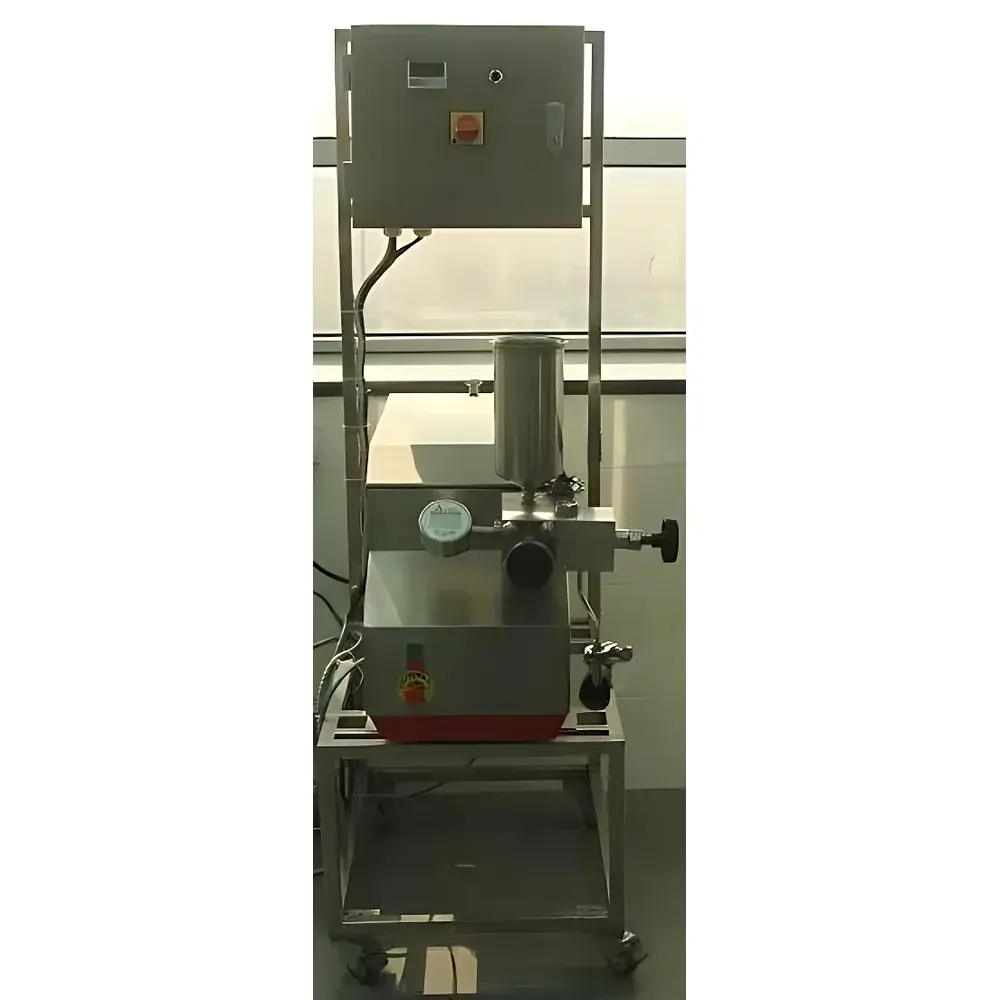
APV1000 High-Pressure Laboratory Homogenizer
| Origin | Shanghai, China |
|---|---|
| Manufacturer Type | Authorized Distributor |
| Origin Category | Domestic (China) |
| Model | APV1000 |
| Price | Upon Request |
| Processing Capacity | 22 L/hr |
| Minimum Sample Volume | 150 mL |
| Maximum Operating Pressure | 1000 bar |
| Plunger Diameter / Material | 14 mm / Ceramic |
| Plunger Seal Material | PVDF/EPDM |
| O-Ring / Gasket Material | EPDM/POM |
| Pump Valve Seat Material | Tungsten Carbide Alloy |
| Pump Valve Material | Cobalt-Based Alloy |
| Homogenizing Valve / Seat Material | Tungsten Carbide Alloy |
| Digital Pressure Display | Yes |
| Overpressure Safety Cut-off | Yes |
| Net Weight | 105 kg |
| Dimensions (W × D × H) | 370 × 818 × 620 mm |
| Motor | TEFC, 3 kW, Three-Phase, 50–60 Hz, Multi-Voltage (200–575 V) |
| Max. Fluid Temperature | 105 °C |
| Wetted Parts Sealing | EPDM |
Overview
The APV1000 High-Pressure Laboratory Homogenizer is an engineered solution for controlled, scalable particle size reduction and dispersion in research, pilot-scale development, and quality control laboratories. Based on the globally recognized APV platform—originally developed by APV GmbH (now part of SPX Flow)—this re-engineered variant integrates robust high-pressure fluid mechanics with hygienic design principles suited for food, pharmaceutical, biotechnology, and nanomaterial applications. It operates on the principle of microfluidization: pressurized liquid is forced through a precisely engineered homogenizing valve at pressures up to 1000 bar, inducing intense shear, cavitation, and impact forces that disrupt cell membranes, emulsify immiscible phases, or reduce colloidal particle size to sub-micron distributions. Unlike rotor-stator or ultrasonic systems, this piston-driven homogenizer delivers consistent energy input per unit volume, enabling reproducible process transfer from lab to production scale.
Key Features
- Dual-stage homogenization architecture with independently adjustable pressure settings via precision handwheel controls—enabling optimization of primary disruption (e.g., cell lysis) and secondary refinement (e.g., nanoemulsion stabilization).
- Ceramic plunger (14 mm diameter) and tungsten carbide alloy valve seats ensure exceptional wear resistance and long-term dimensional stability under repeated high-pressure cycling.
- CIP-compatible sanitary construction: all wetted surfaces are electropolished stainless steel (AISI 316L), with EPDM gaskets rated for continuous operation up to 105 °C—fully compliant with 3-A Sanitary Standards for clean-in-place validation.
- Integrated digital pressure monitoring with audible and visual overpressure alarm; safety interlock triggers automatic pump shutdown if preset threshold (1000 bar ±2%) is exceeded.
- Modular mechanical design allows seamless integration into benchtop beverage pilot lines—including compatibility with small-scale pasteurizers, holding tubes, and sterile filtration modules.
- Self-contained lubrication system with sight-level indicators and sealed gear train minimizes maintenance intervals and ensures consistent torque transmission across voltage variants (200–575 V, 50–60 Hz).
Sample Compatibility & Compliance
The APV1000 accommodates aqueous, viscous, and particulate-laden suspensions—including bacterial cultures, yeast slurries, protein solutions, lipid-based nanoemulsions, and polymer dispersions—with minimum sample volume of 150 mL. All fluid-contact materials comply with USP Class VI and FDA 21 CFR §177.2600 for elastomers. The system meets CE Machinery Directive 2006/42/EC requirements, including EN ISO 12100 for risk assessment and EN 60204-1 for electrical safety. Its hygienic geometry supports full validation of cleaning efficacy per ASTM E2578–21 and supports GLP/GMP documentation workflows when paired with audit-trail-capable data acquisition software.
Software & Data Management
While the base APV1000 operates via analog controls, it is compatible with optional digital interface modules supporting RS-485 Modbus RTU or Ethernet/IP protocols. When integrated with validated laboratory data management systems (e.g., LabWare LIMS or Thermo Fisher SampleManager), pressure profiles, runtime logs, and motor current traces can be timestamped, encrypted, and archived with 21 CFR Part 11-compliant electronic signatures. Real-time pressure trending enables correlation with downstream analytical results (e.g., dynamic light scattering or laser diffraction particle size analysis), facilitating DOE-based process optimization.
Applications
- Microbial cell disruption for recombinant protein extraction (E. coli, Pichia pastoris)
- Preparation of stable nanoemulsions for oral drug delivery and functional beverages
- Homogenization of liposomal formulations prior to extrusion or freeze-drying
- Particle size reduction of pigment dispersions in cosmetic and coating R&D
- Standardization of reference suspensions for instrument calibration (e.g., NIST-traceable polystyrene latex standards)
- Scale-down modeling of industrial high-pressure homogenization processes per ICH Q5A(R2) comparability guidelines
FAQ
What is the maximum allowable temperature for continuous operation?
The system is rated for continuous fluid temperatures up to 105 °C, limited by EPDM elastomer compatibility and thermal expansion tolerances of ceramic components.
Can the APV1000 be used with organic solvents?
Only with prior material compatibility verification; PVDF/EPDM seals are not resistant to chlorinated or ketonic solvents—alternative fluorocarbon seals (e.g., FKM) require factory modification and revalidation.
Is the unit suitable for sterile processing?
Yes—when equipped with SIP-capable valves and connected to steam sterilization manifolds, provided all gaskets are replaced with silicone alternatives rated for 121 °C/20 min cycles.
How is pressure calibration verified?
Each unit ships with a NIST-traceable pressure transducer certificate; field recalibration requires certified deadweight tester (Class 0.02) and must be performed annually per ISO/IEC 17025-accredited procedures.
Does the homogenizer support automated batch logging?
Yes—via optional PLC integration or third-party SCADA platforms using standard Modbus registers for pressure setpoint, actual pressure, runtime, and fault codes.



