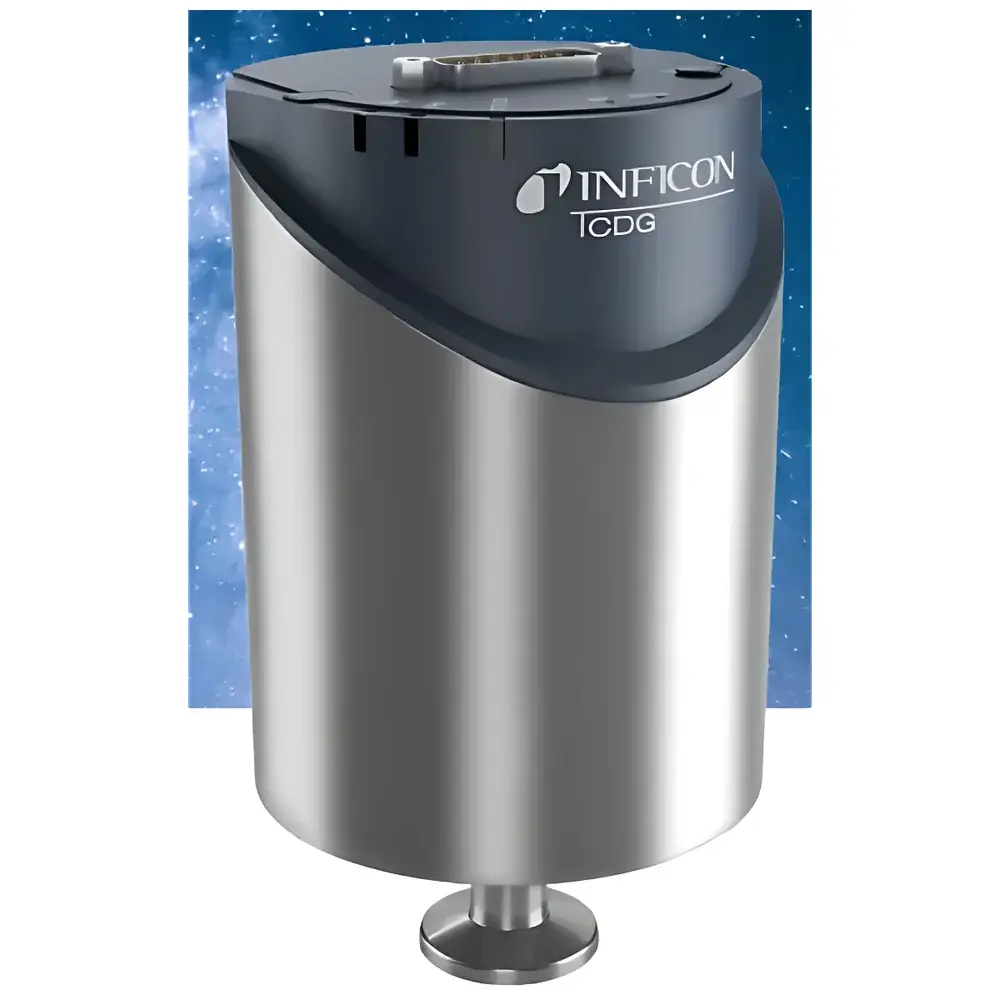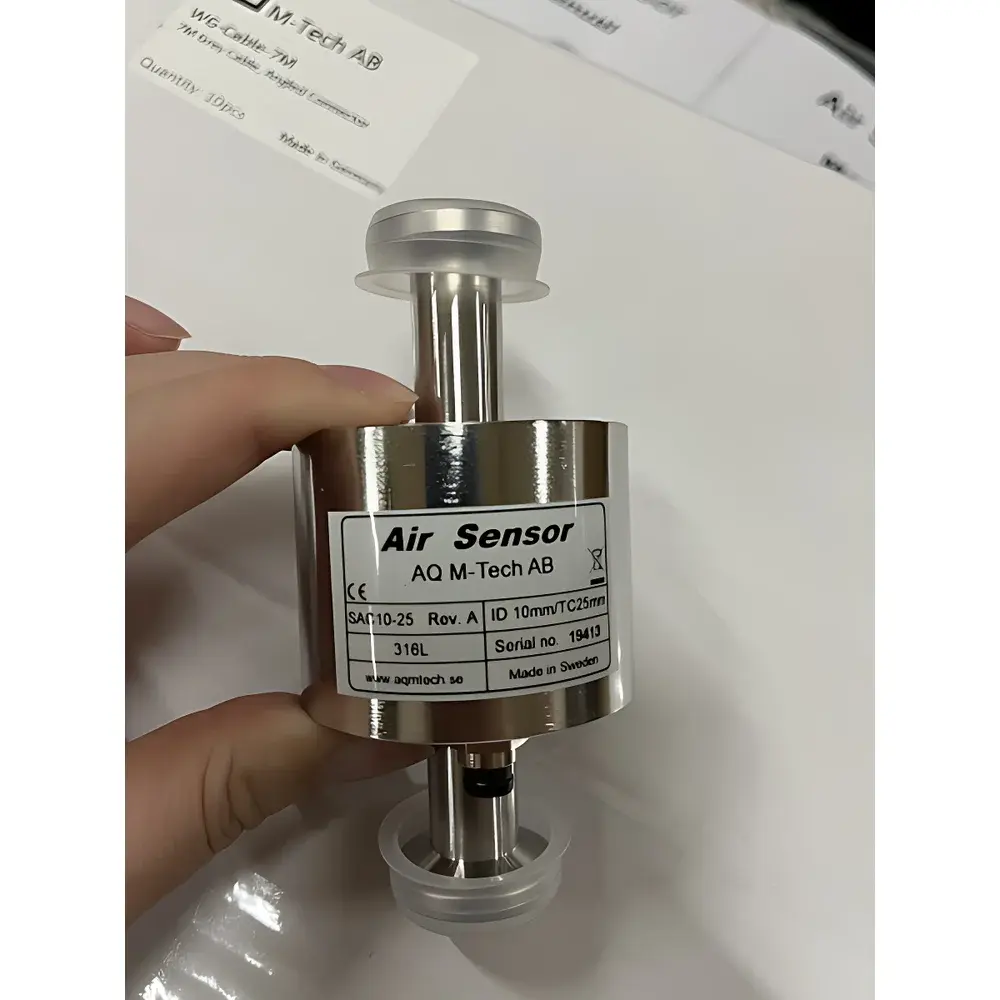
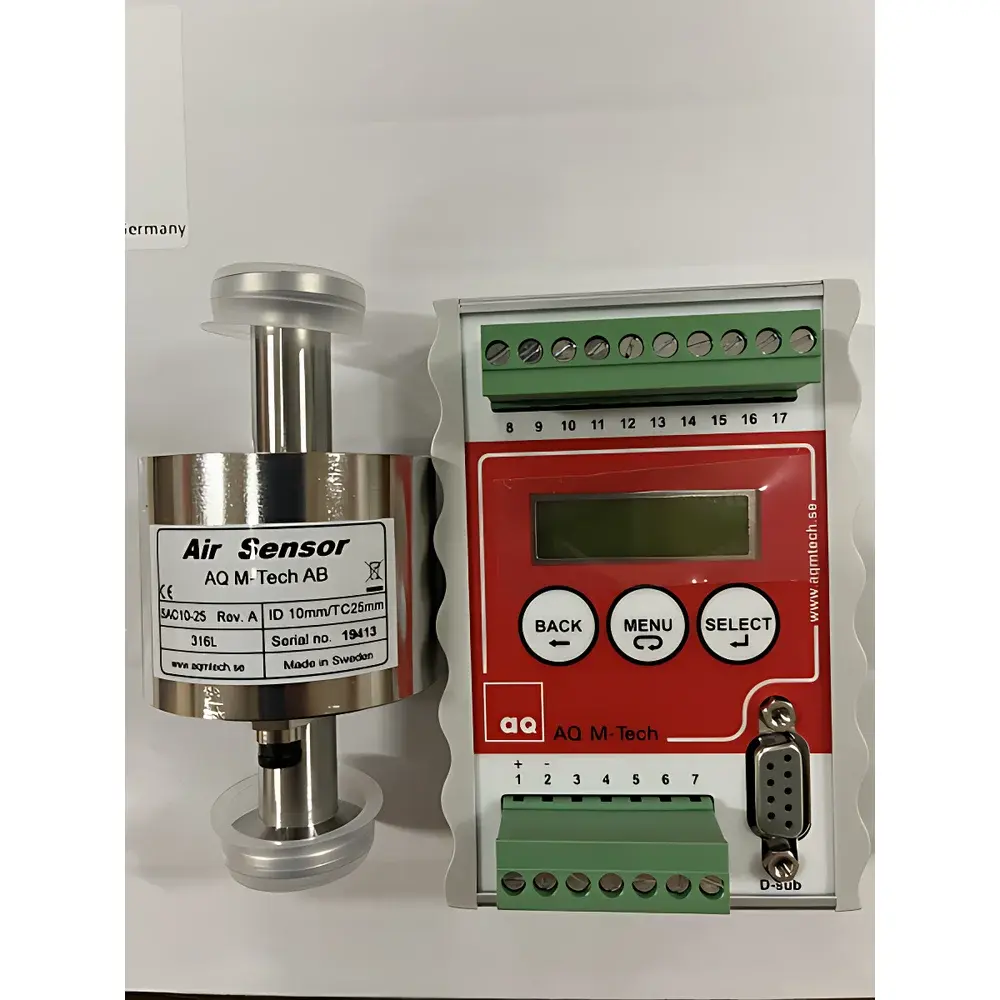
AQ M-Tech CCS15.75-25 Ultrasonic Air-in-Liquid Sensor
| Brand | AQ M-Tech |
|---|---|
| Origin | Sweden |
| Housing Material | 316L Stainless Steel |
| Tube ID | 15.75 mm |
| Tube OD | 51 mm |
| Tri-Clamp Size | 25 mm |
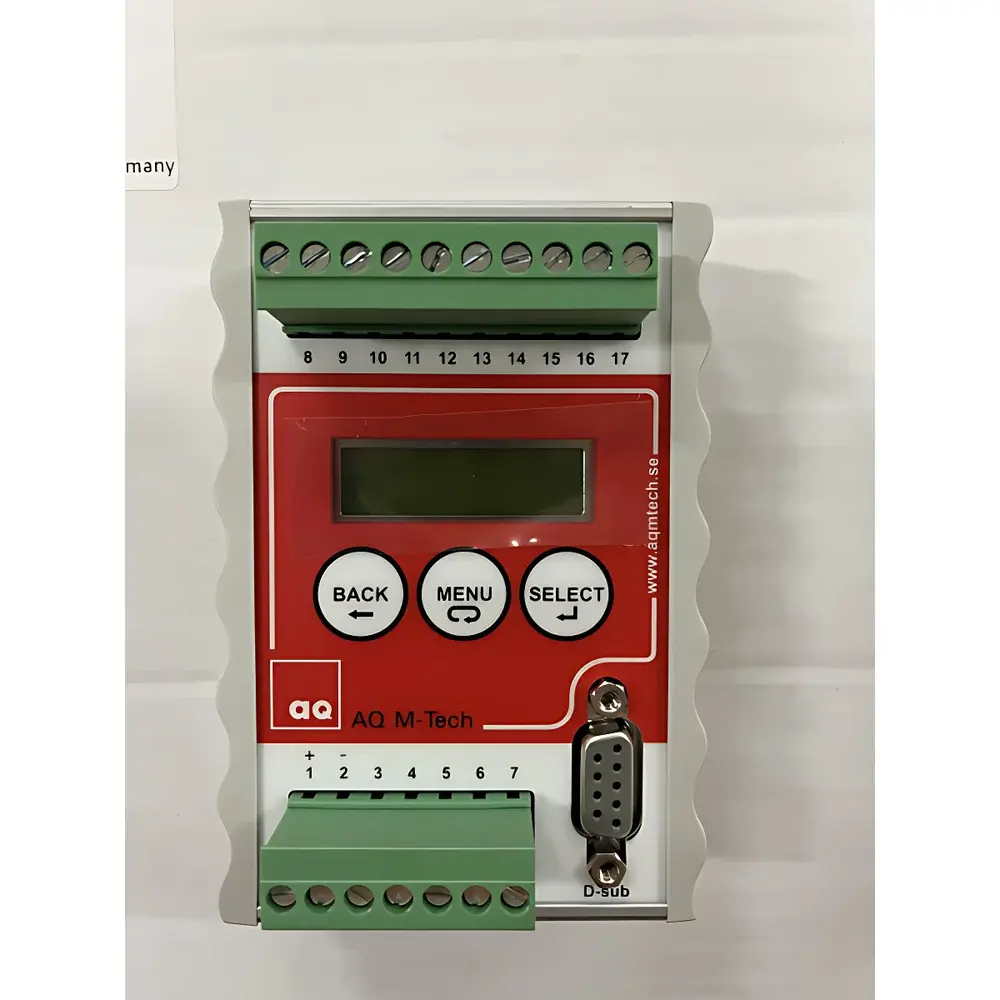
| Output Interface | Analog/RS485 (via external ultrasonic controller) |
| Operating Principle | Transmission-mode ultrasonic detection of gas voids and particulates in flowing liquid streams |
Overview
The AQ M-Tech CCS15.75-25 is a high-integrity, non-invasive ultrasonic air-in-liquid sensor engineered for continuous, real-time detection of entrained gas bubbles and suspended particulates in sanitary process lines. Designed specifically for biopharmaceutical, food & beverage, and fine chemical applications, it operates on the principle of transmission-mode ultrasonic sensing: a piezoelectric transducer emits high-frequency acoustic waves across the pipe wall; changes in signal amplitude, time-of-flight, and spectral damping are analyzed to identify discrete gas pockets or solid-phase anomalies within the liquid stream. Unlike optical or capacitive alternatives, this technology remains insensitive to fluid color, turbidity, conductivity, or dielectric properties—ensuring stable performance across water, buffers, cell culture media, CIP solutions, and viscous formulations up to 500 cP. The CCS15.75-25 is rated for full-process compatibility with SIP (121 °C, 30 min) and meets ASME BPE 2022 surface finish requirements (Ra ≤ 0.4 µm) on all wetted 316L stainless steel surfaces.
Key Features
- Sanitary tri-clamp (DIN 11851 / ISO 2852) mounting interface — size 25 mm — enables rapid, tool-free installation without process interruption
- 316L stainless steel housing with electropolished wetted surfaces compliant with FDA 21 CFR Part 11 and EU Annex 1 GMP expectations for single-use and reusable systems
- Non-intrusive design eliminates flow restriction, pressure drop, or risk of microbial entrapment — validated per ISO 13485 for sterile fluid path integrity
- Wide dynamic range: detects discrete bubbles ≥ 50 µm diameter and aggregate gas volumes ≥ 0.1% v/v in laminar to turbulent flow regimes (Re = 200–200,000)
- Integrated temperature compensation circuitry ensures consistent sensitivity across operating temperatures from 0 °C to 80 °C (short-term exposure to 121 °C during SIP)
- EMC-compliant output signals (4–20 mA analog + RS485 Modbus RTU) compatible with DCS, SCADA, and PLC platforms — supports HART 7 configuration via optional handheld communicator
Sample Compatibility & Compliance
The CCS15.75-25 is validated for use with aqueous, organic, and mixed-solvent streams under both ambient and elevated temperature conditions. It is routinely deployed upstream of sterilizing-grade filters, in fill-finish buffer lines, and within downstream purification skids where undetected air ingress may compromise filter integrity, cause pump cavitation, or trigger false pressure decay test failures. Regulatory alignment includes adherence to ASTM F838-20 (bacterial retention testing), ISO 21501-4 (particulate monitoring principles), and IEC 61511 functional safety guidelines for SIL 2-capable system integration. Documentation packages include Factory Acceptance Test (FAT) reports, material traceability certificates (EN 10204 3.1), and biocompatibility data per USP and .
Software & Data Management
The sensor requires connection to an AQ M-Tech ultrasonic controller (e.g., UC-200 series) for signal processing, threshold calibration, and alarm logic execution. Firmware supports configurable detection modes: bubble-counting (pulse mode), continuous void fraction estimation (analog mode), and event-triggered logging. All configuration parameters—including gain, gate window, alarm hysteresis, and sampling frequency—are stored with timestamped audit trails meeting FDA 21 CFR Part 11 requirements for electronic records and signatures. Raw waveform data export (CSV) enables offline spectral analysis using third-party tools such as MATLAB or Python-based SciPy workflows.
Applications
- Early warning of air ingress during centrifuge discharge or chromatography column elution
- Verification of deaeration efficacy prior to ultrafiltration/diafiltration hold steps
- Monitoring for vapor lock formation in peristaltic pump feed lines
- Validation support for bubble point and diffusion tests on hydrophobic/hydrophilic membranes
- Real-time supervision of WFI (Water for Injection) distribution loops per USP
- Integration into PAT (Process Analytical Technology) frameworks for QbD-driven bioprocess control
FAQ
Is the CCS15.75-25 suitable for high-pressure applications?
Yes — it is rated for continuous operation up to 10 bar (145 psi) at 20 °C, with burst pressure exceeding 40 bar per ASME B31.3 design margins.
Can it detect microbubbles smaller than 50 µm?
Detection sensitivity is optimized for bubbles ≥50 µm; sub-50 µm populations require complementary techniques such as light obscuration or resonant mass measurement.
Does the sensor require recalibration after SIP cycles?
No — factory calibration remains stable post-SIP due to matched thermal expansion coefficients between transducer elements and 316L housing; verification checks are recommended annually per ISO/IEC 17025.
Is cable length customizable beyond standard options?
Yes — custom shielded, low-noise coaxial cables up to 100 m are available with impedance-matched termination and IP67-rated connectors.
How is cleaning validation supported?
The sensor’s smooth, crevice-free geometry enables full coverage during CIP; residue recovery studies confirm ≤0.1 µg/cm² carryover of model proteins (BSA, IgG) following standard NaOH/HNO₃ cycles.