
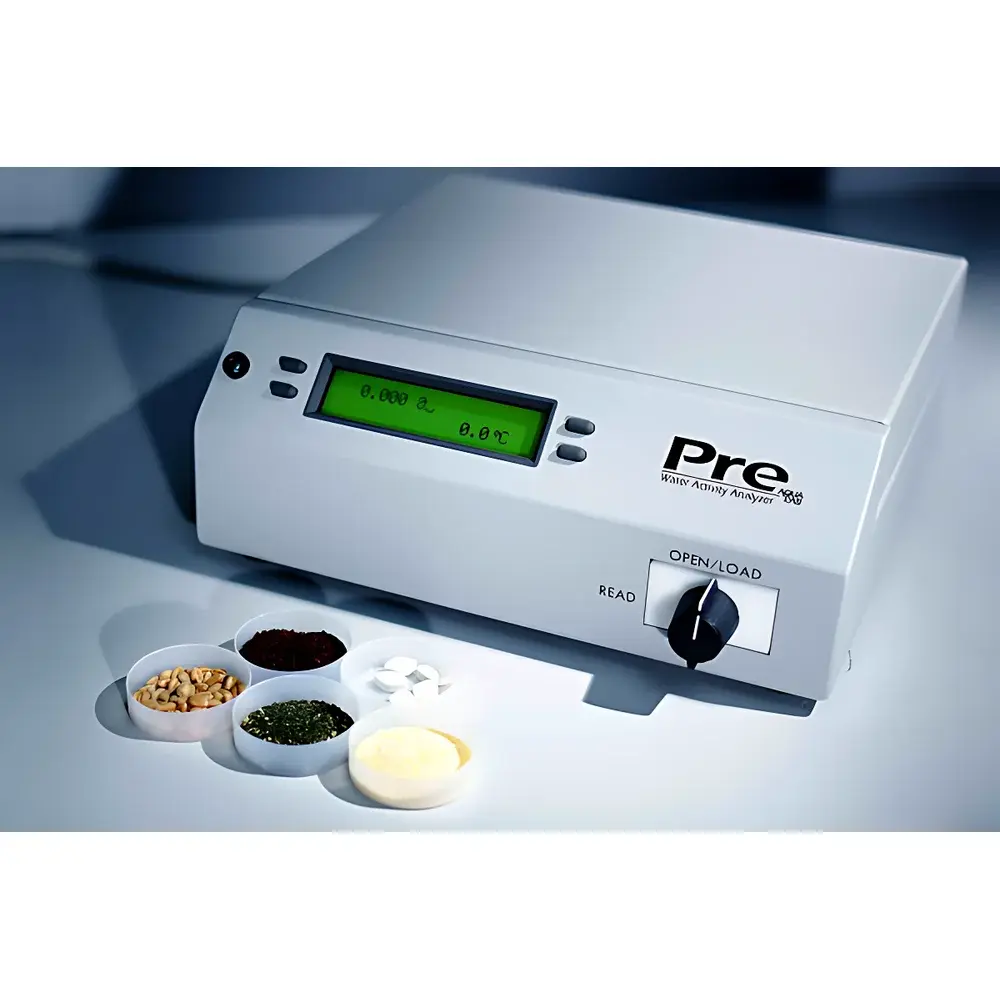
Aqualab Pre Temperature-Controlled Water Activity Analyzer
| Brand | Aqualab |
|---|---|
| Origin | USA |
| Model | Pre |
| Measurement Principle | Chilled-Mirror Dew Point |
| Operating Temperature Range | 4–50 °C |
| Repeatability | ±0.01 a<sub>w</sub> |
| Application | Laboratory-Grade Dew Point Water Activity Analyzer |
| Compliance | AOAC, FDA, ISO 21807, USP <1112>, ASTM F1980 |
| Sample Temperature Control | Precisely maintained at 25 °C (±0.1 °C) |
| Typical Measurement Time | < 5 minutes |
| Calibration | Factory-calibrated with NIST-traceable standards |
Overview
The Aqualab Pre Temperature-Controlled Water Activity Analyzer is an entry-level, laboratory-grade instrument engineered for precise, traceable, and thermally stabilized measurement of water activity (aw) using the fundamental physical principle of chilled-mirror dew point detection. Unlike capacitance or tunable diode laser (TDL) methods, the Pre employs a high-stability, temperature-controlled mirror surface to directly detect the onset of condensation in equilibrium vapor above a sample — a primary measurement method recognized for its metrological rigor and direct link to thermodynamic water potential. The system maintains sample temperature at a fixed 25 °C via integrated Peltier-based thermal regulation, eliminating ambient temperature drift as a source of uncertainty and ensuring result comparability across laboratories, operators, and time. This architecture aligns with the foundational requirements of ISO 21807:2022 (“Foodstuffs — Determination of water activity”), USP <1112> (“Application of Water Activity Determination”), and AOAC Official Method 978.18, establishing the Pre as a compliant solution for GLP- and GMP-aligned quality control environments.
Key Features
- Chilled-mirror dew point sensor: Direct, first-principles measurement of equilibrium vapor pressure without polymer-based sensing elements or humidity-dependent drift.
- Active thermal stabilization: Integrated thermoelectric (Peltier) system holds sample chamber at 25.0 °C ±0.1 °C — independent of ambient lab conditions between 4 °C and 50 °C.
- High repeatability: ±0.01 aw standard deviation across repeated measurements on homogeneous samples under controlled conditions.
- No routine calibration maintenance: Factory-calibrated against NIST-traceable dew point standards; no user-performed sensor recalibration or zero/span adjustments required during normal operation.
- Rapid equilibration: Typical analysis time ≤ 4.5 minutes from sample loading to validated aw output, enabled by optimized thermal mass and mirror cooling dynamics.
- Robust architecture: Sealed optical path, corrosion-resistant stainless-steel sample chamber, and ESD-protected electronics for long-term stability in shared lab environments.
Sample Compatibility & Compliance
The Aqualab Pre accommodates solid, semi-solid, paste, powder, and low-viscosity liquid samples in standard 35 mm or 55 mm aluminum sample cups. Its sealed measurement chamber prevents cross-contamination and supports volatile or hygroscopic materials without external desiccation. The instrument meets regulatory expectations for data integrity in regulated industries: audit trails are timestamped and operator-logged; measurement records include full metadata (sample ID, date/time, chamber temperature, dew point temperature, aw, and instrument serial number); and raw sensor outputs (mirror temperature, photodetector signal slope) are retained internally for traceability. It satisfies documentation requirements for FDA 21 CFR Part 11 compliance when paired with validated LIMS or ELN integration protocols, and conforms to ISO/IEC 17025 clause 6.4.7 regarding equipment suitability for intended use.
Software & Data Management
The Pre operates via embedded firmware with a dedicated Windows-based desktop application (Aqualab Connect v4.x) supporting local data export in CSV, PDF, and XML formats. All measurement sessions are automatically archived with digital signatures, change logs, and electronic notes fields. The software enforces user role-based access (administrator, analyst, reviewer), supports configurable pass/fail limits per product specification, and generates IQ/OQ-ready test reports aligned with ASTM E2500 and ICH Q5C validation frameworks. Data files include embedded MD5 checksums for integrity verification, and optional network deployment enables centralized backup and automated report distribution to QA/QC systems.
Applications
- Microbial safety assessment: Correlating aw thresholds with growth limits of Aspergillus flavus, Staphylococcus aureus, and Clostridium botulinum in food, pharmaceutical, and cosmetic matrices.
- Shelf-life modeling: Inputting experimentally derived aw values into Arrhenius-based kinetic models for oxidation, Maillard browning, or enzymatic degradation.
- Formulation optimization: Quantifying moisture migration in multi-phase products (e.g., cereal bars, coated tablets, dried fruit blends) to prevent caking, stickiness, or texture loss.
- Glass transition analysis: Supporting DSC correlation studies for amorphous excipients (e.g., lactose, trehalose) where Tg shifts predict physical instability.
- Packaging specification: Validating moisture barrier performance of blister foils, sachets, and desiccant-containing closures under accelerated aging protocols.
- Regulatory submission support: Generating auditable aw datasets for ANDA, NDA, and marketing authorization applications requiring USP <1112> or Ph. Eur. 2.9.34 compliance evidence.
FAQ
Does the Aqualab Pre require periodic recalibration by the user?
No. The chilled-mirror sensor is factory calibrated using NIST-traceable dew point standards. Routine recalibration is not required under normal operating conditions. Annual verification against certified reference standards (e.g., saturated salt solutions) is recommended for ISO/IEC 17025 compliance.
Can the Pre measure samples at temperatures other than 25 °C?
No. The Pre maintains a fixed 25 °C sample temperature to ensure method consistency and comparability with international reference methods. For variable-temperature studies, the Aqualab VSA or AquaLab 4TE platforms are recommended.
Is the instrument compatible with hazardous or volatile samples?
Yes — the sealed sample chamber and inert stainless-steel construction allow safe analysis of ethanol-containing tinctures, essential oil emulsions, and solvent-based coatings. Ventilation is not required under standard operation.
How is data integrity ensured during export and archival?
All exported files contain embedded timestamps, operator IDs, instrument serial numbers, and cryptographic checksums. Audit trails record every measurement initiation, parameter change, and report generation event with immutable timestamps.
What regulatory standards explicitly endorse the chilled-mirror dew point method?
AOAC Official Method 978.18, USP <1112>, ISO 21807:2022, ASTM F1980 (for accelerated stability), and FDA Guidance for Industry: “Guidance for Industry – Quality Considerations for Pharmaceutical Products Containing Moisture-Sensitive Ingredients.”





