
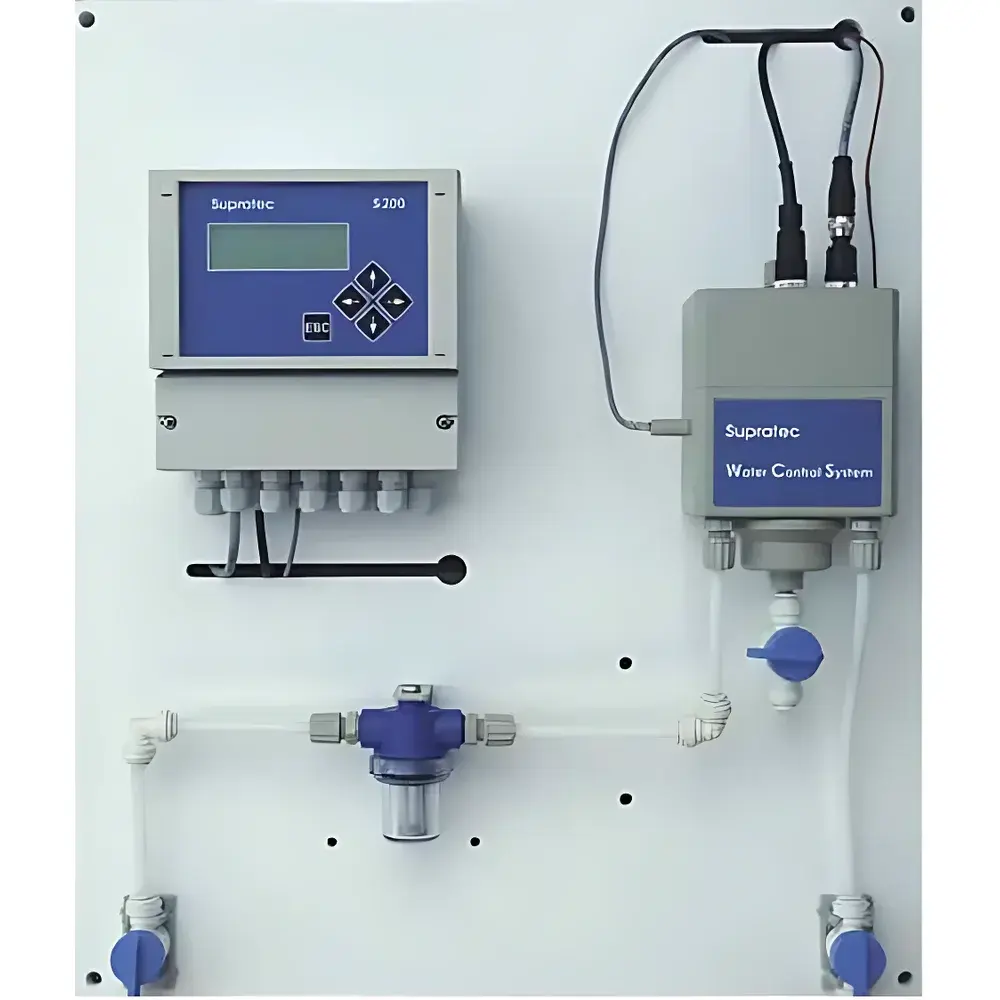
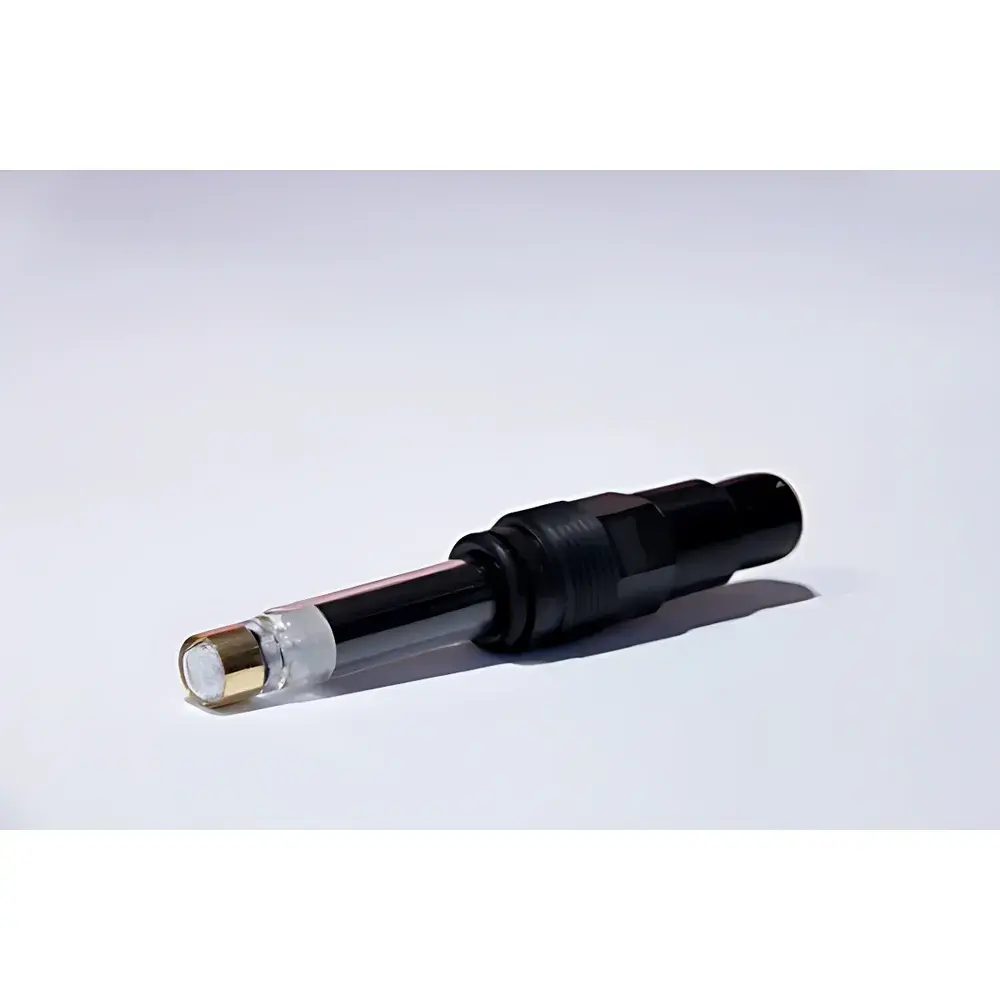
AQUALABO S200 Dissolved Ozone Analyzer
| Brand | AQUALABO |
|---|---|
| Origin | France |
| Model | S200 |
| Instrument Type | Online Analyzer |
| Measurement Principle | Potentiometric (Gold Ring Electrode) |
| Ozone Range | 0–1 mg/L or 0–5 mg/L |
| pH Range | −2 to 16 |
| Temperature Range | −30.00 to 140.00 °C |
| Accuracy | ±2 % of full scale |
| Resolution | Ozone 0.001/0.01 mg/L |
| Response Time | 30 s |
| Max. Operating Pressure | 8 bar @ 20 °C |
| Max. Water Temperature | 70 °C |
| Flow Rate | 40–120 L/h |
| Sensor Material | Glass body with gold ring electrode |
| Enclosure Rating | IP65 |
| Power Supply | 230 VAC ±10 % or 110 VAC ±10 %, 50/60 Hz |
| Power Consumption | 16 VA |
| Dimensions (W×H×D) | 160 × 165 × 85 mm |
| Weight | 1.1 kg |
Overview
The AQUALABO S200 Dissolved Ozone Analyzer is a fully integrated, online electrochemical measurement system engineered for continuous, high-fidelity monitoring of dissolved ozone (O₃) in water distribution systems, disinfection processes, and critical process water loops. It employs a potentiometric detection principle using a proprietary gold-ring sensing element housed in chemically inert glass—eliminating the need for reagents, membranes, or consumables. Unlike amperometric or optical ozone sensors, the S200 operates on a stable redox potential shift induced by dissolved ozone at the gold surface, providing inherent selectivity against chlorine, chloramines, and hydrogen peroxide under typical municipal and industrial water matrices. The analyzer is rated for direct in-line installation up to 8 bar pressure and accommodates process temperatures up to 70 °C, with full thermal compensation via integrated Pt1000 temperature sensing. Its self-regulating hydraulic design ensures consistent sample flow (40–120 L/h) without external pumps or flow controllers, while built-in pressure stabilization maintains sensor integrity and measurement repeatability across variable pipeline dynamics.
Key Features
- True zero-maintenance operation: No mechanical wipers, no chemical dosing, no membrane replacement—enabled by autonomous electrochemical electrode cleaning cycles
- Multi-parameter simultaneous measurement: Dissolved ozone, pH, and temperature—all compensated in real time using embedded algorithms
- Auto-compensation architecture: Dynamic correction for pH drift, temperature-induced potential shifts, and flow-dependent mass transfer effects
- Passive fouling mitigation: Electropotential pulse sequence removes colloids, calcium carbonate deposits, iron oxides, organic films, and biofilm precursors without physical contact or abrasive action
- Zero liquid discharge (ZLD) compliance: Measures directly in the process stream; no sample bypass, no waste effluent, no secondary contamination risk
- Ruggedized industrial enclosure: IP65-rated housing with backlit 4×20 character LCD, five-button interface, and dual-voltage compatibility (110/230 VAC)
Sample Compatibility & Compliance
The S200 is validated for use in potable water, ultrapure water (UPW), pharmaceutical process water (PW/WFI), beverage production lines, and food-grade CIP rinse streams. It meets material compatibility requirements per USP , FDA 21 CFR Part 11 (when paired with compliant SCADA logging), and ISO 9001/14001 quality management frameworks. Sensor wetted parts conform to NSF/ANSI Standard 61 for drinking water system components. While not certified to EN ISO 5814 (which specifies amperometric DO measurement), the S200’s potentiometric ozone methodology is referenced in ASTM D6508-22 Annex A2 for alternative oxidant quantification in advanced oxidation process (AOP) validation studies. Its analog outputs (4–20 mA, galvanically isolated) support integration into legacy PLCs, while Modbus RTU (RS-485) enables bidirectional communication with modern DCS platforms under IEC 61158.
Software & Data Management
The embedded firmware supports configurable alarm logic via three relay outputs (NO/NC/C, 120–240 VAC, 2 A) and two digital outputs (dry contact, ≤12 V, 200 mA). Two independent PID or on/off controllers are programmable for closed-loop ozone dosing control—each with adjustable hysteresis, pulse width modulation, and ramp limits. All setpoints, calibration logs, alarm events, and sensor diagnostics are timestamped and stored locally with non-volatile memory retention (>10 years). Modbus RTU slave functionality allows remote readout of raw sensor values, compensation parameters, and system health status—including electrode polarization voltage, internal reference stability, and flow consistency metrics. Audit trails comply with GLP/GMP data integrity expectations when interfaced with validated historian systems supporting 21 CFR Part 11 electronic signatures.
Applications
- Real-time ozone dose optimization in municipal drinking water treatment plants—particularly post-filtration and pre-chloramination stages
- Continuous verification of ozone residual in distribution network monitoring points and booster station recirculation loops
- In-process ozone concentration control during sterile filtration validation in biopharmaceutical manufacturing (e.g., buffer preparation, SIP cycles)
- Monitoring of ozonated water in dairy and beverage bottling lines where microbiological kill efficacy must be correlated with measured O₃ levels
- Validation of ozone-based AOP reactors treating micropollutants (e.g., pharmaceuticals, pesticides) in tertiary wastewater effluents
FAQ
What measurement principle does the S200 use for dissolved ozone?
It uses a potentiometric method based on the reversible redox reaction between dissolved ozone and a gold-ring working electrode, referenced against an internal Ag/AgCl reference.
Does the S200 require calibration with standard ozone solutions?
Yes—two-point calibration is recommended using zero-ozone deionized water and a certified ozone standard (e.g., iodometric titration traceable to NIST SRM 2670a).
Can the S200 operate in seawater or high-TDS brines?
No—it is designed for freshwater and low-conductivity process waters (<5 mS/cm); high chloride concentrations cause irreversible gold surface passivation.
How often does the automatic electrode cleaning cycle activate?
Default interval is every 6 hours, but configurable from 1 to 24 hours depending on fouling propensity of the application.
Is the pH sensor replaceable independently of the ozone sensor?
Yes—the pH and ozone sensing elements are modular; each can be serviced or recalibrated without affecting the other.
What is the minimum required sample flow rate for accurate measurement?
40 L/h is the lower operational limit; below this, boundary layer effects degrade response time and accuracy due to insufficient mass transport to the electrode surface.
Related Products







