
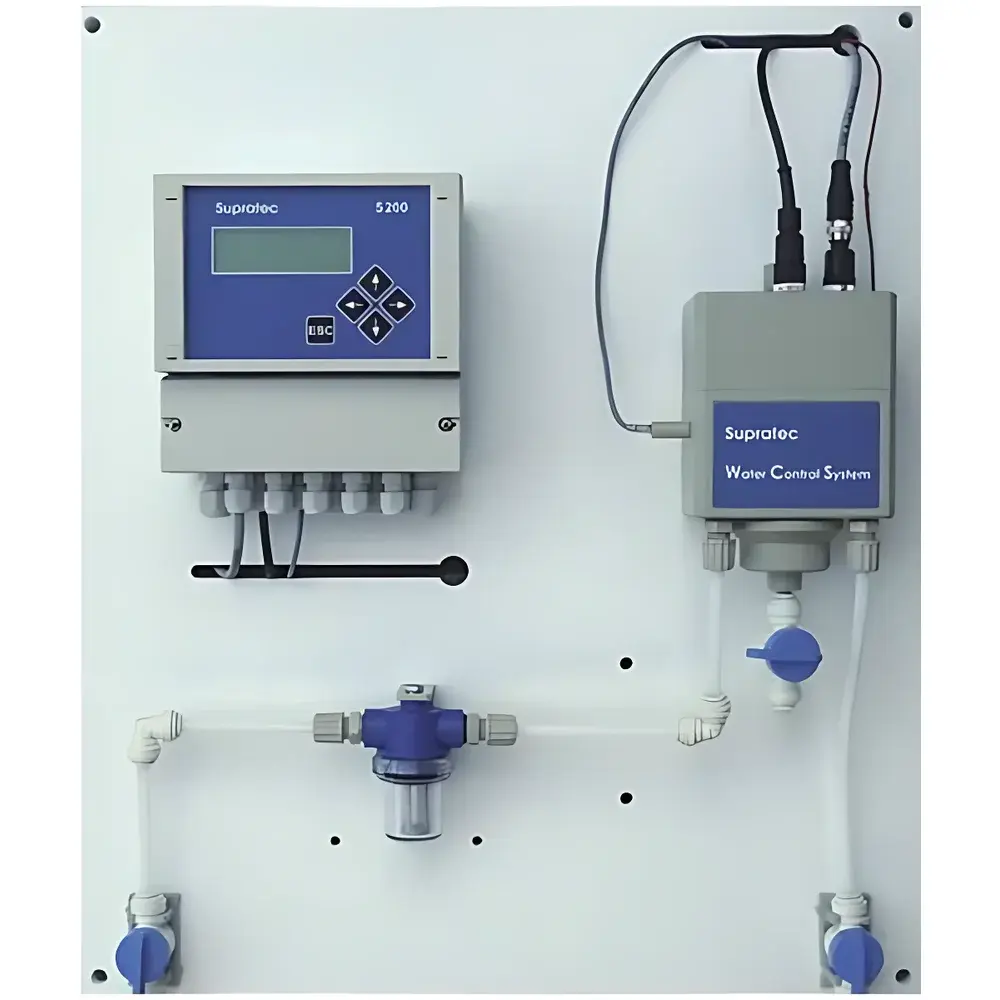
AQUALABO S200 Residual Chlorine and pH Online Analyzer
| Brand | AQUALABO |
|---|---|
| Origin | France |
| Model | S200 |
| Instrument Type | Online Analyzer |
| Measurement Principle | Amperometric (Gold Ring Electrode) + Potentiometric (pH Electrode) |
| Measured Parameters | Free Residual Chlorine, Total Active Chlorine, pH, Temperature |
| Range | Free Chlorine: 0.00–5.00 mg/L |
| Total Active Chlorine | 0.00–5.00 mg/L |
| pH | –2.00–16.00 |
| Temperature | –30–140 °C |
| Accuracy | ±2 % of full scale |
| Resolution | Chlorine: 0.01 mg/L |
| pH | 0.01 unit |
| Temperature | 0.1 °C |
| Response Time | ≤30 s |
| Max. Operating Pressure | 8 bar @ 20 °C |
| Flow Rate | 40–120 L/h |
| Sensor Material | Glass body / Gold working electrode |
| Temp. Sensor | Pt1000 |
| Enclosure Rating | IP65 |
| Power Supply | 110–230 VAC, 50/60 Hz |
| Power Consumption | 16 VA |
| Dimensions (W×H×D) | 160 × 165 × 85 mm |
| Weight | 1.1 kg |
| Operating Temp. | –20–55 °C, ≤90 % RH (non-condensing) |
| Storage Temp. | –20–65 °C |
| Analog Outputs | 2 × 4–20 mA (galvanically isolated, max. load 600 Ω) |
| Digital Interface | Modbus RTU Slave (RS485) |
| Relay Outputs | 3 configurable (NO/NC/C, 120–240 VAC, 2 A) |
| Digital Inputs | 2 (including pulse input for flow meter integration) |
| Control Modes | On/Off, P, PI, Pulse–Pause, Continuous (via analog output) |
Overview
The AQUALABO S200 Residual Chlorine and pH Online Analyzer is an industrial-grade, dual-parameter monitoring system engineered for continuous, real-time measurement of free residual chlorine and pH in potable water, wastewater effluent, and process streams. Unlike colorimetric or DPD-based analyzers requiring reagents and periodic calibration, the S200 employs a stable amperometric detection principle using a gold-ring working electrode—optimized for selective electrochemical reduction of hypochlorous acid (HOCl) and hypochlorite ion (OCl⁻) at a fixed applied potential. Simultaneously, a high-impedance glass pH electrode with integrated Pt1000 temperature sensor enables automatic temperature compensation across the full operational range (–30 to 140 °C), ensuring traceable accuracy under dynamic thermal conditions. The system’s robust architecture supports long-term deployment in municipal drinking water plants, swimming pool circulation loops, pharmaceutical clean-in-place (CIP) lines, and food & beverage process water circuits—where regulatory compliance, low maintenance, and zero chemical consumption are non-negotiable.
Key Features
- Amperometric residual chlorine sensing with gold-ring electrode—eliminates reagent dependency, drift, and interferences from oxidants such as ozone or hydrogen peroxide
- Integrated potentiometric pH measurement with automatic temperature compensation via embedded Pt1000 sensor
- Electrolytic self-cleaning function—periodically dissolves carbonate scale and organic fouling on the chlorine sensor membrane without manual intervention
- Dual independent control loops supporting on/off, proportional (P), or proportional-integral (PI) regulation—configurable for dosing pump activation or alarm signaling
- Galvanically isolated 4–20 mA analog outputs (2 channels) with programmable scaling, compliant with IEC 61000-6-2/4 EMC standards
- Modbus RTU (RS485) communication protocol for seamless integration into SCADA, DCS, or PLC-based supervisory systems
- IP65-rated wall-mount enclosure with backlit 4×20 character LCD display and intuitive 5-key navigation interface
- Wide operating temperature range (–20 to 55 °C) and humidity tolerance (≤90 % RH, non-condensing) suitable for outdoor kiosk or indoor panel mounting
Sample Compatibility & Compliance
The S200 is validated for use in aqueous matrices meeting standard drinking water quality criteria (e.g., WHO Guidelines, EU Directive 98/83/EC, US EPA Method 334.0). It complies with ISO 7027 for turbidity interference limits (<5 NTU recommended) and maintains performance within ASTM D1293 (pH) and ASTM D1253 (residual chlorine) methodological boundaries when installed with proper sample conditioning. The analyzer supports GLP/GMP-aligned operation through audit-trail-capable configuration logging (via Modbus register access), timestamped event records (relay actuation, cleaning cycles, out-of-range alarms), and user-accessible calibration history. While not FDA 21 CFR Part 11 certified out-of-the-box, its deterministic analog output behavior, hardware-level signal isolation, and non-volatile parameter storage enable validation for regulated environments under site-specific SOPs.
Software & Data Management
No proprietary PC software is required for basic commissioning—the S200 is fully configured via front-panel menu navigation. Advanced parameter management—including relay hysteresis tuning, PID loop setpoints, Modbus slave ID assignment, and analog output mapping—is accessible through standardized Modbus function codes (03h, 06h, 10h). All configuration changes are retained in EEPROM with power-loss protection. The device logs up to 1,000 chronological events (e.g., “Chlorine low alarm triggered”, “Auto-clean cycle completed”) with UTC timestamps. For centralized data aggregation, the RS485 interface supports polling intervals as short as 1 second, enabling sub-minute resolution trending in historian platforms such as Ignition SCADA or Siemens Desigo CC. Optional third-party OPC UA gateways can bridge Modbus RTU to cloud-based dashboards (e.g., Azure IoT Hub) without firmware modification.
Applications
- Municipal water treatment: Real-time monitoring of chlorine residual pre- and post-filtration, at clearwell outlets, and in distribution network pressure zones
- Swimming pool & spa management: Closed-loop control of sodium hypochlorite dosing based on pH and free chlorine feedback
- Pharmaceutical water systems: Monitoring of purified water (PW) and water-for-injection (WFI) loop sanitization cycles per USP
- Food & beverage production: Verification of chlorine concentration in CIP rinse water and process line sanitization validation
- Industrial cooling towers: Corrosion mitigation via automated biocide dosing controlled by ORP-pH-chlorine correlation logic
- Wastewater disinfection: Final effluent compliance tracking against local discharge permits (e.g., EPA NPDES limits)
FAQ
What measurement principle does the S200 use for residual chlorine detection?
The S200 employs amperometry with a gold-ring working electrode operated at a fixed polarizing voltage (typically +650 mV vs. Ag/AgCl reference), selectively reducing free chlorine species while rejecting common interferents.
Is temperature compensation automatic and integrated?
Yes—each sensor assembly includes a factory-matched Pt1000 RTD; compensation is applied in real time to both chlorine and pH readings per NIST-traceable algorithms.
Can the S200 operate in high-pressure pipelines?
It is rated for continuous service up to 8 bar at 20 °C; for pressures exceeding this, an inline pressure-reducing valve must be installed upstream per EN 13445 guidelines.
How often does the chlorine sensor require membrane replacement?
Under typical municipal water conditions (2–3 mg/L Cl₂, <1 NTU turbidity), the electrolyte-filled membrane lasts ≥12 months; replacement kits include new membrane, electrolyte, and O-rings.
Does the S200 support digital communication for remote diagnostics?
Yes—Modbus RTU over RS485 provides full read/write access to all operational registers, including live measurements, status flags, and diagnostic counters (e.g., total cleaning cycles, sensor impedance values).
Related Products







