
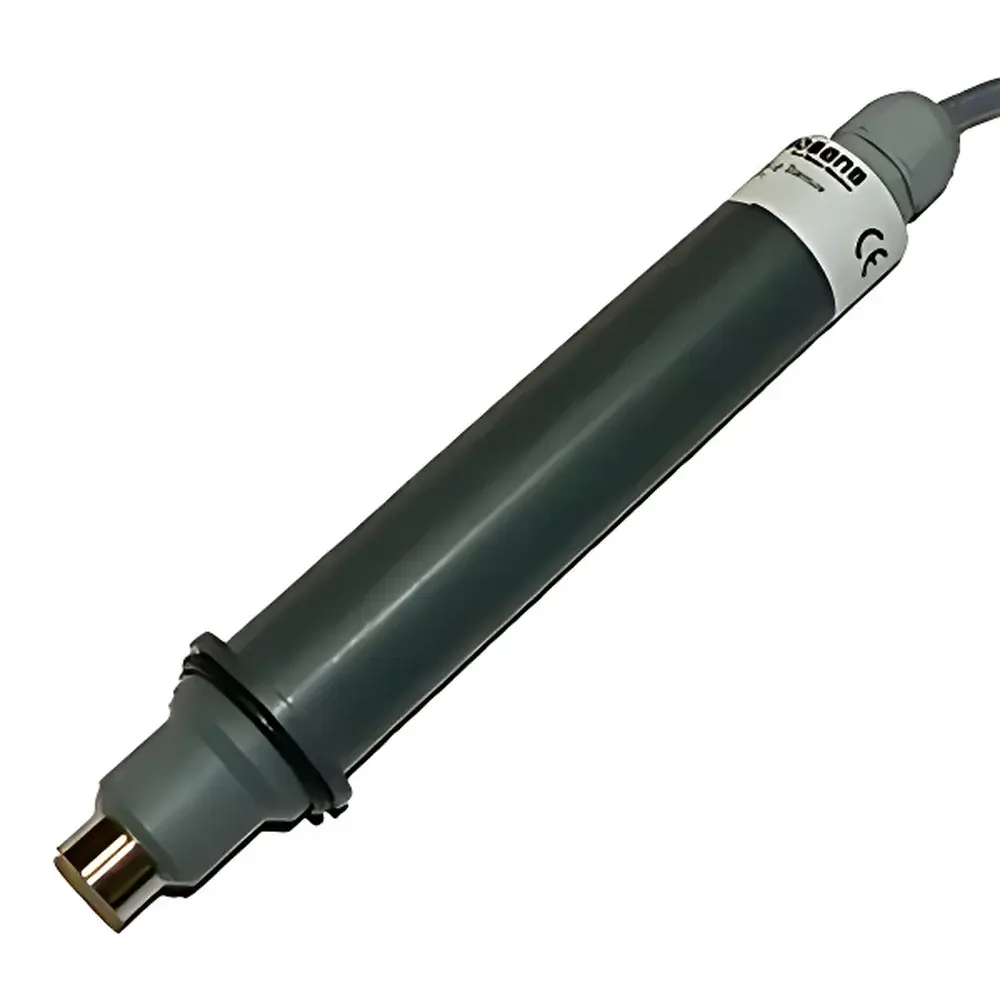
AQUALABO Skidsens Fouling Monitor
| Brand | AQUALABO |
|---|---|
| Origin | France |
| Model | Skidsens |
| Probe Dimensions | Ø28 mm × 190 mm |
| Connection | 3/4″ T-fitting |
| Cable Length | 1.5 m |
| Output | 4–20 mA (max. 250 Ω), fouling potential measurement |
| Power Supply | 24 VDC / 50 mA |
| Measured Parameter | Fouling Potential (0–1 u.a.) |
| Process Temperature Range | 0–60 °C (32–140 °F) |
| Max. Pressure | 5 bar (72.5 psi) |
| Minimum Flow Rate (for Ø25.4 mm pipe) | >1000 L/h (>4.4 GPM) |
| Max. Temperature Ramp Rate | 10 °C/min |
| Ambient Operating Temperature | 5–50 °C |
| Relative Humidity | 0–90 % RH |
| Certification | CE |
| Housing Materials | PVC, 316L stainless steel |
Overview
The AQUALABO Skidsens Fouling Monitor is an electrochemical interface gauge engineered for continuous, real-time in-situ monitoring of fouling dynamics—including biofilm formation, scale deposition, and colloidal accumulation—in industrial water systems. Unlike optical or ultrasonic methods that infer fouling indirectly, the Skidsens operates on the principle of fouling potential, a normalized electrochemical signal derived from the interfacial impedance shift between a reference electrode and a fouling-sensitive sensing surface exposed to flowing process water. This parameter correlates with early-stage surface colonization and mineral precipitation kinetics, enabling detection before hydraulic resistance or thermal efficiency loss becomes measurable. Designed for integration into bypass loops or control cabinets, the instrument delivers actionable data without requiring sample extraction, chemical reagents, or periodic calibration—making it suitable for long-term deployment in cooling towers, membrane pre-treatment lines, heat exchanger circuits, and potable water distribution networks.
Key Features
- True continuous monitoring: No moving parts, no consumables, no scheduled maintenance—operational uptime exceeds 99.5% under typical industrial conditions.
- Electrochemical fouling potential measurement: Provides quantitative, unitless output (0–1 u.a.) directly tied to interfacial charge transfer resistance, offering higher sensitivity to nascent biofilm than turbidity or pressure drop metrics.
- Ruggedized probe architecture: 316L stainless steel wetted parts and PVC housing ensure compatibility with chlorinated, ozonated, and mildly acidic or alkaline waters (pH 4–10).
- Industrial-grade analog interface: Isolated 4–20 mA output compliant with standard PLC/DCS I/O modules; supports loop-powered operation at 24 VDC.
- Thermal and flow resilience: Validated for operation across 0–60 °C and pressures up to 5 bar, with minimum flow dependency mitigated via optimized hydrodynamic probe geometry (validated at ≥1000 L/h in 1″ nominal pipe).
Sample Compatibility & Compliance
The Skidsens probe is compatible with municipal, industrial, and recirculated cooling waters containing suspended solids ≤50 mg/L, total dissolved solids ≤2000 ppm, and free chlorine ≤5 mg/L. It is not intended for use in viscous fluids, slurries >2% w/w, or highly reducing environments (e.g., anaerobic digestate). The device conforms to CE marking requirements under the EU Electromagnetic Compatibility Directive 2014/30/EU and Low Voltage Directive 2014/35/EU. While not certified to IEC 61508 or SIL standards, its failure mode behavior (open-circuit output on sensor fault) supports integration into safety-instrumented functions when combined with appropriate logic solvers per IEC 61511.
Software & Data Management
The Skidsens outputs a linear 4–20 mA signal proportional to fouling potential, enabling direct integration with SCADA, Historian, or cloud-based asset management platforms (e.g., Siemens Desigo CC, Schneider EcoStruxure, or custom MQTT-enabled dashboards). When paired with a programmable logic controller, the analog signal can trigger threshold-based alarms (e.g., >0.7 u.a. sustained for 15 min), initiate automated biocide dosing cycles, or log time-series fouling trends correlated with temperature, pH, and ORP inputs. For auditability in regulated environments, users may configure external data loggers to record timestamped 4–20 mA values with NIST-traceable calibration metadata—supporting GLP-compliant record retention per 21 CFR Part 11 when implemented with electronic signature controls.
Applications
- Cooling water systems: Early detection of Legionella-prone biofilm maturation in open recirculating towers, enabling proactive biocide scheduling and reducing regulatory non-conformance risk.
- Membrane filtration plants: Monitoring fouling onset upstream of ultrafiltration or reverse osmosis units to optimize backwash frequency and antiscalant dosing—demonstrated to reduce chemical consumption by 18–32% in pilot-scale trials.
- Heat exchanger networks: Correlating fouling potential spikes with thermal performance decay to prioritize mechanical cleaning interventions and extend service intervals.
- Drinking water storage and distribution: Tracking biofilm re-growth post-disinfection in reservoirs and booster stations to validate residual disinfectant efficacy and inform flushing protocols.
FAQ
Does the Skidsens require periodic recalibration?
No. The fouling potential signal is inherently self-referencing and drift-compensated through dual-electrode architecture. Field verification against baseline clean-surface readings is recommended annually but does not constitute calibration.
Can the probe be installed directly in-line, or is a bypass loop mandatory?
While designed for bypass installation to minimize pressure drop and enable safe servicing, the probe may be installed in-line if system hydraulics permit full-rated flow velocity (>1 m/s) across the sensing face and isolation valves are provided.
Is the 4–20 mA output intrinsically safe for hazardous area installations?
The standard Skidsens is not ATEX- or IECEx-certified. For Zone 2 applications, it must be deployed with an approved galvanic isolator or barrier meeting EN 60079-11.
How does fouling potential differ from traditional conductivity or turbidity measurements?
Conductivity reflects bulk ionic strength; turbidity measures light-scattering particles. Fouling potential specifically quantifies interfacial electron-transfer resistance at the solid–liquid boundary—a more direct indicator of adhesive biofilm matrix formation and crystalline nucleation than bulk-phase proxies.
What maintenance is required over a 5-year service life?
None beyond visual inspection of the sensing surface during routine system shutdowns. The 316L/PVC construction resists pitting and biofouling; no cleaning agents or mechanical abrasion are needed.
Related Products







