
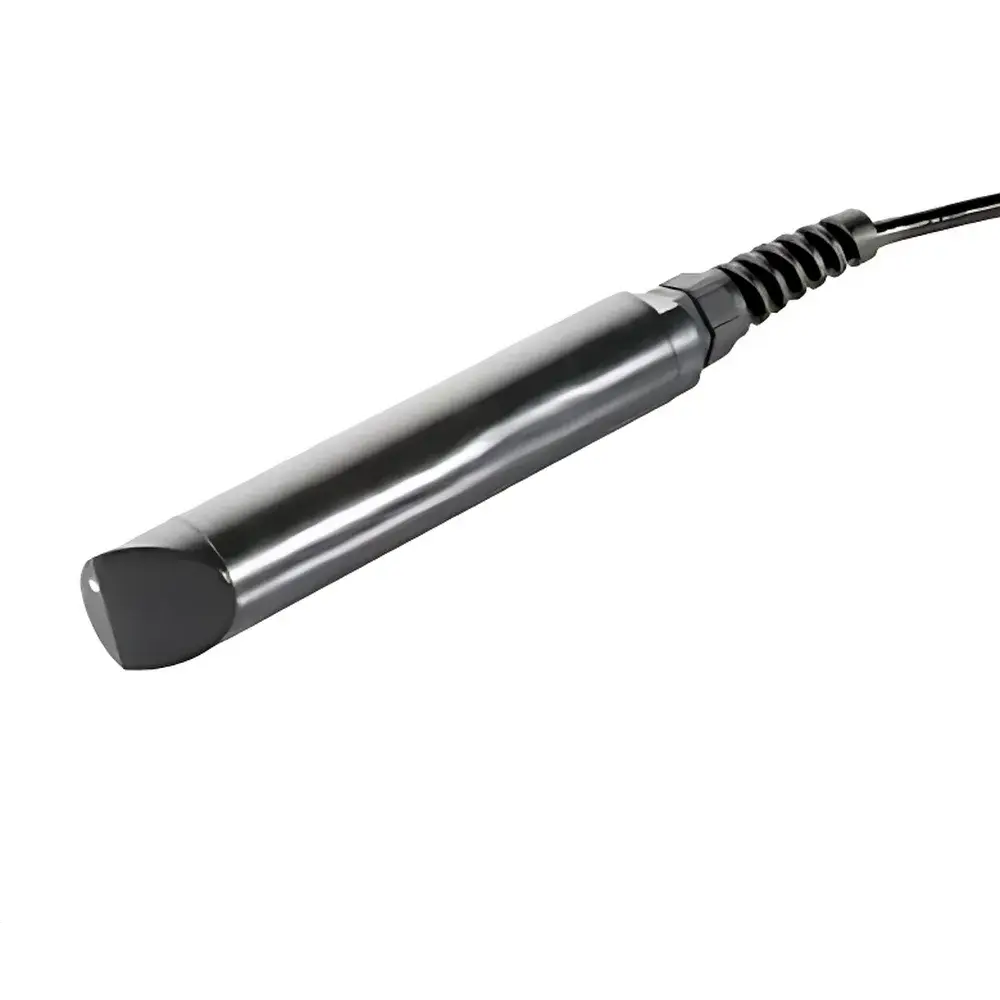
AQUALABO SOMQUALITY-NTU Infrared Scattering Turbidity Sensor
| Brand | AQUALABO |
|---|---|
| Origin | France |
| Model | NTU |
| Measurement Principle | 90° Infrared Light Scattering at 880 nm |
| Turbidity Range | 0–4000 NTU (5 selectable sub-ranges) |
| TSS Range | 0–4500 mg/L |
| Resolution | 0.01–1 NTU / mg/L |
| Accuracy | < ±5% of reading |
| Temperature Compensation | Integrated CTN sensor (±0.5 °C) |
| Output | Modbus RTU over RS-485 (standard), SDI-12 (optional) |
| Power Supply | 5–12 VDC |
| Typical Current Draw | 820 µA (RS-485, 1 Hz) |
| Peak Pulse | 500 mA |
| Enclosure Material | PVC, Delrin®, Quartz, PMMA, Polyamide |
| Dimensions | Ø27 mm × 170 mm |
| Weight | 300 g (sensor + 3 m cable) |
| Pressure Rating | 5 bar |
| IP Rating | IP68 |
| Operating Temperature | 0–50 °C |
| Storage Temperature | −10 to +60 °C |
| Calibration Standards | NF EN 872 (0–500 mg/L), NFT 90 105-2 (>500 mg/L) |
| Max Refresh Rate | < 1 s |
Overview
The AQUALABO SOMQUALITY-NTU is a high-stability, submersible infrared turbidity sensor engineered for continuous, real-time monitoring in municipal and industrial water and wastewater treatment processes. It operates on the principle of 90° infrared light scattering at a fixed wavelength of 880 nm — a method standardized under ISO 7027 and widely adopted for its immunity to color interference and reduced susceptibility to photobleaching compared to visible-light systems. Unlike nephelometric instruments relying on white or blue LED sources, this sensor’s narrow-band IR emitter ensures consistent signal integrity across variable chromatic conditions, particularly in highly colored or humic-rich waters. The device simultaneously measures turbidity (0–4000 NTU), suspended solids concentration (0–4500 mg/L), and temperature (0–50 °C), delivering three co-located, time-synchronized parameters critical for process control, regulatory reporting, and compliance verification.
Key Features
- Infrared optical architecture with quartz-coupled fiber-optic path, eliminating drift from lens fouling and enabling long-term stability in aggressive media
- Five programmable turbidity sub-ranges (5–50, 5–200, 5–1000, 5–4000 NTU, and auto-ranging 0–4500 mg/L) optimized for dynamic process conditions
- IP68-rated stainless-steel-free housing constructed from chemically resistant polymers: PVC body, Delrin® mounting collar, PMMA optical window, and polyamide strain relief
- Integrated CTN (Cold Temperature Negative coefficient) thermistor with ±0.5 °C accuracy, enabling real-time temperature compensation per ISO 7027 Annex B
- Dual digital output interface: standard Modbus RTU over RS-485 (addressable, multi-drop capable) and optional SDI-12 for legacy environmental data loggers
- Ultra-low power consumption: 40 µA standby, 820 µA average during RS-485 polling at 1 Hz — suitable for solar-powered or battery-operated telemetry deployments
Sample Compatibility & Compliance
The SOMQUALITY-NTU is validated for direct immersion in raw influent, activated sludge, tertiary effluent, drinking water distribution lines, and stormwater retention basins. Its optical design conforms to ISO 7027:2016 for turbidimetric measurement and supports traceable calibration against formazin (NF EN 872) and kaolin (NFT 90 105-2) reference suspensions. For regulatory reporting under EU Urban Wastewater Treatment Directive (91/271/EEC), US EPA Method 180.1, or ISO 10705-2, the sensor’s documented accuracy (< ±5% of reading), resolution (0.01 NTU in low-range mode), and audit-ready output logging meet minimum QA/QC requirements. Its 5-bar pressure rating allows deployment in pressurized filtration skids or deep-well applications without auxiliary housings.
Software & Data Management
Data acquisition is fully compatible with industry-standard SCADA platforms (e.g., Ignition, Siemens Desigo, Schneider EcoStruxure) via native Modbus register mapping. Each measurement packet includes timestamped NTU, mg/L TSS, and °C values — all timestamped with microsecond precision when synchronized to an external PTP or NTP source. Firmware supports configurable averaging windows (1–60 s), outlier rejection algorithms, and automatic zero-point validation using dark-current referencing. All configuration changes and calibration events are logged with immutable timestamps and user-defined identifiers, satisfying FDA 21 CFR Part 11 and EU Annex 11 requirements for electronic records in GLP/GMP environments.
Applications
- Real-time optimization of coagulation/flocculation dosing in drinking water plants
- Monitoring clarifier performance and sludge blanket depth in secondary treatment
- Effluent compliance verification prior to discharge (e.g., NPDES permits)
- Early detection of membrane fouling or filter breakthrough in advanced treatment trains
- Stormwater quality monitoring at outfall points with adaptive range switching
- Research-grade suspended solids quantification in limnological and hydrological field studies
FAQ
Does the SOMQUALITY-NTU require periodic recalibration in situ?
Field recalibration is not required under stable operational conditions; however, quarterly verification against a certified formazin standard (NF EN 872) is recommended for compliance-critical installations.
Can the sensor be deployed in seawater or brackish environments?
Yes — its IP68 rating and non-metallic construction ensure corrosion resistance; however, biofouling mitigation (e.g., wiper mechanisms or periodic cleaning protocols) is advised for long-term deployments above 20 °C.
Is temperature compensation applied automatically to turbidity readings?
Yes — the integrated CTN sensor feeds real-time temperature data into the firmware’s compensation algorithm, applying ISO 7027-compliant correction curves to all NTU outputs.
What is the maximum cable length supported for RS-485 communication?
Up to 1,200 meters is achievable using twisted-pair shielded cable (AWG24) and proper termination resistors, maintaining signal integrity at standard 9,600 baud.
How does the sensor handle air bubbles or entrained gas in the sample stream?
The 90° scattering geometry and signal-processing firmware include bubble-detection logic that flags transient spikes and suppresses invalid readings during gas passage — minimizing false alarms in aerated basins or pump suction lines.






