
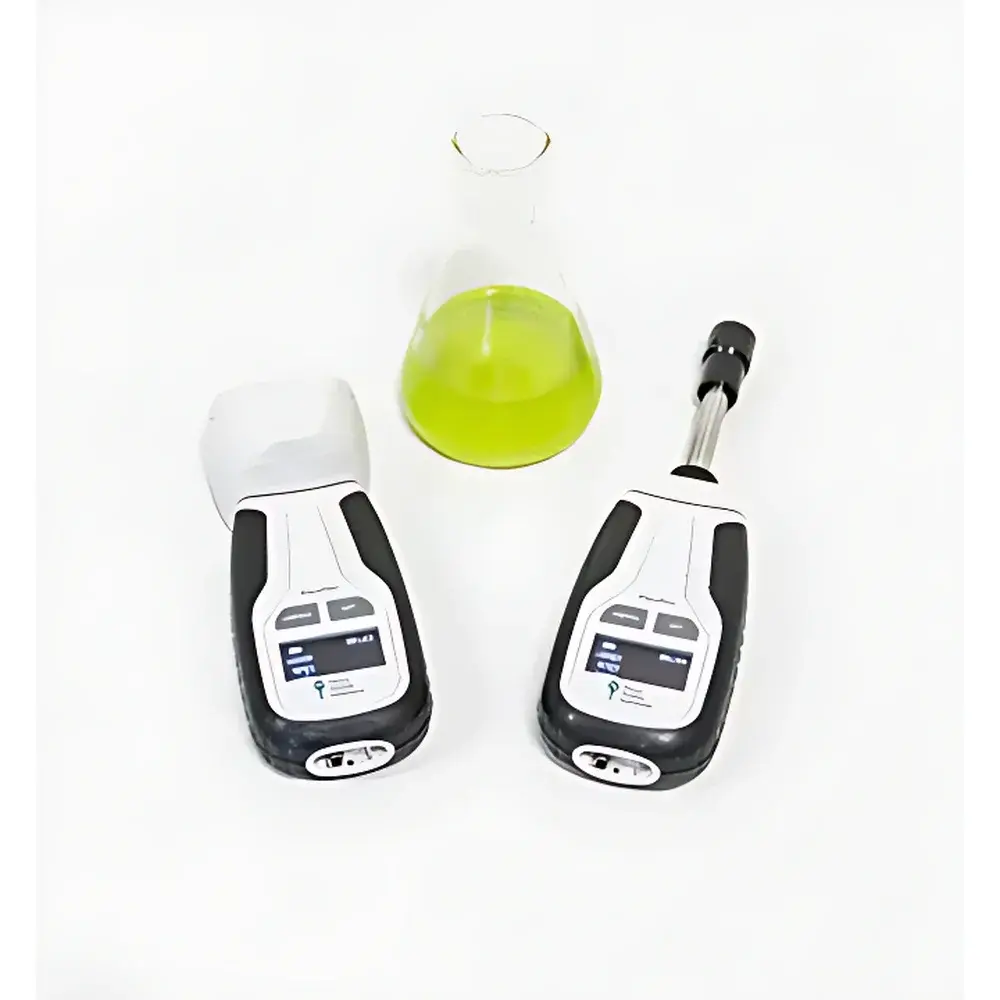
AquaPen AP110 Handheld Chlorophyll Fluorometer by PSI
| Brand | PSI (Czech Republic) |
|---|---|
| Origin | Czech Republic |
| Model | AquaPen AP110 |
| Detection Limit | 0.5 µg Chl/L |
| Excitation Wavelengths | 455 nm (blue), 620 nm (red) for AP110-C |
| Emission Detection Range | 667–750 nm |
| Optical Configurations | AP110-C (cuvette-based, 4 mL volume, OD680 & OD720 capability), AP110-P (submersible probe) |
| Time Resolution | 10 µs (100,000 measurements/s) for OJIP kinetics |
| Fluorescence Parameters | >50 standard and derived parameters including F₀, Fₘ, Fᵥ/Fₘ, ΦPSII, NPQ, Rfd, Area, Mo, Sm, PI_ABS, ABS/RC, TR₀/RC, ET₀/RC, DI₀/RC, and 26 OJIP-specific indices |
| Light Sources | Measuring light (0.09 µmol photons/m²·s, 10–100% adjustable), Actinic light (10–1000 µmol photons/m²·s), Saturating pulse (up to 3000 µmol photons/m²·s, 11–100% adjustable) |
| Data Storage | 16 MB flash memory (≈149,000 data points) |
| Power | Rechargeable 2000 mAh Li-ion battery (48 h continuous operation) |
| Dimensions | 165 × 65 × 55 mm (body only), Weight: 290 g |
| Environmental Rating | 0–55 °C operating, 0–95% RH (non-condensing) |
| Connectivity | Dual-mode Bluetooth 5.0 (20 m range, 3 Mbps max) + USB 2.0 |
| Integrated GPS | Yes (1.5 m horizontal accuracy) |
| Software | FluorPen v1.1 (Windows 7+, Excel export, kinetic curve visualization, remote instrument control, audit-ready data logging) |
Overview
The AquaPen AP110 Handheld Chlorophyll Fluorometer is a field-deployable, high-resolution instrument engineered for quantitative assessment of photosynthetic performance in phytoplankton, cyanobacteria, macroalgae, and benthic microalgae. Based on pulse-amplitude modulated (PAM) fluorometry principles, it measures chlorophyll a fluorescence kinetics with microsecond temporal resolution—enabling robust quantification of Photosystem II (PSII) photochemical efficiency, energy dissipation pathways, and electron transport dynamics. Unlike conventional benchtop fluorometers, the AquaPen AP110 integrates full-featured laboratory-grade measurement protocols—including OJIP transient analysis, multiphase NPQ kinetics, and multi-intensity light response curves—into a portable platform certified for use in ambient outdoor environments, marine research vessels, polar field stations (e.g., Mendel Station, Antarctica), and controlled bioreactor facilities.
Key Features
- Two interchangeable optical configurations: AP110-C cuvette module (4 mL pathlength, dual-wavelength OD680/OD720 absorbance + fluorescence) and AP110-P submersible probe (direct immersion in natural waters, suspended cultures, or macroalgal thalli)
- High-sensitivity detection down to 0.5 µg Chl/L—validated for low-biomass oligotrophic systems and early-stage culture monitoring
- 10 µs time resolution for OJIP transients, generating standardized kinetic curves and computing 26 biophysically grounded parameters (e.g., PIAbs, ABS/RC, TR0/RC, DI0/RC) per measurement
- Programmable light regimes: independently adjustable measuring light, actinic illumination (10–1000 µmol photons·m⁻²·s⁻¹), and saturating pulses (up to 3000 µmol photons·m⁻²·s⁻¹)
- Integrated GPS module with timestamped georeferencing—critical for spatially resolved water quality mapping and longitudinal ecosystem surveys
- Dual communication architecture: Bluetooth 5.0 for real-time telemetry and USB 2.0 for bulk data transfer and firmware updates
- Embedded FluorPen v1.1 software engine supports autonomous unattended monitoring sequences, automated protocol execution, and GLP-compliant metadata tagging (operator ID, location, ambient temperature, measurement time)
Sample Compatibility & Compliance
The AquaPen AP110 accommodates diverse sample matrices without preprocessing: raw lake/river/seawater, algal suspensions (freshwater and marine), wastewater effluents, photobioreactor harvests, and intact macroalgal tissue. Its optical design minimizes scattering artifacts through spectral filtering (667–750 nm detection bandpass) and optimized excitation geometry. The instrument complies with ISO 10260:2021 (phytoplankton fluorescence measurement guidelines) and supports traceable calibration via factory-characterized reference standards. Data integrity meets FDA 21 CFR Part 11 requirements when used with FluorPen v1.1’s electronic signature, audit trail, and user-access controls—making it suitable for regulatory environmental monitoring programs and GxP-aligned research workflows.
Software & Data Management
FluorPen v1.1 is a Windows-native application enabling full instrument control, real-time parameter visualization, batch analysis of OJIP/NPQ/LC datasets, and export of tabular results (CSV/Excel) and publication-ready figures (SVG/PNG). It implements standardized nomenclature per the International Commission on Photosynthesis Research (ICPR) and supports cross-platform interoperability with MATLAB, R, and Python-based bioinformatics pipelines. All measurements are automatically annotated with GPS coordinates, UTC timestamps, battery voltage, and sensor thermal drift compensation values—ensuring reproducibility across multi-site collaborative studies. Raw binary files retain full 16-bit intensity resolution for retrospective reprocessing.
Applications
- Quantitative assessment of phytoplankton community health in eutrophication monitoring and harmful algal bloom (HAB) early warning systems
- In situ evaluation of photoinhibition, non-photochemical quenching (NPQ), and PSII repair capacity under UV-B, thermal stress, or heavy metal exposure
- High-throughput phenotyping of algal mutants and strains in biotechnology screening (e.g., lipid productivity, stress tolerance, circadian rhythm profiling)
- Long-term ecological studies tracking photosynthetic acclimation to climate variables—documented in peer-reviewed Antarctic, tropical, and temperate aquatic investigations
- Quality assurance in aquaculture feedstock production and wastewater-grown biomass certification
- Undergraduate and graduate teaching modules on plant physiology, limnology, and environmental photobiology
FAQ
What distinguishes the AP110-C from the AP110-P probe configuration?
The AP110-C uses a 4 mL quartz cuvette for controlled, scatter-corrected measurements of filtered or unfiltered suspensions and enables concurrent OD680/OD720 absorbance—ideal for correlating fluorescence yield with cell density. The AP110-P employs a waterproof submersible probe for direct in situ profiling, including vertical water column transects and benthic mat assessments.
Does the AquaPen AP110 support compliance with ISO or ASTM standards?
Yes—it adheres to ISO 10260:2021 for chlorophyll a fluorescence methodology and generates data structures compatible with ASTM D8012-18 (standard guide for algal biomass characterization).
Can measurement protocols be customized beyond factory presets?
Yes—users may define custom light intensities, pulse durations, dark adaptation periods, and kinetic acquisition windows via FluorPen v1.1’s script editor, preserving full traceability in audit logs.
Is the instrument suitable for long-term unattended deployment?
With optional waterproof housing (IP68-rated, 10 m depth rating), external power interface, and programmable sleep/wake cycles, the AquaPen AP110 supports multi-day autonomous monitoring in buoy-mounted or moored configurations.
How is data security ensured during field operations?
All stored data are encrypted at rest using AES-128; Bluetooth sessions require authenticated pairing; and FluorPen v1.1 enforces role-based access control (administrator/operator) with immutable audit trails meeting GLP/GMP documentation requirements.







