
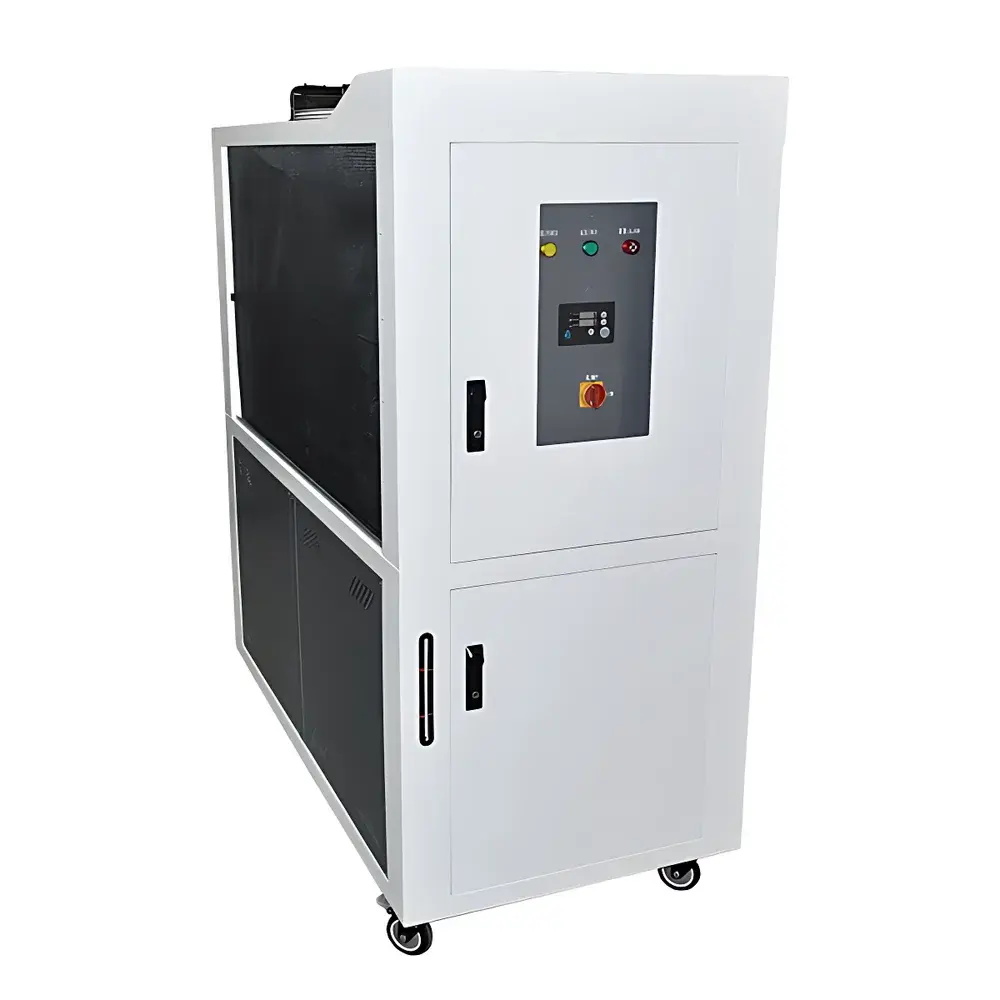
AR Series Industrial Circulating Chiller
| Origin | Beijing, China |
|---|---|
| Manufacturer Type | Authorized Distributor |
| Origin Category | Domestic (China) |
| Model | AR Series |
| Price Range | USD 7,000 – 14,000 |
| Instrument Type | Integrated Unit |
| Cooling Method | Water-Cooled |
| Temperature Control Range | 5–35 °C |
| Refrigeration Capacity | 18–190 kW |
| Temperature Stability | ±1 °C |
| Circulation Pump Head | 19–55 m |
| Circulation Flow Rate | 1–32 m³/h |
| Reservoir Volume | 150–900 L |
| Operating Principle | Phase-Change Refrigeration |
Overview
The AR Series Industrial Circulating Chiller is a robust, integrated water-cooled refrigeration system engineered for continuous, high-duty-cycle thermal management in demanding industrial and laboratory environments. Based on vapor-compression phase-change refrigeration, it delivers precise temperature control across a stable operating range of 5–35 °C—optimized for applications requiring consistent coolant supply to heat-generating equipment such as CNC machine tools, laser systems, vacuum deposition chambers, and bioreactors. Unlike air-cooled units, the water-cooled architecture enables higher energy efficiency, reduced ambient heat rejection, and quieter operation—critical in climate-controlled production floors or shared lab facilities. The chiller’s modular design accommodates scalable cooling loads (18–190 kW), with each model validated under ISO 5149-compliant refrigerant handling protocols and constructed to meet IP54 ingress protection standards for industrial deployment.
Key Features
- High-efficiency water-cooled condensing system with dual flat-plate heat exchangers and blue hydrophilic finned coils—engineered for superior thermal transfer, corrosion resistance, and ease of maintenance.
- Dual control modes: “Setpoint Temperature” mode for fixed-temperature operation and “Ambient Synchronization” mode for dynamic offset-based regulation—enabling adaptive thermal response to process load fluctuations.
- Multi-layer safety architecture including high/low pressure cutouts, flow loss detection, overtemperature shutdown, and refrigerant leak monitoring—each fault type mapped to discrete alarm codes for rapid diagnostics.
- Industrial-grade circulation pump with adjustable head (19–55 m) and flow rate (1–32 m³/h), supporting long-distance coolant distribution and multi-point branching without performance degradation.
- Optional dual-circuit configuration with sequential startup and automatic redundancy switching—ensuring uninterrupted cooling during scheduled maintenance or component failure.
- Configurable water filtration module (5–25 µm particulate retention) and optional conductivity monitoring—supporting compliance with ASTM D1193 Type IV water specifications for sensitive optical or electrochemical processes.
Sample Compatibility & Compliance
The AR Series is compatible with standard glycol-water mixtures (up to 30% ethylene or propylene glycol), deionized water, and other non-corrosive heat-transfer fluids meeting ISO 6743-23 (Class HEES or HETG) classifications. All wetted components—including reservoirs, pumps, and heat exchangers—are fabricated from stainless steel 304 or electropolished SS316, ensuring compatibility with pH 5.5–9.5 aqueous media and resistance to galvanic corrosion. The unit complies with CE marking requirements (2014/30/EU EMC Directive and 2014/68/EU PED), meets UL 61010-1 safety standards for industrial control equipment, and supports traceable calibration per ISO/IEC 17025 when paired with external PT100 reference probes. Optional audit-trail logging and user-access controls align with FDA 21 CFR Part 11 readiness for regulated pharmaceutical or medical device manufacturing environments.
Software & Data Management
The embedded controller features a 7-inch TFT-LCD touchscreen interface with multilingual support (English, German, Spanish, Chinese), real-time trend graphing, and password-protected parameter access levels (Operator / Technician / Administrator). All operational data—including setpoints, actual temperatures, flow rates, compressor run hours, and alarm history—are timestamped and stored locally for ≥12 months. Data export is supported via USB 2.0 or RS485 Modbus RTU protocol for integration into SCADA, MES, or LIMS platforms. Optional Ethernet connectivity enables remote monitoring through secure HTTPS web interface and SNMP v3 traps—facilitating predictive maintenance scheduling and centralized fleet management across distributed facilities.
Applications
- Metalworking: Continuous coolant temperature stabilization for CNC machining centers, EDM wire-cutting machines, and high-speed milling spindles.
- Surface Engineering: Thermal regulation of sputtering targets, electron-beam evaporation sources, and plasma-enhanced CVD reactors.
- Laser Systems: Heat dissipation for CO₂, fiber, and diode-pumped solid-state (DPSS) lasers used in cutting, welding, and additive manufacturing.
- Pharmaceutical & Biotech: Precise jacket temperature control for jacketed reactors, fermenters, and lyophilizers operating under cGMP conditions.
- Plastics & Packaging: Mold temperature control in injection molding, blow molding, and thermoforming lines—reducing cycle time and improving part dimensional stability.
- Research Infrastructure: Stable cooling for X-ray diffractometers, NMR pre-amplifiers, and high-power RF amplifiers requiring low-noise thermal environments.
FAQ
What refrigerants are used in the AR Series chillers?
All models utilize R-410A or R-134a refrigerants—selected for zero ozone depletion potential (ODP = 0) and compliance with EU F-Gas Regulation (EU) No 517/2014.
Can the chiller operate continuously at 5 °C ambient temperature?
Yes—the system is rated for continuous operation within an ambient range of 5–40 °C, with derating applied only above 35 °C per ISO 5149 Annex B.
Is remote start/stop and setpoint adjustment supported?
Yes—via dry-contact I/O terminals (NO/NC) and Modbus RTU commands; optional Ethernet firmware enables full web-based control with role-based authentication.
Does the unit support validation documentation (IQ/OQ/PQ)?
Factory-provided IQ/OQ templates are available upon request; PQ execution requires site-specific sensor calibration and is typically performed by qualified third-party service providers.
What is the expected service interval for the main refrigeration circuit?
Under normal operating conditions (≤8,000 annual runtime hours), the hermetic scroll compressor and brazed plate heat exchanger require no scheduled maintenance for 36 months or 15,000 operating hours—whichever occurs first.



