
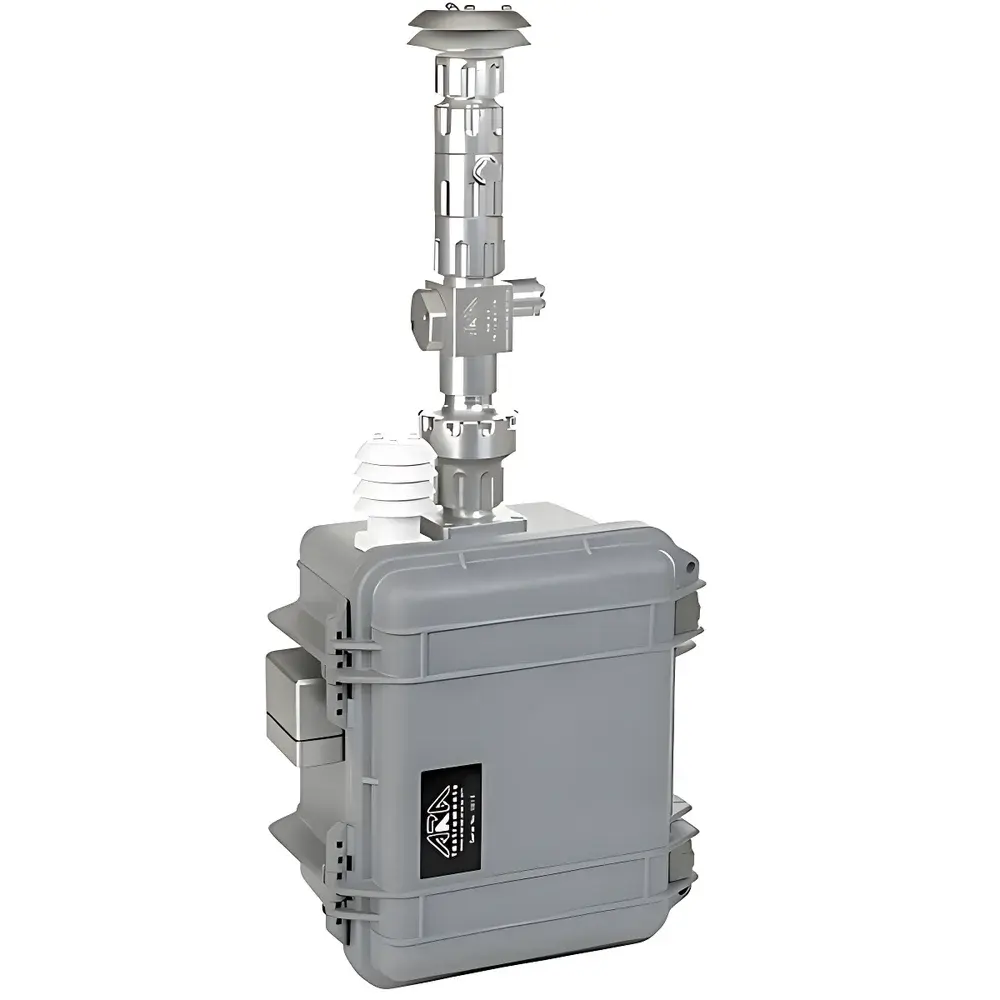
ARA LFR-6 Low-Flow Research Sampler
| Brand | ARA |
|---|---|
| Origin | USA |
| Manufacturer Type | Authorized Distributor |
| Import Status | Imported |
| Model | LFR-6 |
| Weight | 15 lb |
| Flow Rate | 6 L/min (adjustable 3–10 L/min) |
| Flow Accuracy | ±2% |
| Battery | 18 V Li-ion (rechargeable, 1 hr charge time, >30 hr runtime) |
| Data Logging Interval | 5 min |
| Dimensions | 10" × 12" × 7" |
| Data Export | USB flash drive |
| Filter Format | 47 mm FRM-compatible |
| Sampling Modes | TSP, PM₁₀, PM₂.₅ |
| Optional Sensors | Real-time particulate (RTP), PEET anemometer, optical scattering sensor |
| Compliance | Designed to meet U.S. EPA Reference Method (FRM) criteria for low-flow ambient particulate monitoring |
Overview
The ARA LFR-6 Low-Flow Research Sampler is a field-deployable, battery-powered ambient air particulate sampler engineered for regulatory-grade and research-oriented monitoring of total suspended particulates (TSP), PM₁₀, and PM₂.₅. Based on the Federal Reference Method (FRM) impactor principle, the LFR-6 employs a precision-machined, grease-free inertial impactor stage to achieve gravimetrically traceable particle size separation at a nominal flow rate of 6 L/min—within ±2% accuracy across its 3–10 L/min active flow control range. Its compact footprint (10″ × 12″ × 7″), lightweight design (15 lb), and integrated lithium-ion power system enable rapid deployment in remote or infrastructure-limited locations without AC dependency. Unlike traditional high-volume samplers, the LFR-6 prioritizes operational flexibility and long-term unattended operation while maintaining compatibility with EPA-compliant 47 mm filter substrates and standard FRM filter tapes.
Key Features
- FRM-compliant low-flow impactor architecture with no lubricants required—ensuring consistent cut-point performance and eliminating maintenance-related calibration drift.
- Configurable inlet modules for TSP, PM₁₀, or PM₂.₅ sampling using standardized 47 mm filters and filter tapes—fully interoperable with legacy FRM data workflows.
- Onboard microprocessor-controlled active flow regulation with real-time pressure and temperature compensation for stable volumetric flow under variable ambient conditions.
- Integrated 5-minute interval data logging of critical sampling parameters: actual flow rate, filter temperature, barometric pressure, relative humidity, and optional meteorological inputs.
- Modular sensor expansion capability—including optional real-time particulate (RTP) counters, PEET cup anemometers for wind-aware directional sampling, and optical scattering sensors for temporal aerosol dynamics profiling.
- Intuitive menu-driven interface with USB-based configuration and data retrieval—no proprietary software or cloud dependency required.
- Rechargeable 18 V lithium-ion battery system delivering >30 hours of continuous operation per full charge (1 hour recharge time).
Sample Compatibility & Compliance
The LFR-6 supports gravimetric analysis protocols aligned with U.S. EPA Methods IO-1, IO-2, and IO-3 for PM₂.₅ and PM₁₀, as well as ISO 7708 and EN 12341 for inhalable and respirable fraction definitions. It accepts all standard 47 mm glass fiber, quartz, or PTFE filters used in FRM-certified laboratories and is compatible with certified weighing protocols under ISO/IEC 17025-accredited environments. While not itself EPA-certified as a Reference or Equivalent Method device, the LFR-6 is routinely deployed in supplemental monitoring networks, method validation studies, and pre-compliance site characterization where traceable, low-flow, multi-parameter particulate data are required. Its mechanical design adheres to NIST-traceable flow calibration practices and supports audit-ready metadata capture per GLP and GMP-aligned quality systems.
Software & Data Management
Data acquisition and instrument configuration are managed via a built-in embedded controller with non-volatile memory. All logged parameters—including flow, temperature, pressure, humidity, and optional sensor outputs—are timestamped and stored in comma-separated value (CSV) format on any standard USB 2.0 flash drive. No drivers or vendor-specific applications are needed for data extraction or reprogramming. The user interface supports customizable start/stop schedules, flow setpoint adjustments, and alarm thresholds for out-of-spec conditions. Audit trails—including operator ID entry, parameter changes, and power cycle logs—are retained onboard and exportable alongside sample data. For integration into centralized environmental data management platforms, raw CSV files conform to AQMS- and EPA AirNow-compatible schema conventions.
Applications
- Urban and rural ambient air quality monitoring networks requiring portable, low-power, multi-fraction particulate data.
- Roadside and traffic corridor studies where spatial resolution and temporal granularity exceed fixed-station capabilities.
- Industrial fence-line and community monitoring programs supporting EHS compliance and stakeholder transparency initiatives.
- Environmental impact assessments (EIAs) and baseline characterization prior to construction or permitting activities.
- Short-term hotspot identification and emergency response deployments following industrial incidents or wildfire events.
- Academic and government-led aerosol process studies—including diurnal variation analysis, source apportionment support, and sensor intercomparison campaigns.
- Occupational hygiene screening in semi-enclosed or transient worksite environments.
FAQ
Is the LFR-6 EPA-certified as a Reference or Equivalent Method sampler?
No—the LFR-6 is not listed on the EPA’s Certified Air Monitoring Devices (CAMD) list. It is designed for supplemental, research, and pre-compliance monitoring where FRM-compliant sampling geometry and traceable flow control are required.
Can the LFR-6 operate unattended for extended periods?
Yes—its >30-hour battery life, weather-resistant enclosure, and robust data logging allow for multi-day autonomous operation; external solar charging kits are supported via optional DC input.
What filter media are compatible with the LFR-6?
All standard 47 mm diameter filters used in FRM applications: quartz fiber (e.g., Pallflex Tissuquartz), glass fiber (e.g., Whatman GF/F), and PTFE membrane filters (e.g., SKC PVC-backed).
Does the LFR-6 support remote telemetry or cellular data transmission?
Not natively—but third-party cellular modems with serial-to-USB bridging can be integrated via the device’s RS-232 port for custom telemetry solutions.
How is flow calibration performed and verified?
Calibration is conducted using NIST-traceable primary standards (e.g., dry gas meters or critical orifices) per EPA Guidance Document QA/G-5. Field verification is supported using handheld calibrators such as the Gilian Gilibrator-2 or Mesa Labs DryCal.
Related Products







