
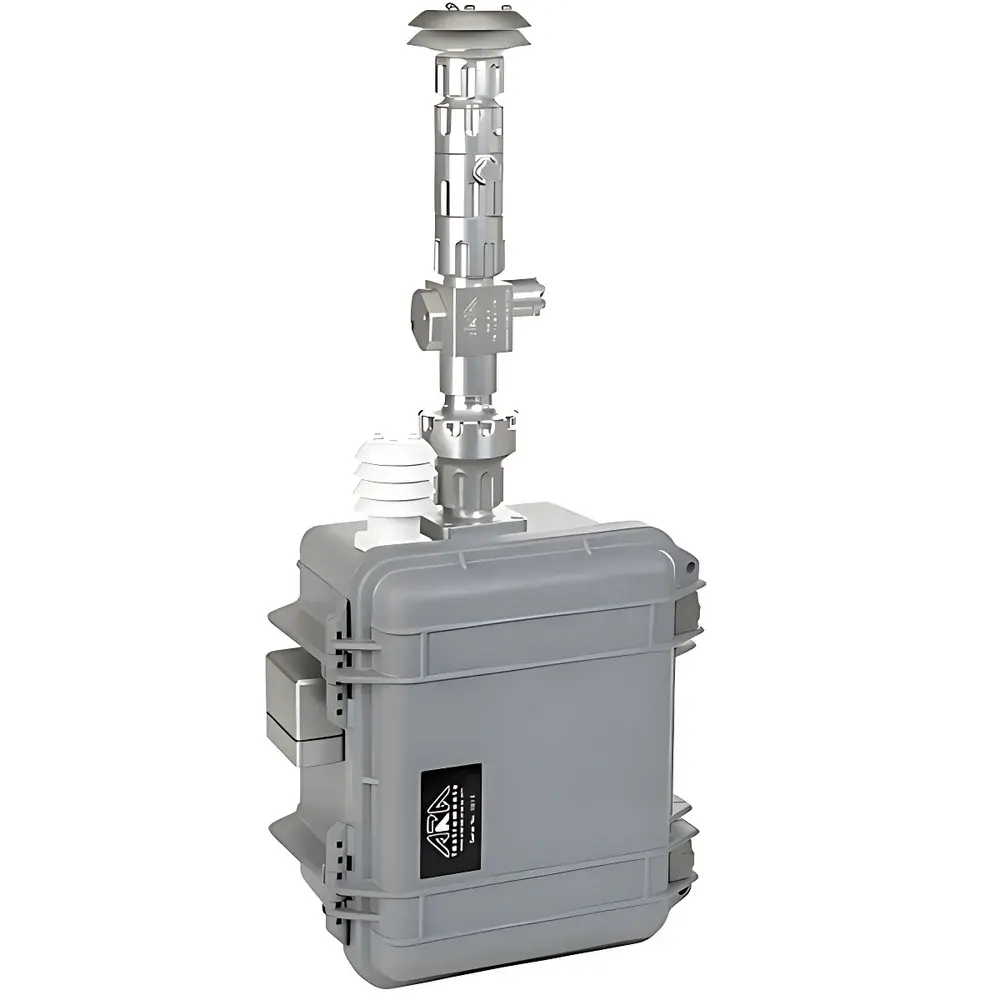
ARA LFR-6 Low-Flow Research Sampler
| Brand | ARA |
|---|---|
| Origin | USA |
| Manufacturer Type | Authorized Distributor |
| Import Status | Imported |
| Model | LFR-6 |
| Weight | 15 lb |
| Flow Rate Range | 3–10 L/min |
| Nominal Flow Rate | 6 L/min |
| Flow Accuracy | ±2% |
| Battery | 18 V Li-ion (rechargeable) |
| Charge Time | 1 h |
| Runtime | >30 h |
| Data Logging Interval | 5 min |
| Dimensions (L×W×H) | 10" × 12" × 7" |
| Shipping Weight | 25 lb |
| Filter Format | 47 mm FRM-compatible |
| Sampling Modes | TSP, PM₁₀, PM₂.₅ |
| Optional Sensors | Real-Time Particle (RTP) Sensor, PEET Anemometer, Optical Scattering Dust Monitor |
| Data Export | USB Flash Drive |
| Compliance | Designed to meet EPA Reference Method (FRM) criteria for low-flow particulate sampling |
Overview
The ARA LFR-6 Low-Flow Research Sampler is a field-deployable, battery-powered ambient air particulate sampler engineered for precision, portability, and regulatory-relevant data acquisition. It operates on the principle of inertial impaction using an FRM-compliant impactor stage to physically separate airborne particles by aerodynamic diameter—enabling selective collection of Total Suspended Particulates (TSP), PM₁₀, or PM₂.₅ fractions onto standard 47 mm filter substrates. Unlike high-volume samplers, the LFR-6 maintains a tightly controlled nominal flow rate of 6 L/min with active feedback regulation, ensuring compliance with U.S. EPA guidance for low-flow research-grade monitoring. Its compact footprint (10″ × 12″ × 7″), lightweight chassis (15 lb), and integrated lithium-ion power system support unattended operation in remote or infrastructure-limited locations for up to 30+ hours per charge—making it suitable for both short-term intensive campaigns and extended baseline surveys.
Key Features
- Active mass flow control with real-time digital regulation across 3–10 L/min range, maintaining ±2% accuracy at 6 L/min nominal setpoint
- FRM-validated impactor design requiring no grease or lubricants—minimizing maintenance intervals and eliminating contamination risks associated with mechanical oiling
- Modular inlet configuration supporting TSP, PM₁₀, and PM₂.₅ sampling via interchangeable 47 mm filter cassettes compatible with standard FRM media (e.g., Teflon®, quartz, PVC)
- Integrated data logger recording all operational parameters—including actual flow rate, temperature, pressure, relative humidity, and battery voltage—at user-defined 5-minute intervals
- Optional real-time particle (RTP) sensor enabling concurrent gravimetric and optical particle concentration measurement for method validation and source apportionment studies
- Expandable environmental sensing suite including PEET anemometer for wind vector-aware directional sampling and optical scattering dust monitor for time-resolved mass trend analysis
- Intuitive menu-driven interface with on-device programming capability; data export via standard USB flash drive—no proprietary software required
- Rapid-deployment architecture featuring foldable mounting brackets, universal pole-mount compatibility, and optional solar charging integration for multi-week deployments
Sample Compatibility & Compliance
The LFR-6 is designed to collect representative airborne particulate samples in accordance with U.S. EPA Reference Method requirements for low-flow research applications. It accommodates standard 47 mm filter media used in federal reference and equivalent methods—including EPA Methods IO-1, IO-2, and IO-3—for TSP, PM₁₀, and PM₂.₅ quantification via gravimetric analysis. While not certified as a Federal Equivalent Method (FEM) device, its flow stability, impactor geometry, and calibration traceability align with ASTM D1357 (Standard Practice for Planning the Sampling of the Ambient Atmosphere), ISO 7708 (Airborne particles—Particle size fraction definitions for health-related sampling), and EU Directive 2008/50/EC Annex XII technical specifications. All firmware and data logging functions comply with GLP audit trail expectations, including timestamped parameter records and immutable USB-based data archiving.
Software & Data Management
Data acquisition and configuration are handled entirely through the onboard microcontroller interface—eliminating dependency on external PCs or vendor-specific drivers. Sampled parameters (flow, temperature, pressure, RH, battery status), optional meteorological inputs (wind speed/direction), and real-time particle counts (if RTP sensor installed) are stored in comma-separated value (CSV) format on any standard USB 2.0 flash drive. Files are organized by date-stamped session ID and include header metadata describing instrument configuration, calibration constants, and filter identification. No cloud connectivity or subscription services are embedded; raw datasets remain fully under user control and are directly importable into statistical analysis platforms (e.g., R, Python pandas, MATLAB) or regulatory reporting tools compliant with EPA Air Quality System (AQS) submission templates.
Applications
- Urban and regional air quality monitoring networks requiring spatially dense, low-cost node deployment
- Roadside monitoring near traffic corridors to assess ultrafine and coarse-mode particle contributions
- Industrial fence-line monitoring for fugitive emissions verification and community exposure assessment
- Environmental impact assessments (EIA) supporting permitting for construction, mining, or energy projects
- Short-term hotspot identification during episodic events (wildfire smoke, dust storms, industrial incidents)
- Occupational hygiene screening in outdoor or semi-enclosed work environments
- Long-term background aerosol characterization in ecological or climate research stations
- Method development and intercomparison studies involving gravimetric, optical, and chemical speciation techniques
FAQ
Is the LFR-6 certified as a Federal Reference Method (FRM) or Federal Equivalent Method (FEM) device?
No—the LFR-6 is a research-grade sampler designed to meet FRM performance criteria (e.g., flow accuracy, impactor cut-points) but is not formally designated as an FRM/FEM by the U.S. EPA.
Can the LFR-6 operate continuously for more than 24 hours without recharging?
Yes—under typical operating conditions (6 L/min flow, ambient temperature 20°C), the integrated 18 V lithium-ion battery supports over 30 hours of continuous sampling.
What filter media are compatible with the LFR-6?
All standard 47 mm circular filters used in FRM applications, including polytetrafluoroethylene (PTFE), quartz fiber, glass fiber, and PVC membrane filters.
Does the LFR-6 require annual factory recalibration?
While not mandatory, ARA recommends biannual verification of flow sensor linearity and impactor cut-point performance using NIST-traceable calibrators; full recalibration is available through authorized service centers.
How is meteorological data synchronized with particulate measurements?
When equipped with the optional PEET anemometer or other analog/digital sensors, wind speed, direction, and ambient conditions are logged in parallel with flow and particle data at identical 5-minute intervals—ensuring temporal alignment for dispersion modeling.
Related Products







