
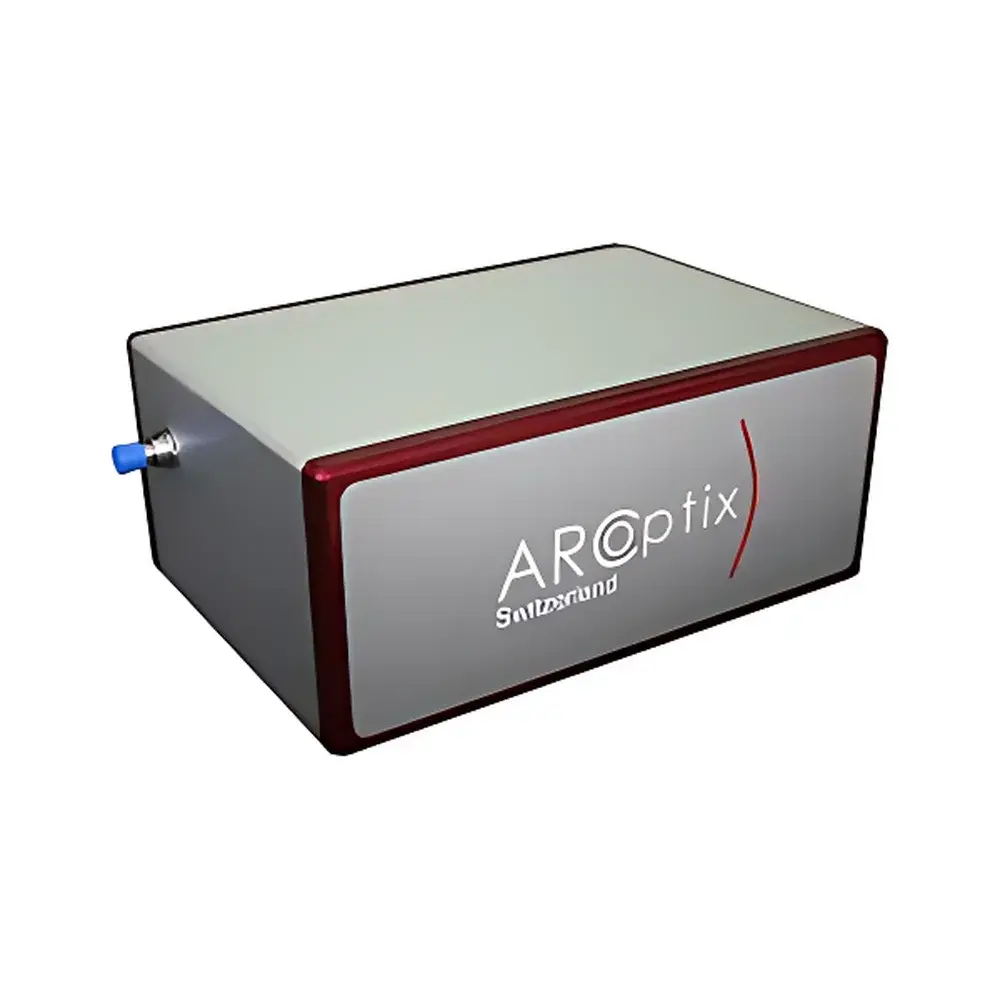
ARCoptix FT-NIR 0.9–2.6 Fourier Transform Near-Infrared Spectrometer
| Brand | ARCoptix |
|---|---|
| Origin | Switzerland |
| Model | FT-NIR 0.9–2.6 |
| Instrument Type | Laboratory FT-NIR Spectrometer |
| Spectral Range | 900–2600 nm (3800–11,000 cm⁻¹) |
| Resolution | 4 cm⁻¹ |
| SNR | >200,000:1 (at 4 cm⁻¹, 60 s acquisition) |
| Wavelength Stability | <10 ppm long-term repeatability |
| Baseline Intensity Drift | <2% over 10 h (1100–2500 nm) |
| Detector | Extended-range InGaAs PIN photodiode (thermoelectrically cooled option available) |
| Data Acquisition Rate | 1 spectrum/s (continuous mode) |
| Interface | USB 2.0 (Ethernet optional) |
| A/D | 24-bit |
| Power | 7.5–12 V DC, 1–6 W |
| Operating Temperature | 5–40 °C |
| Dimensions | 180 × 160 × 80 mm |
| Weight | 1.7 kg |
Overview
The ARCoptix FT-NIR 0.9–2.6 is a laboratory-grade Fourier Transform Near-Infrared spectrometer engineered for high-fidelity spectral acquisition in the 900–2600 nm range (3800–11,000 cm⁻¹). It operates on the principle of Michelson interferometry with a permanently aligned, dual-reflection interferometer core and a temperature-stabilized solid-state reference laser (795 nm), enabling exceptional wavelength accuracy and long-term spectral reproducibility. Unlike dispersive NIR systems, this FT-NIR instrument delivers inherent radiometric consistency, high optical throughput (Jacquinot advantage), and precise wavenumber calibration traceable to the internal laser reference—critical for quantitative analysis, method transfer, and regulatory-compliant workflows. Its compact footprint, fiber-coupled architecture (SMA 905 input, NA = 0.25, core diameter < 1 mm), and low power consumption make it suitable for integration into benchtop analytical stations, process monitoring setups, or portable QA/QC laboratories.
Key Features
- Permanently aligned Michelson interferometer with dual-mirror design—eliminates mechanical drift and eliminates need for periodic realignment
- Integrated temperature-stabilized 795 nm reference laser—ensures wavenumber accuracy better than 10 ppm and supports automatic zero-path-difference (ZPD) detection
- Extended-range InGaAs PIN detector with optional thermoelectric cooling—optimized for signal-to-noise performance across the full 0.9–2.6 µm range
- 24-bit analog-to-digital conversion and real-time apodization—enables high dynamic range and minimal quantization noise
- Baseline intensity stability <2% over 10 hours (1100–2500 nm)—validated under constant ambient conditions without active dark-current compensation
- High acquisition speed: 1 full interferogram per second in continuous mode, supporting rapid sample screening and kinetic measurements
- Robust mechanical housing (aluminum alloy) with passive thermal management—designed for stable operation in non-climate-controlled lab environments
Sample Compatibility & Compliance
The FT-NIR 0.9–2.6 accommodates diverse sampling modalities via standard SMA 905 fiber coupling, including diffuse reflectance probes (e.g., bifurcated or contact-type), transmission cells (quartz or CaF₂), and attenuated total reflectance (ATR) accessories. It is routinely deployed in pharmaceutical raw material identification (per USP <857>), agricultural grain moisture/protein analysis (AOAC 985.21, ISO 12099), polymer composition verification (ASTM D6262), and food authenticity screening (e.g., olive oil adulteration per EU Regulation No. 29/2012). The system’s deterministic wavenumber scale and intensity stability support compliance with GLP and GMP documentation requirements; raw interferogram data and processed spectra are timestamped and exportable in ASTM E131-compliant formats (.spa, .jdx). While the instrument itself does not include built-in 21 CFR Part 11 audit trail functionality, its API-enabled control architecture allows integration into validated LIMS or ELN platforms that enforce electronic signature and change-control protocols.
Software & Data Management
The spectrometer ships with Windows-compatible native software (XP through Windows 10) offering real-time interferogram visualization, Fourier transformation with selectable apodization functions (Happ-Genzel, Blackman-Harris), phase correction, and baseline flattening. A comprehensive DLL-based API enables programmatic control via Python, MATLAB, LabVIEW, or C#, facilitating automated measurement sequences, multivariate calibration deployment (PLS, PCR), and integration into industrial SCADA or PAT frameworks. All spectral data—including raw interferograms, single-beam, background-subtracted, and ratioed spectra—are stored with embedded metadata (acquisition time, resolution, scan count, detector temperature, laser status). Export options include CSV, ASCII, JCAMP-DX, and Omnic-compatible .spa files. No cloud storage or proprietary subscription services are required; data ownership remains fully local and auditable.
Applications
- Pharmaceutical: Quantitative assay of active pharmaceutical ingredients (APIs) in tablets, excipient uniformity testing, and blend homogeneity monitoring
- Agriculture & Food: Moisture, protein, oil, and starch content determination in cereals, legumes, and dairy powders
- Polymers & Plastics: Identification of copolymer ratios, additive concentration (e.g., plasticizers, flame retardants), and degradation state assessment
- Fuel & Lubricants: Determination of biodiesel blend ratio (B0–B100), cetane number estimation, and oxidation stability indicators
- Research & Development: Method development for NIR chemometrics, reference method correlation studies, and optical property characterization of novel materials
FAQ
What is the minimum fiber core diameter supported by the FT-NIR 0.9–2.6?
The instrument accepts fibers with core diameter < 1 mm and numerical aperture ≤ 0.25 via SMA 905 connector. Optimal coupling efficiency is achieved with 400–600 µm core fibers.
Is the detector actively cooled in the standard configuration?
No—the base model uses an uncooled extended-InGaAs PIN diode. A thermoelectrically cooled (TEC) detector option is available for applications requiring lower dark current and improved SNR at longer wavelengths (>2.2 µm).
Can this spectrometer be used for quantitative analysis under regulated environments?
Yes—its wavelength accuracy (<10 ppm), intensity stability (<2% over 10 h), and deterministic interferogram acquisition meet foundational requirements for validated NIR methods. Full compliance requires integration with qualified software, documented SOPs, and periodic performance qualification (PQ) per ICH Q2(R2).
Does the system support external triggering or synchronization with other instruments?
Yes—the USB interface provides TTL-compatible trigger input/output lines for synchronized acquisition with pumps, actuators, or complementary analytical modules (e.g., HPLC fraction collectors or Raman systems).
What calibration standards are recommended for routine verification?
NIST-traceable rare-earth oxide glass filters (e.g., Holmium Oxide, Didymium) and polystyrene film standards are recommended for wavelength verification. For intensity linearity, neutral density step wedges or calibrated integrating sphere sources may be employed.



