
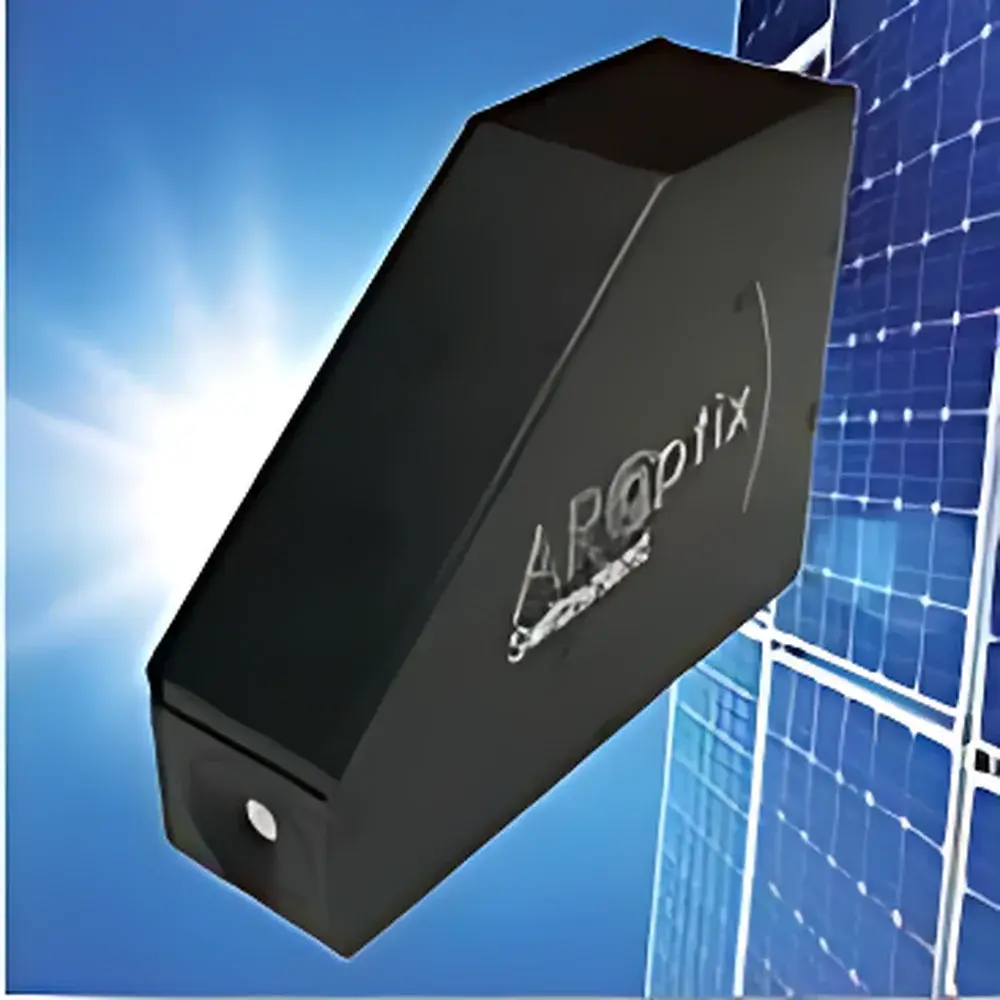
ARCoptix Solar Simulator Spectral Measurement System
| Brand | ARC |
|---|---|
| Origin | Switzerland |
| Manufacturer Type | Authorized Distributor |
| Import Status | Imported |
| Model | ARCoptix |
| Pricing | Upon Request |
| Spectral Range | 400–1100 nm |
| Spectral Resolution | <5 nm |
| Wavelength Accuracy | <0.5 nm |
| Wavelength Temperature Drift | <0.03 nm/°C |
| Stray Light Suppression | –27 dB (broadband), –35 dB (narrowband) |
| Radiometric Accuracy | <5% |
| Dynamic Range | 5000:1 |
| Integration Time | 0.1–2000 ms |
| Wavelength Repeatability | <0.2 nm |
| Field of View (Relative Radiometry) | 10° |
| Field of View (Absolute Radiometry) | 180° |
| Compliance | IEC 60904-9 (Ed. 2), JIS C 8912, ASTM E927, IEC 60904-3 AM1.5 G spectral classes (50 nm bins) |
| Programmable Trigger Delay | 0–2000 ms (0.1 ms resolution) |
Overview
The ARCoptix Solar Simulator Spectral Measurement System is a dual-channel, USB-powered portable spectrometer engineered for high-fidelity spectral characterization of both pulsed and continuous solar simulators. Based on optimized Czerny–Turner optical architecture with two high-efficiency holographic diffraction gratings, the system delivers stable, repeatable radiometric performance across the critical photovoltaic response band (400–1100 nm). Its core measurement principle relies on calibrated CCD-based spectral detection with real-time dark-current compensation and temperature-stabilized wavelength referencing—enabling traceable irradiance quantification under transient illumination conditions as short as 100 µs. Designed explicitly for compliance-driven photovoltaic testing environments, the instrument meets the stringent spectral match, temporal stability, and spatial uniformity requirements defined in IEC 60904-9 (Edition 2), ASTM E927, and JIS C 8912. Unlike conventional single-channel spectrometers, its synchronized dual-channel acquisition eliminates timing-induced spectral distortion during flash-type solar simulator evaluation, making it an essential tool for Class AAA solar simulator validation and module-level quantum efficiency mapping.
Key Features
- Dual-channel synchronized acquisition for artifact-free spectral capture of pulsed light sources (minimum pulse width: 100 µs)
- High-stability optical bench with thermally compensated grating mounts, ensuring wavelength drift <0.03 nm/°C
- Calibrated 2D back-illuminated CCD sensor with linear response (R² > 0.9999) over full dynamic range (5000:1)
- USB 3.0 bus-powered operation—no external power supply or cooling required
- Programmable hardware trigger with adjustable delay (0–2000 ms, 0.1 ms resolution) for precise synchronization with flash controllers or external DAQ systems
- Integrated cosine-corrected input optics supporting both relative (10° FOV) and absolute (180° Lambertian) radiometric configurations
- Factory-calibrated NIST-traceable irradiance scale with uncertainty <5% (k=2) across 400–1100 nm
Sample Compatibility & Compliance
The ARCoptix system is validated for use with all major solar simulator architectures—including xenon arc, LED-array, and hybrid broadband sources—as well as pulsed flash testers operating under IEC 60904-9 Class A, B, or C specifications. Its spectral data output conforms to IEC 60904-3 AM1.5G reference spectra binned at 50 nm intervals, enabling direct comparison against PV cell spectral response functions. The instrument’s radiometric calibration is performed per ISO/IEC 17025-accredited procedures, with documentation supporting GLP-compliant laboratory audits. All firmware and calibration files include embedded metadata compliant with ASTM E2919 for spectral data interchange. No sample preparation is required; measurements are conducted in situ using standardized mounting fixtures compatible with standard solar simulator test chambers.
Software & Data Management
The system ships with ARCoptix SpectraView Suite—a platform-independent application supporting Windows, macOS, and Linux. The software provides real-time spectral visualization, automated IEC 60904-9 spectral match classification (A/B/C), temporal intensity profiling, and batch export to CSV, HDF5, and ASTM E2919-compliant XML formats. All raw and processed datasets include embedded audit trails recording user identity, timestamp, calibration ID, integration time, and environmental temperature. For regulated environments, optional 21 CFR Part 11 compliance packages are available, including electronic signatures, role-based access control, and immutable audit logs. API support (Python, MATLAB, LabVIEW) enables integration into automated test sequences and MES/QMS platforms.
Applications
- Class AAA solar simulator validation per IEC 60904-9 Ed. 2
- Time-resolved spectral analysis of flash-type PV testers (e.g., for perovskite or tandem cell evaluation)
- In-line spectral monitoring of LED-based solar simulators in production environments
- Quantum efficiency (QE) and external quantum efficiency (EQE) measurement support
- Radiometric verification of AM1.5G spectral irradiance distribution in climate chambers
- Source stability assessment (short- and long-term) for accelerated aging studies
- Calibration transfer between reference and field-deployed spectroradiometers
FAQ
Is this spectrometer suitable for measuring ultra-short solar simulator flashes (<100 µs)?
No—the minimum measurable pulse width is 100 µs (0.1 ms), limited by CCD readout and onboard memory buffer constraints.
Can the system perform absolute irradiance measurements without external calibration?
Yes—each unit ships with factory-applied NIST-traceable irradiance calibration valid for 12 months; recalibration services are available through ARC-certified labs.
Does the software support automated pass/fail reporting per IEC 60904-9?
Yes—SpectraView Suite generates annotated reports showing spectral mismatch values (MM0, MM1, MM2) with visual overlays against AM1.5G reference bands.
What is the maximum recommended operating ambient temperature?
The spectrometer is rated for continuous operation between 15 °C and 35 °C; extended exposure above 35 °C may affect wavelength repeatability beyond spec.
Is the 180° absolute radiometry mode compatible with integrating sphere coupling?
Yes—the 180° cosine corrector is mechanically and optically designed to interface directly with industry-standard 2″, 4″, and 6″ integrating spheres via SMA905 or FC/PC adapters.




