
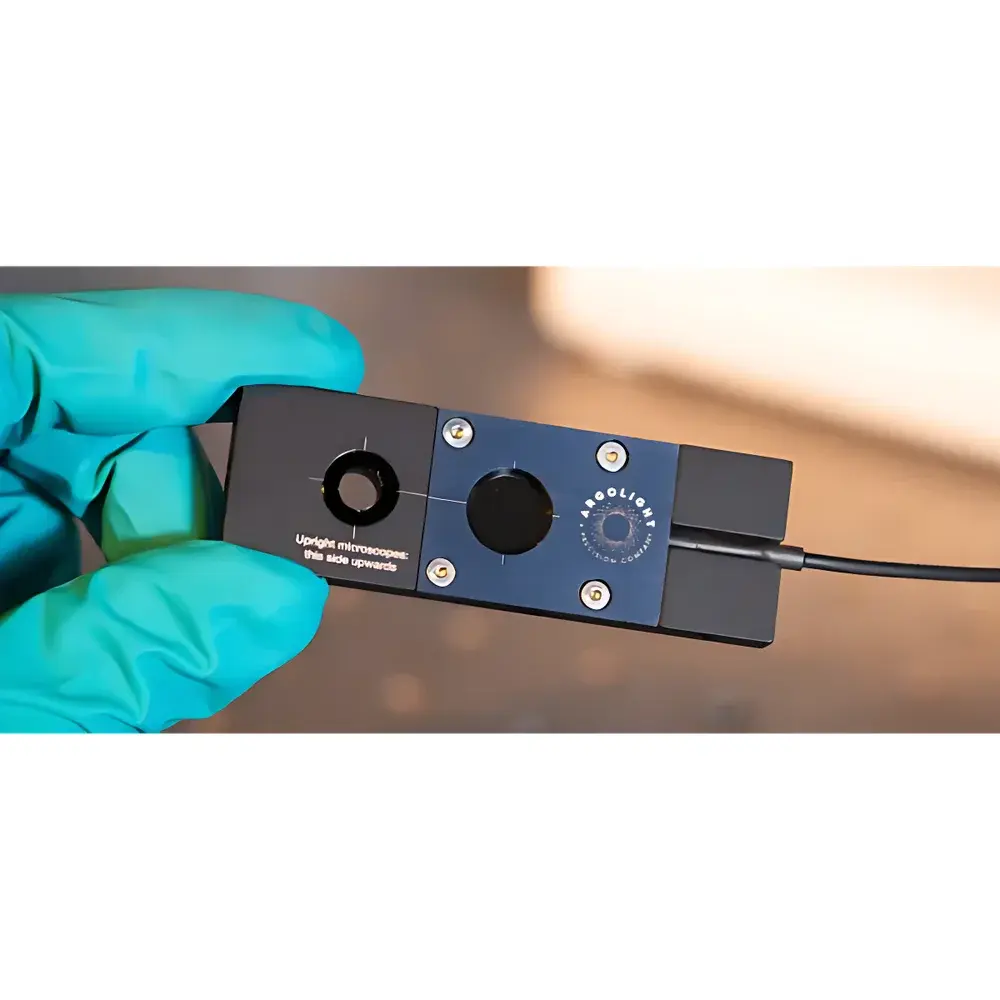
Argolight Fluorescence Calibration Slide for Widefield, Super-Resolution (SIM), and Confocal Microscopy
| Brand | Argolight |
|---|---|
| Origin | France |
| Substrate | Fused Silica with Embedded 3D Fluorescent Patterns |
| Dimensions (ArGo-PowerLM V2) | 75 × 25 × 6 mm |
| Excitation Range | 250–650 nm |
| Immersion Compatibility | Dry, Oil (unlimited) |
| Damage Threshold | 50 GW·cm⁻² (peak or average irradiance) |
| Power Range | 10 µW to 100 mW |
| Fluorescent Pattern Count | 5 (LM/HM/SIM variants: 5/16/27) |
| Software | Daybook v3.2 (Analysis & Data Manager modules) |
| Compliance | ISO 17025 traceable calibration protocols, compatible with GLP/GMP documentation workflows |
Overview
The Argolight Fluorescence Calibration Slide is an engineered metrology standard designed for quantitative performance validation of fluorescence microscopy systems. Unlike conventional fluorescent beads or stained biological samples—whose emission intensity, photostability, and spatial distribution vary unpredictably—the Argolight slide integrates permanent, sub-micrometer-precision fluorescent structures directly into high-purity fused silica via proprietary two-photon polymerization. These embedded 3D patterns emit stable, spectrally defined fluorescence across UV–visible wavelengths (250–650 nm excitation), enabling repeatable, instrument-independent assessment of optical performance. It is specifically validated for use in widefield epifluorescence, laser scanning confocal (LSCM), spinning disk confocal, and structured illumination microscopy (SIM)—including commercial platforms from Zeiss, Nikon, Leica, Olympus, and Thermo Fisher. The core measurement principles rely on spatially resolved intensity mapping, geometric distortion quantification, axial drift tracking during Z-stack acquisition, lateral registration accuracy evaluation, and field-of-view (FOV) uniformity profiling—all without requiring user-installed reference standards or empirical calibration curves.
Key Features
- Permanently embedded 3D fluorescent patterns with nanoscale positional fidelity and photobleaching resistance (>10⁶ frames under typical imaging conditions)
- Multiple configuration variants optimized for distinct modalities: Argo-PowerLM V2 (low-magnification widefield), Argo-PowerHM V2 (high-NA confocal), and Argo-PowerSIM V2 (structured illumination and algorithm-based super-resolution)
- Defined excitation bandwidth compatibility (250–650 nm) supporting DAPI, FITC, TRITC, Cy3, Cy5, and Alexa Fluor fluorophore channels
- Controlled immersion behavior: fully compatible with dry and oil-immersion objectives; water immersion permitted up to 20 minutes per session to prevent substrate hydration-induced refractive index mismatch
- Laser damage threshold certified at 50 GW·cm⁻² (peak or time-averaged irradiance), enabling safe use with pulsed and CW lasers across common microscope light sources
- Integrated traceability: each slide is serialized and supplied with a certificate referencing ISO/IEC 17025-accredited characterization data for pattern geometry, emission profile, and intensity homogeneity
Sample Compatibility & Compliance
The Argolight slide functions as a universal reference across fluorescence imaging platforms regardless of detector type (sCMOS, EMCCD, PMT, hybrid detectors) or illumination architecture (LED, mercury/xenon arc lamps, solid-state lasers). It meets the functional requirements of ASTM E2897-22 (Standard Practice for Characterizing Fluorescence Microscope Performance) and supports compliance with regulatory frameworks including FDA 21 CFR Part 11 (via Daybook audit-trail logging), ISO 13485 (for IVD-related imaging validation), and EU GMP Annex 11 (computerized system validation). All variants are manufactured in a cleanroom environment (ISO Class 5) and undergo 100% optical inspection prior to shipment. No biological material, dyes, or organic binders are used—eliminating batch-to-batch variability and eliminating the need for storage at -20°C or humidity-controlled environments.
Software & Data Management
Daybook software (v3.2, Windows/macOS/Linux) provides standardized, vendor-agnostic analysis of acquired calibration images. The “Log Analysis” module automatically detects embedded patterns—including grids, crosses, line pairs, and z-drift markers—and computes quantitative metrics: FOV intensity uniformity (per ISO 19038), lateral chromatic shift (in nm/pixel), geometric distortion (radial/tangential coefficients), axial repeatability (nm/stack), and signal-to-noise ratio (SNR) maps. The “Diary Data Manager” module stores metadata (date/time, microscope model, objective ID, laser power, exposure settings), generates PDF reports compliant with GLP audit requirements, and exports CSV/JSON datasets for integration into LIMS or ELN systems. All processing algorithms are deterministic and reproducible; no machine learning or black-box interpolation is applied.
Applications
- Routine daily QC of fluorescence microscope alignment, illumination homogeneity, and detector sensitivity stability
- Validation of Z-stack reconstruction accuracy and stage thermal drift compensation algorithms
- Quantitative comparison of system performance before/after maintenance, optical realignment, or detector replacement
- Multi-instrument harmonization across core facilities or multi-site clinical trials
- Supporting method validation for regulated applications such as digital pathology image analysis, single-cell phenotyping, and high-content screening assays
- Training resource for new users to visualize and interpret common imaging artifacts (e.g., vignetting, coma, field curvature)
FAQ
Can the Argolight slide be used with water-immersion objectives?
Yes, but continuous immersion must not exceed 20 minutes per session. Prolonged exposure may cause micro-fracture propagation in the fused silica substrate due to differential thermal expansion.
Is cleaning required between uses?
Yes. Wipe gently with lens tissue and >99.5% isopropanol only. Acetone, ethanol, or abrasive cleaners will degrade the anti-reflective coating and compromise pattern fidelity.
Why does the Argo-PowerSIM V2 contain 27 patterns?
The increased pattern density enables simultaneous evaluation of SIM-specific parameters: grating orientation fidelity, phase-shift consistency across multiple angles, and reconstruction artifact detection in Fourier-space domain outputs.
Does the slide require recalibration over time?
No. The embedded fluorophores are covalently bound within the glass matrix and exhibit negligible photodegradation under recommended irradiance limits—no scheduled recalibration is necessary.
Can Daybook software interface with third-party acquisition platforms?
Yes. Daybook accepts TIFF, ND2, CZI, and OME-TIFF formats with embedded metadata. Custom import plugins are available for Hamamatsu, Andor, and Photometrics camera SDKs upon request.




