
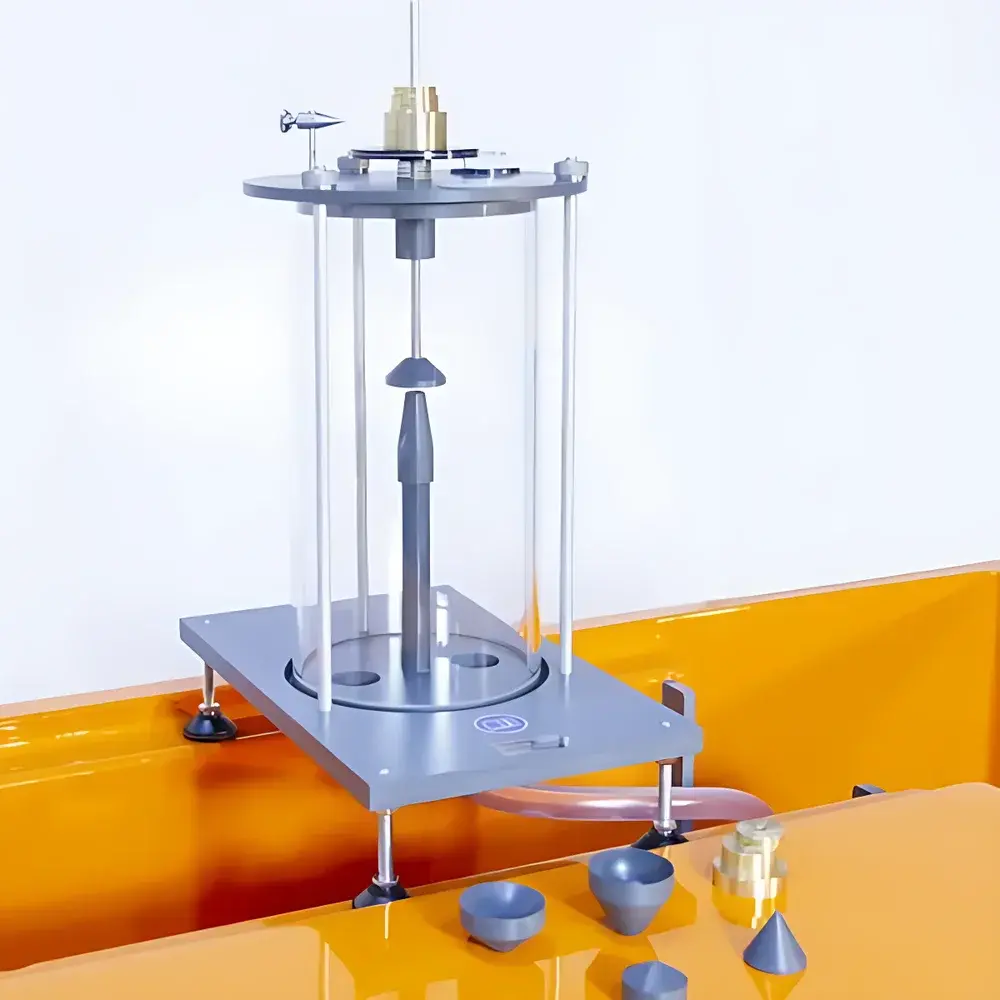
Armfield F1-16 Jet Impingement Apparatus
| Brand | Armfield |
|---|---|
| Origin | United Kingdom |
| Model | F1-16 |
| Construction | Cylindrical transparent acrylic enclosure |
| Target plates | 8 interchangeable |
| Force measurement method | Spring-balanced lever system with calibrated mass loading |
| Leveling capability | Integrated adjustable feet |
| Hydraulic interface | Quick-release coupling for hydraulics bench integration |
| Educational software | Optional companion software for data logging and theoretical comparison |
Overview
The Armfield F1-16 Jet Impingement Apparatus is a precision-engineered educational and research instrument designed to quantitatively investigate the momentum transfer principles associated with fluid jet impingement on solid surfaces. Operating on the fundamental conservation of linear momentum in steady, incompressible flow, the apparatus enables direct experimental validation of theoretical force predictions derived from the Reynolds transport theorem. A controlled vertical water jet—generated by a regulated supply from a hydraulics bench—is directed through a standardized nozzle onto a target plate mounted on a spring-balanced lever mechanism. The resulting impingement force is resolved statically via calibrated masses applied to a suspended weight pan, with equilibrium established when the lever’s reference mark aligns with an integrated spirit level. This mechanical null-balance methodology eliminates dynamic transients and ensures high reproducibility under undergraduate laboratory conditions.
Key Features
- Cylindrical transparent acrylic test chamber (diameter ≥ 200 mm, height ≥ 400 mm) enabling full visual observation of jet formation, impact zone, and splatter dynamics
- Eight interchangeable target geometries—including flat disc, hemispherical, conical, and angled plates—each precisely machined to ISO 2768-mK tolerances for consistent surface finish and dimensional repeatability
- Spring-compensated lever system with low-friction pivot bearing and calibrated counterbalance, minimizing hysteresis and static friction errors
- Integrated leveling feet with bubble level indicator ensuring gravitational alignment within ±0.1° over full operational range
- Standardized quick-release hydraulic coupling compliant with Armfield F1 series bench interfaces (BSPP 1/4″ thread)
- Nozzle assembly featuring removable orifice inserts (0.5 mm, 1.0 mm, 1.5 mm nominal diameters) for systematic variation of jet velocity and Reynolds number
Sample Compatibility & Compliance
The F1-16 is compatible with standard laboratory-grade deionized or tap water supplies operating at pressures between 50–300 kPa. All wetted components—including nozzle, target plates, and lever shaft—are constructed from corrosion-resistant stainless steel (AISI 304) or anodized aluminum, ensuring long-term dimensional stability per ASTM G151 accelerated aging protocols. The apparatus conforms to EN 61000-6-3 (EMC emissions) and EN 61000-6-2 (immunity) for educational instrumentation. While not certified for industrial process control, its mechanical design supports GLP-aligned experimental documentation when used with traceable mass standards (Class M2 or better, per OIML R111) and calibrated hydraulics benches meeting ISO/IEC 17025 metrological requirements.
Software & Data Management
An optional Windows-based educational software package is available for real-time data acquisition, theoretical force calculation (based on jet velocity, density, and target geometry), and comparative error analysis. The software logs timestamped mass loadings, calculates percentage deviation from ideal momentum theory, and exports CSV-formatted datasets for post-processing in MATLAB or Python. Audit trail functionality records operator ID, session start/stop time, calibration date, and version-controlled parameter inputs—supporting pedagogical compliance with UK QAA Benchmark Statements for Engineering programs and facilitating Part 11–ready configuration when deployed in validated teaching labs.
Applications
- Verification of momentum equation for normal and oblique jet impingement on stationary targets
- Quantitative study of force dependence on jet velocity, nozzle diameter, and fluid density
- Comparison of theoretical vs. empirical coefficients of momentum transfer for curved and angled surfaces
- Investigation of boundary layer separation effects and pressure distribution asymmetry on non-planar targets
- Calibration exercises for introductory fluid mechanics laboratories (e.g., ME201, CE320-level courses)
- Foundation experiments for advanced topics including hydraulic machinery efficiency, turbine blade loading, and aerodynamic force modeling
FAQ
What jet velocities can be achieved with the F1-16?
Jet velocity is determined by supply pressure and nozzle orifice size; typical range spans 1.5–8.0 m/s using standard hydraulics benches (e.g., Armfield F1-10 or F1-20).
Is the apparatus suitable for use with fluids other than water?
Yes—provided viscosity remains below 10 mPa·s and density is known; glycerol-water mixtures up to 30% v/v have been validated in academic studies.
How is zero-force calibration performed?
With no jet flow, adjust the counterbalance spring until the lever reference mark aligns with the spirit level; confirm repeatability across three independent null checks.
Are replacement nozzles and target plates available as spares?
Yes—Armfield part numbers F1-16-NZ-05, F1-16-NZ-10, F1-16-NZ-15 (nozzles) and F1-16-TGT-FLAT, F1-16-TGT-HEMI, etc. (targets) are stocked globally.
Does the optional software support automated curve-fitting against theoretical models?
Yes—the software includes built-in regression tools for fitting measured force vs. V² data and exporting residuals plots per ISO 5725-2 precision guidelines.





