
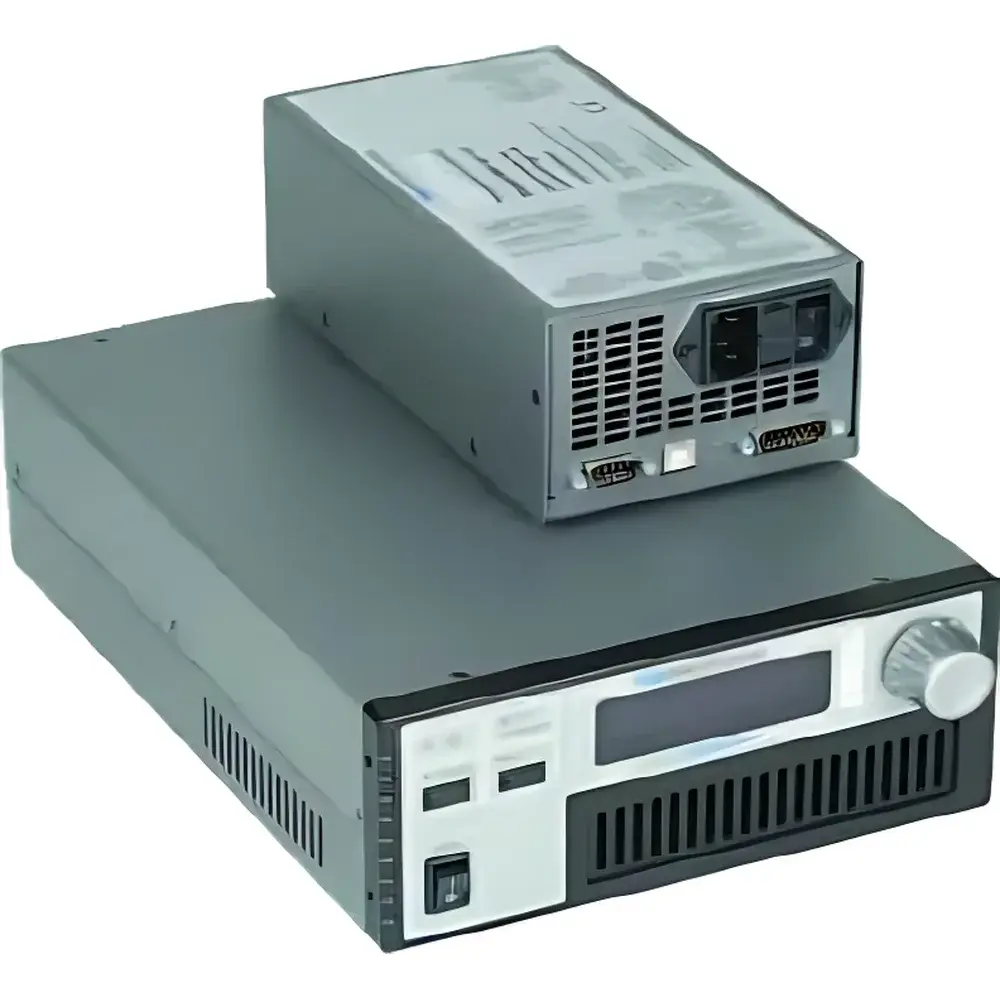
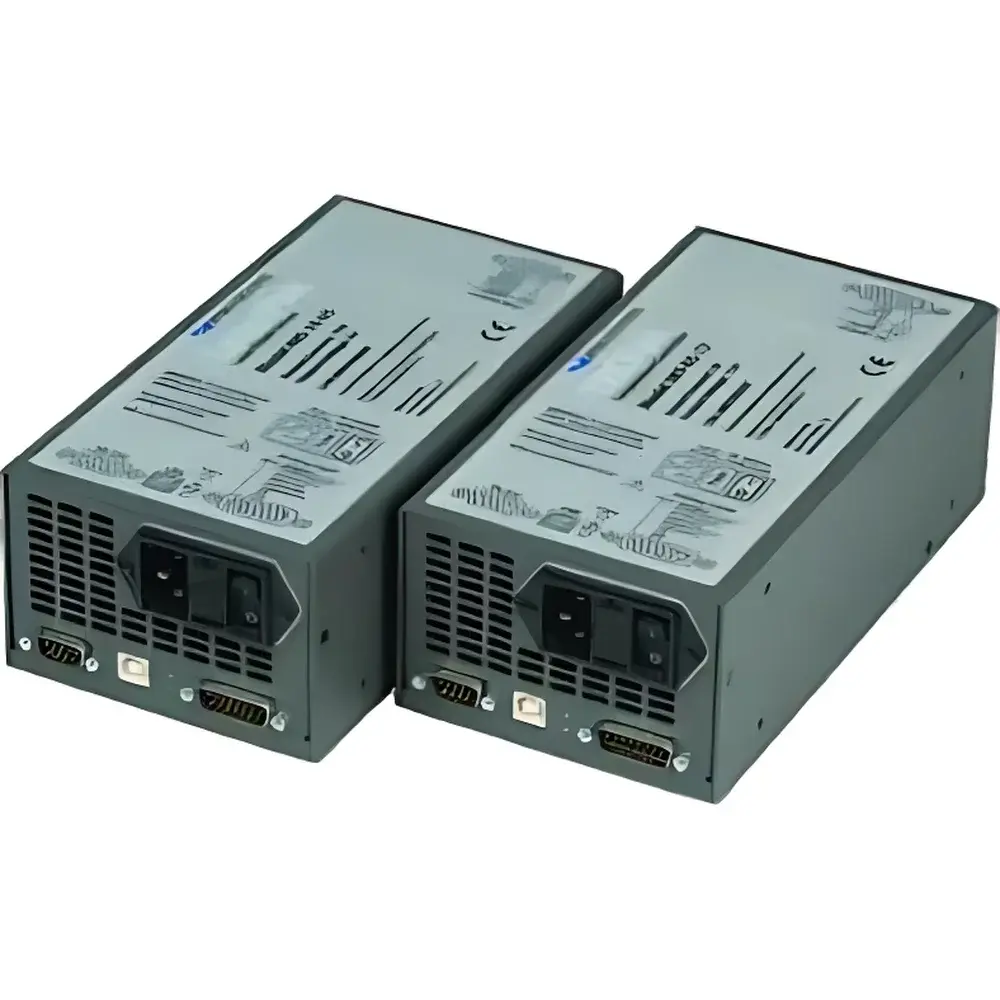
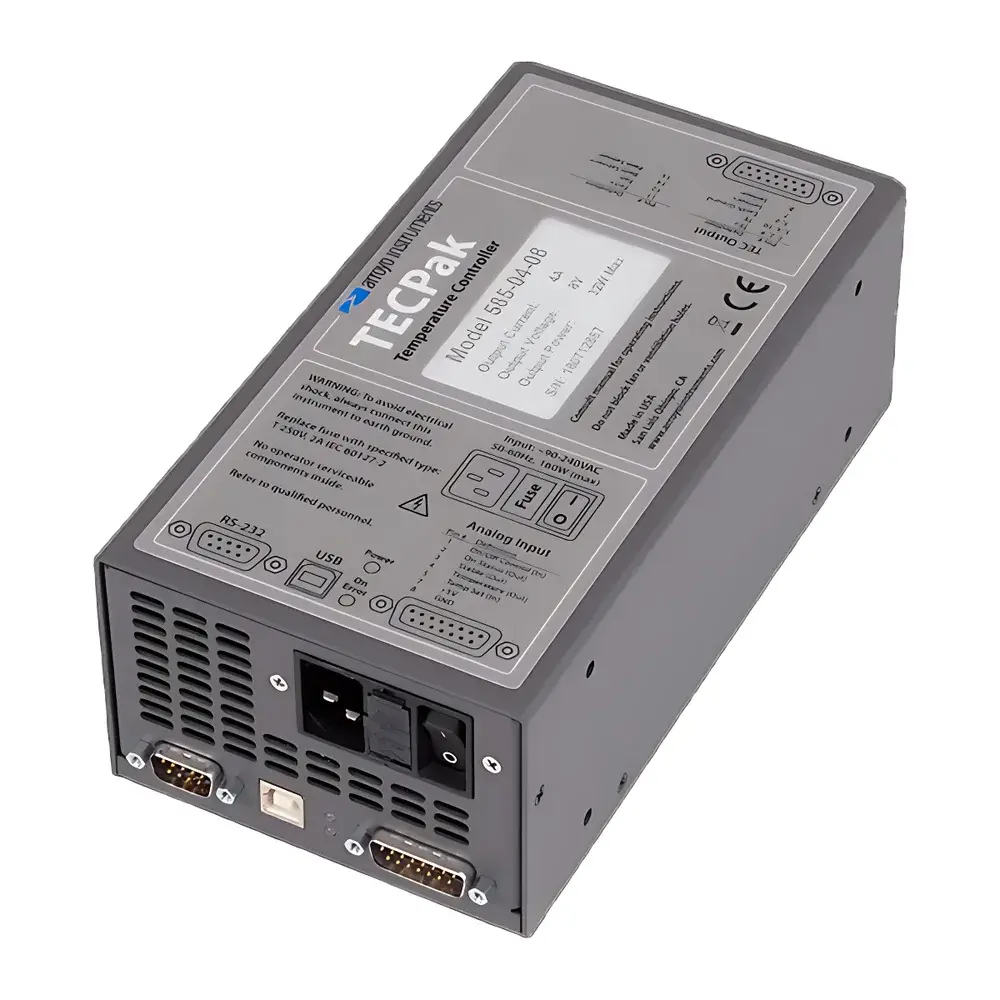
Arroyo Instruments 485 Series OEM Laser Diode Current Source and Temperature Controller for Optical Metrology
| Brand | Arroyo Instruments |
|---|---|
| Origin | USA |
| Model | 485 Series |
| Output Current Range | up to 10 A |
| Output Voltage Range | up to 15 V |
| Current Accuracy | 0.05% + offset (e.g., 0.4–1.6 mA) |
| Current Noise | < 60 µA RMS |
| Bandwidth | 45–65 kHz |
| Temperature Stability | ±0.004°C |
| Compatible Sensors | Thermistor, RTD |
| Control Interfaces | USB, RS-232, Analog (0–5 V or 0–10 V) |
| Power Output (TECPak) | 32 W / 55 W |
| Form Factor | Compact OEM module (≈1/3 volume of benchtop equivalents) |
Overview
The Arroyo Instruments 485 Series represents a purpose-engineered family of OEM-grade laser diode current sources and thermoelectric temperature controllers designed specifically for integration into optical measurement systems requiring high stability, low noise, and deterministic control. Unlike general-purpose laboratory power supplies, the 485 Series implements precision analog feedback architectures optimized for driving semiconductor lasers and stabilizing thermistor- or RTD-sensed TEC modules under dynamic optical metrology conditions — including interferometry, spectroscopic calibration, cavity ring-down detection, and fiber-optic sensor interrogation. Each unit operates on a closed-loop principle: the current source regulates output via real-time voltage-sense feedback across a low-thermal-EMF shunt, while the temperature controller employs PID algorithms with adaptive gain scheduling to maintain sub-millikelvin thermal setpoint fidelity over wide ambient fluctuations. The series is engineered for continuous-duty operation in embedded environments where EMI resilience, thermal drift suppression, and long-term repeatability are non-negotiable.
Key Features
- Modular OEM architecture: DIN-rail mountable, conduction-cooled chassis with standardized 0.1″ pitch header interfaces for seamless PCB-level integration.
- Ultra-low current noise floor: <60 µA RMS (485-02-15) enables high-fidelity laser intensity modulation without introducing photodetector-limited baseline artifacts.
- Dual-interface control: Native USB 2.0 and RS-232 for host-based configuration; optional analog voltage input (0–5 V or 0–10 V) supports standalone operation in PLC- or FPGA-driven systems without host CPU dependency.
- Hardware-enforced safety: Integrated over-current, over-voltage, over-temperature, and open-load detection with automatic foldback and latching fault reporting via digital status lines.
- Thermal controller co-location: TECPak models (585/685) share identical mechanical footprint and mounting holes with corresponding LaserPak current sources, enabling matched thermal–optical actuation pairs within minimal board space.
- Calibration traceability: Factory-calibrated per NIST-traceable procedures; full calibration reports available upon request for ISO/IEC 17025-compliant system validation.
Sample Compatibility & Compliance
The 485 Series supports direct drive of single-mode and multi-mode laser diodes (FP, DFB, VCSEL), quantum cascade lasers (QCLs), and superluminescent LEDs (SLEDs) across visible to mid-IR bands. Its low-noise, high-bandwidth design ensures compatibility with wavelength-scanned applications governed by ASTM E2912 (Standard Practice for Calibration of Tunable Diode Laser Spectrometers) and IEC 61290-3-1 (Optical Amplifiers – Test Methods). All units comply with FCC Part 15 Class B and CE EMC Directive 2014/30/EU for industrial environments. For regulated optical instrumentation used in clinical or pharmaceutical settings, firmware supports audit trail logging and user-access-level configuration locking aligned with FDA 21 CFR Part 11 requirements when deployed with validated host software.
Software & Data Management
Arroyo provides the cross-platform LaserStudio SDK (Windows/macOS/Linux), delivering native C/C++, Python, LabVIEW, and MATLAB APIs for deterministic command sequencing and real-time parameter streaming. The SDK includes built-in support for synchronized current–temperature ramp profiles, trigger-based acquisition gating (TTL input/output), and binary data logging at up to 10 kHz sample rate. Configuration files are stored in human-readable JSON format with cryptographic checksums to prevent unauthorized modification. Firmware updates are performed via signed .bin packages verified using ECDSA-256 signatures, ensuring supply-chain integrity during field deployment.
Applications
- Embedded optical coherence tomography (OCT) light sources requiring precise k-clock synchronization and jitter-free current sweeps.
- Portable Raman spectrometers where battery-powered operation demands high efficiency (<85% typical conversion) and minimal standby current drain.
- Atomic vapor cell stabilization systems demanding simultaneous sub-10 mK temperature hold and <100 kHz current modulation for Doppler-free spectroscopy.
- Free-space optical communication terminals requiring radiation-hardened current drivers for space-qualified laser transceivers.
- Quantum optics testbeds integrating multiple laser diodes with shared thermal management and interlocked safety interlocks.
FAQ
Can the 485 Series be operated without a computer?
Yes — all models support analog voltage control (0–5 V or 0–10 V) for current setpoint and temperature setpoint, enabling fully autonomous operation in PLC-, microcontroller-, or FPGA-based systems.
Is remote firmware update supported over USB or RS-232?
Yes — firmware updates are performed via the LaserStudio SDK using authenticated, signed binaries; no bootloader access is exposed over serial interfaces for security compliance.
What sensor types are supported by the TECPak temperature controllers?
Thermistors (10 kΩ, 100 kΩ) and platinum RTDs (PT100, PT1000) with configurable excitation current and linearization coefficients per IEC 60751.
Do the units meet MIL-STD-810G environmental specifications?
While not formally certified, the 485 Series has been independently tested to operate continuously at 55°C ambient with 95% RH non-condensing and withstand 5 g RMS vibration (10–2000 Hz), consistent with Class 3B industrial equipment per IEC 60601-1 Annex BB.
Is there a version with Ethernet or CAN bus interface?
Not natively — however, Arroyo offers custom interface modules (sold separately) for EtherCAT, Modbus TCP, and CANopen protocol translation under NDA for volume OEM programs.



