
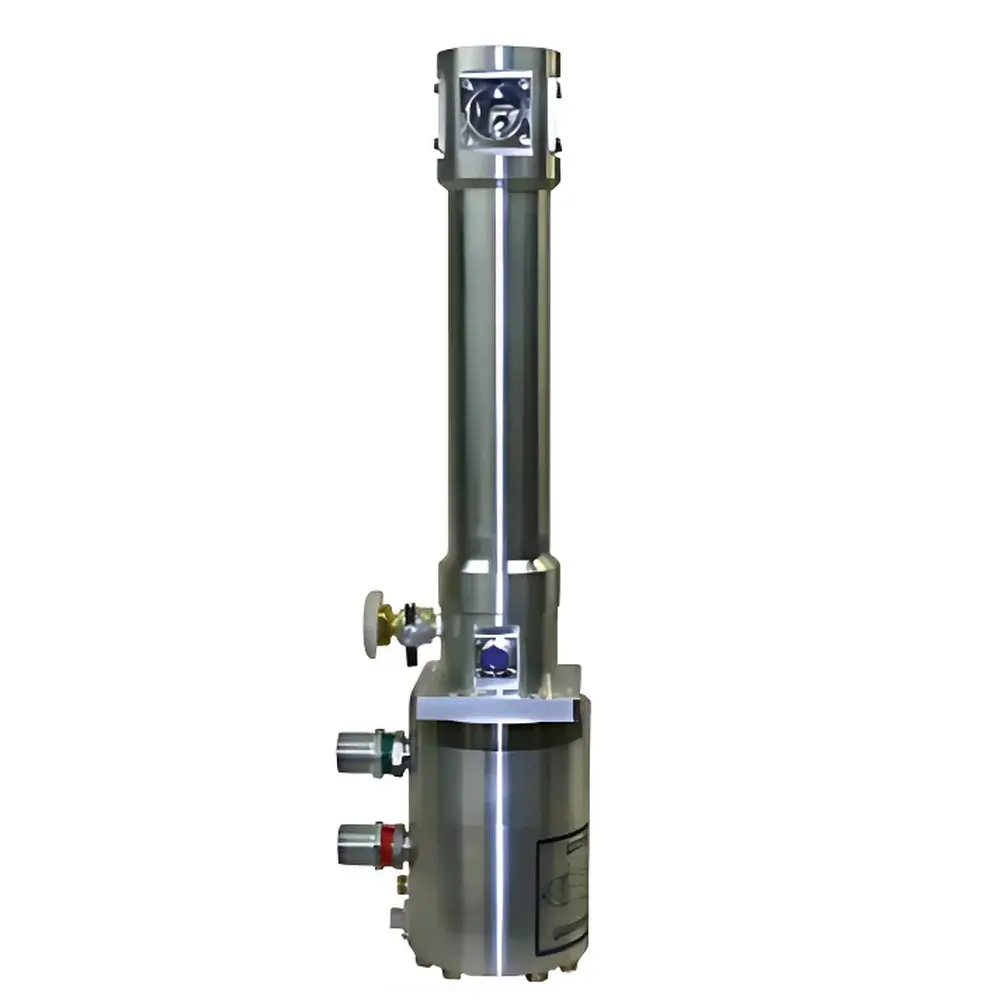
ARS X-1AL-4 Standard Optical Cryogenic Closed-Cycle Refrigerator
| Brand | ARS |
|---|---|
| Origin | USA |
| Model | X-1AL-4 |
| Type | Vertical |
| Cooling Method | Helium-Free Closed-Cycle Refrigeration |
| Base Temperature | ≤ 4 K (typical) |
| Optical Access | Dual Side Ports + Top Window |
| Vibration Isolation | Engineered for Ultra-Low-Vibration Operation |
| Mounting Configuration | Optical Table Compatible |
Overview
The ARS X-1AL-4 Standard Optical Cryogenic Closed-Cycle Refrigerator is a vertically oriented, helium-free cryogenic thermostat engineered for precision low-temperature optical experiments requiring stable, vibration-sensitive environments. Utilizing a two-stage Gifford-McMahon (GM) closed-cycle refrigeration system, the X-1AL-4 achieves base temperatures of ≤ 4 K without liquid cryogens—eliminating operational dependency on liquid helium refills, associated handling hazards, and supply-chain volatility. Its optical design features three high-transmission access points: two lateral ports with interchangeable flanges (CF-63 or KF-50 compatible) and a top-mounted quartz window (UV-VIS-NIR broadband transmission), enabling simultaneous excitation and detection pathways typical in photoluminescence, magneto-optical Kerr effect (MOKE), and time-resolved spectroscopy setups. The unit integrates seamlessly with commercial optical platforms—including confocal microscopes, FTIR spectrometers, and quantum optics benches—via standard kinematic mounting interfaces and vacuum-compatible feedthroughs for electrical, fiber-optic, and signal cabling.
Key Features
- Helium-free operation: Eliminates reliance on liquid cryogens while maintaining thermal stability < ±10 mK over 24 h at 4.2 K
- Optimized mechanical architecture: Monolithic cold-head support structure and passive damping reduce conductive and airborne vibrations to < 50 nm RMS (1–100 Hz band), critical for interferometric and single-photon detection applications
- Modular optical interface: Standard CF-63 side ports accept viewports, lens tubes, or custom optical mounts; top quartz window supports >90% transmission from 200 nm to 2.5 µm
- Integrated temperature control: Dual-sensor PID regulation (Cernox® CX-1050 and RuO₂) with programmable ramp rates (0.1–5 K/min) and hold accuracy of ±5 mK
- Vacuum compatibility: All-metal sealed chamber rated to 1×10⁻⁷ Torr base pressure; includes turbo-molecular pump port and leak-tested stainless-steel body
- Electrical and signal integration: 24-pin hermetic feedthrough (optional fiber-optic or SMA variants) supports DC biasing, lock-in detection, and real-time sensor feedback loops
Sample Compatibility & Compliance
The X-1AL-4 accommodates samples up to Ø76 mm × 25 mm height within its central cold finger cavity, with customizable sample holders (e.g., copper heat-sink stages, magnetic field inserts up to 9 T via optional split-pair magnets). It complies with international safety and electromagnetic compatibility standards including UL 61010-1, IEC 61326-1 (EMC), and RoHS 2015/863/EU. For regulated research environments—such as those governed by GLP or ISO/IEC 17025—the system supports audit-ready documentation packages, including factory calibration certificates traceable to NIST standards and full thermal performance validation reports (including cooldown curves, hold stability, and thermal gradient mapping across the cold stage).
Software & Data Management
Control is managed via ARS’s CryoCommand™ software (Windows-based), which provides synchronized monitoring of refrigeration stage temperatures, compressor status, vacuum level, and user-defined setpoints. The software exports timestamped data in CSV and HDF5 formats, supports scripting via Python API (pyARS), and enables integration with LabVIEW and MATLAB through TCP/IP or shared memory protocols. Audit trail functionality logs all parameter changes, operator IDs, and system events—meeting FDA 21 CFR Part 11 requirements for electronic records when deployed in pharmaceutical or materials qualification workflows. Remote diagnostics and firmware updates are supported over secure HTTPS connections.
Applications
- Low-temperature photoluminescence (PL) and cathodoluminescence (CL) spectroscopy of 2D materials (e.g., TMDCs, hBN) and quantum dots
- Time-resolved fluorescence lifetime measurements using TCSPC systems (e.g., PicoQuant HydraHarp, Becker & Hickl SPC-150)
- Magneto-optical characterization under variable temperature and magnetic field (with optional superconducting magnet integration)
- Cryogenic Raman spectroscopy of phonon modes in superconductors and topological insulators
- Quantum device testing: Characterization of superconducting qubits, single-photon detectors (SNSPDs), and spin-photon interfaces
- In situ cryo-electron microscopy sample pre-cooling and thermal stabilization
FAQ
What is the minimum base temperature achievable with the X-1AL-4 under standard operating conditions?
Typical base temperature is ≤ 4.0 K at zero thermal load; with 1 W static heat load applied to the cold stage, the stabilized temperature is ≤ 4.5 K.
Can the X-1AL-4 be integrated with third-party optical spectrometers or laser systems?
Yes—standardized flange dimensions, vacuum feedthrough options, and documented communication protocols ensure compatibility with major OEM platforms including Horiba, Ocean Insight, Toptica, and Coherent.
Is remote operation and monitoring supported?
Yes—CryoCommand™ enables full bidirectional control and real-time telemetry via Ethernet; optional VPN-configurable security settings meet institutional IT policies.
Does ARS provide installation, commissioning, and training services?
ARS-certified field engineers perform on-site installation, vacuum integrity verification, thermal performance validation, and hands-on operator training aligned with ISO/IEC 17025 competency frameworks.
How often does preventive maintenance require scheduled downtime?
Compressor oil and filter replacement is recommended every 12 months or 8,000 operating hours; no cold-head servicing is required within the first 20,000 hours of operation per manufacturer specifications.



