
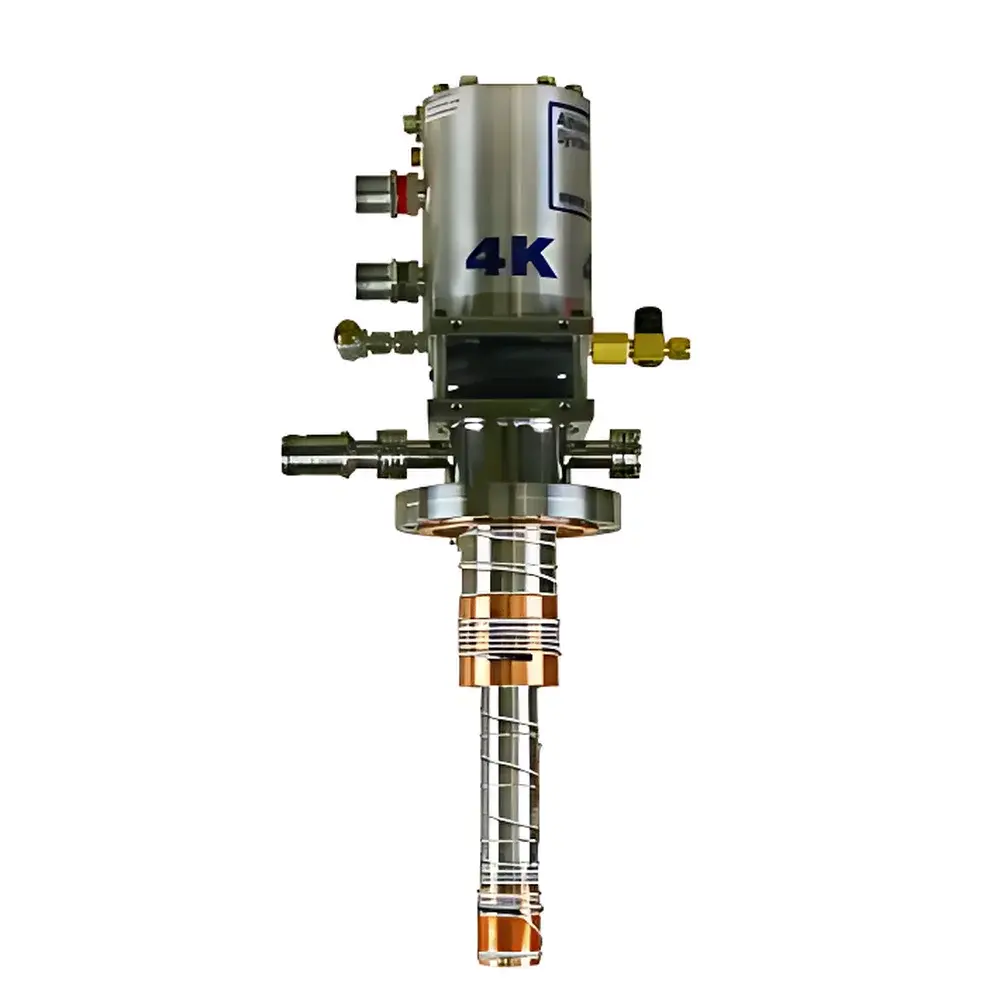
ARS X-20B UHV Ultra-Low-Vibration Cryogenic Closed-Cycle Refrigerator
| Brand | ARS |
|---|---|
| Origin | USA |
| Model | X-20B UHV-1 |
| Type | Vertical |
| Vacuum Performance | ≤1×10⁻¹¹ Torr |
| Vibration Amplitude | 3–5 nm (RMS, at sample stage) |
| Temperature Range | 3.5 K to 800 K (continuous, helium-exchange cooled) |
| Cooling Method | Helium-gas exchange (cryocooler-driven, helium-free operation) |
| UHV Compatibility | All-metal seals, welded CF flanges, bakeable to 200 °C |
| Sample Access | Open architecture, downward-facing cold head |
| Customization | Available for STM/SEM/AFM/SPM integration |
Overview
The ARS X-20B UHV is a vertically oriented, helium-free closed-cycle cryogenic refrigerator engineered exclusively for ultra-high-vacuum (UHV) surface science applications requiring atomic-scale mechanical stability. Unlike conventional liquid-helium-based cryostats, the X-20B employs a high-efficiency helium-gas exchange thermal transfer system coupled with a two-stage pulse tube cryocooler—eliminating dependency on liquid cryogens while maintaining continuous, programmable temperature control from 3.5 K to 800 K. Its operational principle relies on conductive and convective heat exchange via high-purity helium gas circulated between the cold head and sample stage, enabling precise thermal equilibration without introducing mechanical perturbations typical of direct cold-head coupling. Designed as the only commercially available UHV-compatible cryostat qualified for scanning tunneling microscopy (STM), it meets the stringent vibration and vacuum requirements of sub-angstrom-resolution imaging and spectroscopy in surface physics, quantum materials research, and nanoscale device characterization.
Key Features
- Ultra-low vibration performance: 3–5 nm RMS displacement at the sample position—validated under operational UHV conditions and critical for STM, AFM, and SPM stability.
- True UHV architecture: All-welded stainless-steel construction with metal gasket (ConFlat®) seals; no elastomeric O-rings; base pressure ≤1×10⁻¹¹ Torr after 200 °C in-situ bakeout.
- Cryocooler-integrated cold head: Removable without breaking vacuum—enabling routine maintenance, detector replacement, or system reconfiguration without venting.
- Open-sample geometry: Downward-facing cold head provides unobstructed optical, electrical, and probe access; compatible with multi-probe UHV chambers and in situ deposition systems.
- Helium-exchange cooling: Eliminates liquid helium handling, boil-off losses, and supply-chain constraints—reducing operational overhead and enhancing experimental reproducibility across long-duration measurements.
- Full temperature programmability: Linear ramp rates from 0.01 K/min to 10 K/min; PID-controlled stability ±5 mK over 24 h at any setpoint within 3.5–800 K range.
Sample Compatibility & Compliance
The X-20B supports standard UHV-compatible sample holders (e.g., Ta, Mo, or Cu stages with low-outgassing coatings) and integrates seamlessly with commercial and custom-built STM, SEM, and AFM platforms. Its mechanical design conforms to ISO 8573-1 Class 0 compressed gas purity standards for helium supply lines and complies with ASTM E1596-22 (Standard Practice for Vacuum System Integrity Testing). The system meets essential requirements for GLP-compliant surface analysis workflows, including audit-trail-capable temperature logging and vacuum history recording when paired with ARS’s optional data acquisition module. All wetted materials are vacuum-baked per NASA-STD-6012B specifications, ensuring minimal hydrocarbon and water vapor outgassing during extended operation.
Software & Data Management
Control is managed via ARS’s CryoCommand™ v4.2 software suite—a Windows-based application supporting local touchscreen operation and remote Ethernet interface (TCP/IP). The software provides synchronized logging of temperature (Pt-100 and Cernox® sensors), pressure (Bayard-Alpert and capacitance manometers), cryocooler status (phase angle, compressor current, cold-head temperature), and user-defined analog inputs (e.g., lock-in amplifier outputs). Data export adheres to HDF5 format with embedded metadata (timestamp, sensor calibration IDs, vacuum history), ensuring compatibility with Python-based analysis pipelines (NumPy, SciPy, PyVista) and MATLAB. Optional FDA 21 CFR Part 11 compliance package includes electronic signatures, role-based access control, and immutable audit trails for regulated environments.
Applications
- Atomic-resolution STM imaging and spectroscopy of topological insulators, 2D materials (e.g., graphene, TMDs), and correlated electron systems under variable-temperature UHV conditions.
- In situ low-temperature surface reaction studies using combined thermal desorption spectroscopy (TDS) and Auger electron spectroscopy (AES).
- Quantum transport measurements in mesoscopic devices, requiring sub-10 nm mechanical isolation and milli-Kelvin thermal stability.
- Low-vibration cryogenic alignment of fiber-coupled photonic probes and superconducting nanowire single-photon detectors (SNSPDs).
- Surface diffusion kinetics and defect dynamics studies via time-resolved LEED or microchannel plate-based electron detection.
FAQ
Is the X-20B compatible with existing UHV chambers equipped with standard CF-150 or CF-200 flanges?
Yes—the cold head mounts directly to CF-150 or CF-200 ports using ARS-supplied kinematic alignment fixtures and UHV-rated bellows-compensated thermal links.
Can the system achieve <3.5 K with optional modifications?
No—3.5 K is the certified base temperature under standard helium-exchange configuration; lower temperatures require integration of a dilution refrigerator insert, which is not supported by the X-20B platform.
What is the maximum allowable magnetic field for operation near superconducting magnets?
The X-20B is rated for static fields up to 0.5 T; operation above this requires magnetic shielding upgrades and prior consultation with ARS engineering.
Does the system support automated temperature sweeps synchronized with external measurement hardware?
Yes—via TTL-triggered start/stop signals and real-time analog voltage output (0–10 V) proportional to setpoint temperature, fully integrated into common DAQ systems (e.g., National Instruments PXI, Keysight DAQ970A).
How often does the cryocooler require preventive maintenance?
Compressor oil and filter replacement is recommended every 20,000 operating hours; full service interval is 40,000 hours—documented in the included maintenance logbook compliant with ISO 55001 asset management guidelines.



