
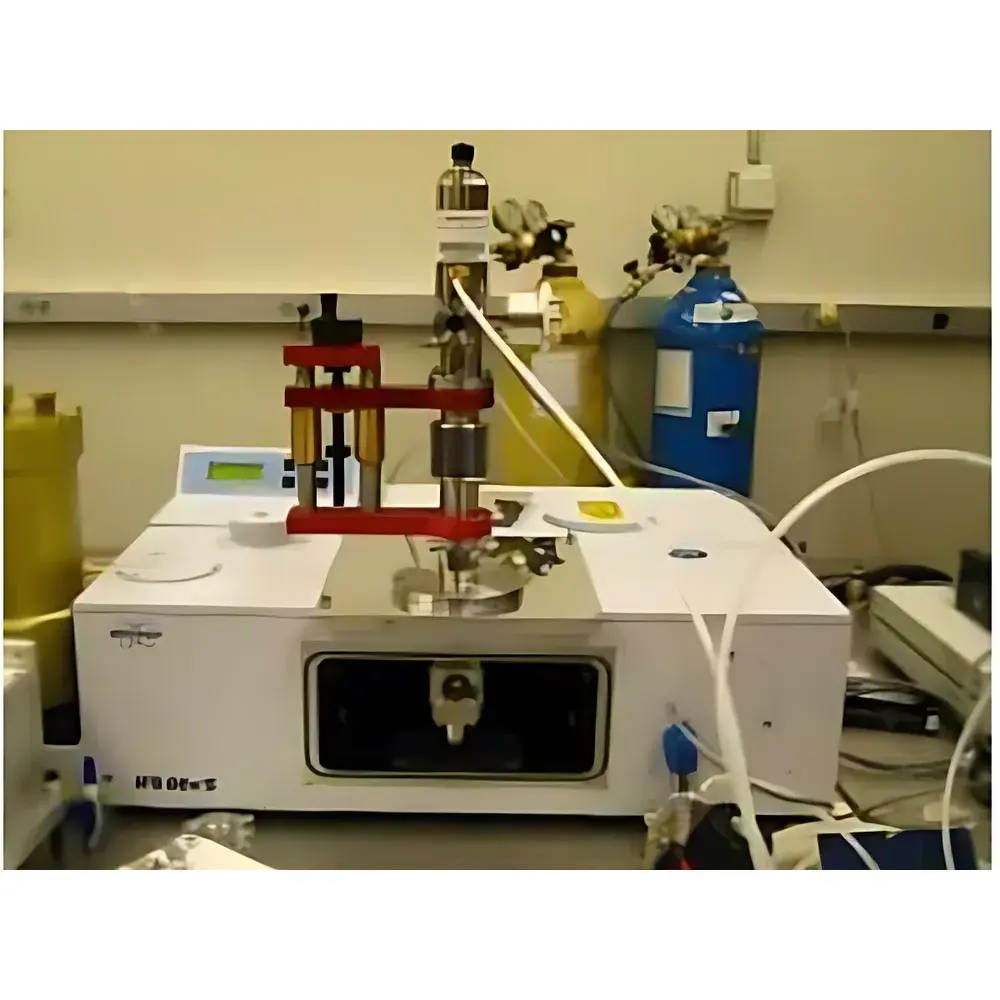
ARS LT4-FTIR Liquid Helium Continuous Flow Cryogenic Thermostat
| Brand | ARS |
|---|---|
| Origin | USA |
| Model | LT4-FTIR |
| Operating Temperature Range | 4.2 K (liquid helium) to 77 K (liquid nitrogen) |
| Optical Access | Dual high-purity quartz windows, 1.25″ clear aperture, F/1 field of view |
| Cooling Medium | Compatible with both liquid helium and liquid nitrogen |
| Helium Consumption | 0.75 L/hr at 4.2 K |
| Construction | Aluminum cold stage, aluminum radiation shield, aluminum vacuum housing (DMX-1AL) |
| Temperature Sensing | Two calibrated silicon diode thermometers (±0.5 K accuracy), one mounted on cold stage, one on sample holder with 4-ft lead |
| Electrical Interface | Hermetic 10-pin feedthrough, four test leads, integrated 36 Ω foil heater |
| Sample Mounting | Flat optical sample stage |
| Compliance | Designed for integration into FTIR, Raman, photoluminescence, and magneto-optical spectroscopy systems per ISO/IEC 17025-aligned laboratory practice |
Overview
The ARS LT4-FTIR is a purpose-engineered continuous-flow cryogenic thermostat optimized for Fourier Transform Infrared (FTIR) spectroscopy and complementary low-temperature optical characterization techniques. Based on the proven Couette-flow-cooled cold finger architecture, it delivers stable, vibration-minimized thermal environments from 4.2 K (liquid helium operation) up to 77 K (liquid nitrogen mode), enabling high-resolution spectral acquisition across mid-IR to far-IR bands without condensation or thermal drift artifacts. Its modular aluminum construction—comprising a LT4 cold stage, DMX-1AL aluminum vacuum housing, and dual high-transmission fused silica windows—ensures mechanical rigidity, low thermal mass, and minimal infrared absorption. The system integrates seamlessly into commercial FTIR spectrometers (e.g., Bruker VERTEX, Thermo Nicolet iS50) via standard flange interfaces and supports both transmission and reflection geometries under high-vacuum or controlled-atmosphere conditions.
Key Features
- Continuous-flow cooling with dual-cryogen compatibility: stable operation at 4.2 K using liquid helium (0.75 L/hr consumption) or at 77 K using liquid nitrogen
- Optimized optical path: two 1.25-inch diameter high-purity fused silica windows with >90% transmission from 0.2–5.5 µm; F/1 numerical aperture enables maximum light throughput for weak-signal FTIR detection
- Low-vibration cold finger design minimizes mechanical coupling to the spectrometer’s interferometer, preserving spectral resolution and phase stability
- Integrated temperature metrology: two NIST-traceable silicon diode sensors (±0.5 K accuracy), one mounted directly on the cold stage and one affixed to the sample holder with 4-foot low-thermal-conductance leads
- Electrical feedthrough capability: hermetically sealed 10-pin connector plus four independent low-noise test leads for simultaneous resistivity, Hall effect, or DLTS measurements during spectroscopic acquisition
- Modular thermal architecture: aluminum radiation shield, vacuum-jacketed transfer line, and DMX-1AL optical housing ensure reproducible base temperature and rapid cooldown (<60 min from 300 K to 4.2 K)
Sample Compatibility & Compliance
The LT4-FTIR accommodates diverse sample formats including thin films on IR-transparent substrates (CaF₂, BaF₂, KBr), bulk crystals, powder pellets, diamond anvil cell assemblies, and matrix-isolation samples in cryogenic gas matrices. Its flat optical sample stage (standard configuration) permits precise alignment for normal-incidence FTIR, while optional custom stages support grazing-angle, ATR, or magneto-optic Kerr effect (MOKE) geometries. All materials comply with ASTM E2847 (Standard Practice for Calibration of Cryogenic Thermometers) and are compatible with GLP/GMP laboratory workflows requiring audit-ready thermal traceability. The system meets vacuum integrity requirements per ISO 10110-7 for optical instrumentation and supports integration into FDA 21 CFR Part 11-compliant data acquisition environments when paired with validated temperature controllers.
Software & Data Management
While the LT4-FTIR operates as a hardware platform without embedded firmware, it is fully compatible with industry-standard temperature control systems—including Lake Shore 336, CryoCon 26, or BlueMatter CryoControl—enabling programmable ramping, hold profiles, and real-time logging of stage and sample temperatures with timestamped metadata. Digital I/O interfaces support synchronization with spectrometer trigger signals for time-resolved FTIR acquisition. All sensor calibrations are stored in external lookup tables compliant with IEEE 1451.2 transducer electronic data sheet (TEDS) conventions. Raw temperature and heater power data export to CSV or HDF5 formats ensures interoperability with Python-based analysis pipelines (e.g., SciPy, NumPy, h5py) and MATLAB-based spectral fitting toolchains.
Applications
- Low-temperature FTIR spectroscopy of phonon modes, hydrogen-bonding dynamics, and charge-transfer excitations in quantum materials
- In situ photoluminescence and electroluminescence mapping under cryogenic bias conditions
- Magneto-IR studies requiring simultaneous magnetic field application (up to ±9 T with compatible split-pair magnets)
- Matrix isolation spectroscopy of reactive intermediates in noble-gas matrices at 4–20 K
- Temperature-dependent dielectric function extraction via reflectance/absorption modeling (e.g., Drude-Lorentz fitting)
- Calibration reference source development for spaceborne IR spectrometers (e.g., JWST MIRI instrument validation)
FAQ
What cooling media does the LT4-FTIR support?
It operates with either liquid helium (for 4.2 K base temperature) or liquid nitrogen (for 77 K operation), with no hardware modification required.
Is the system compatible with ultra-high vacuum (UHV) environments?
Yes—the DMX-1AL vacuum housing and all seals meet UHV specifications (<1×10⁻⁹ mbar after bakeout); optional CF-63 or KF-40 flange adapters available.
Can I integrate electrical transport measurements during FTIR acquisition?
Yes—hermetic 10-pin feedthrough and four dedicated low-noise leads enable concurrent DC/resistance, AC impedance, or Hall effect measurements without optical path interference.
Are custom window materials available?
Yes—alternatives include CaF₂ (UV-enhanced), ZnSe (broadband IR), or diamond (high-pressure compatibility); transmission curves provided upon request.
Does ARS provide calibration certificates for the included temperature sensors?
Yes—each silicon diode is supplied with a NIST-traceable calibration certificate covering the 1.4–300 K range, updated annually per ISO/IEC 17025 requirements.



