
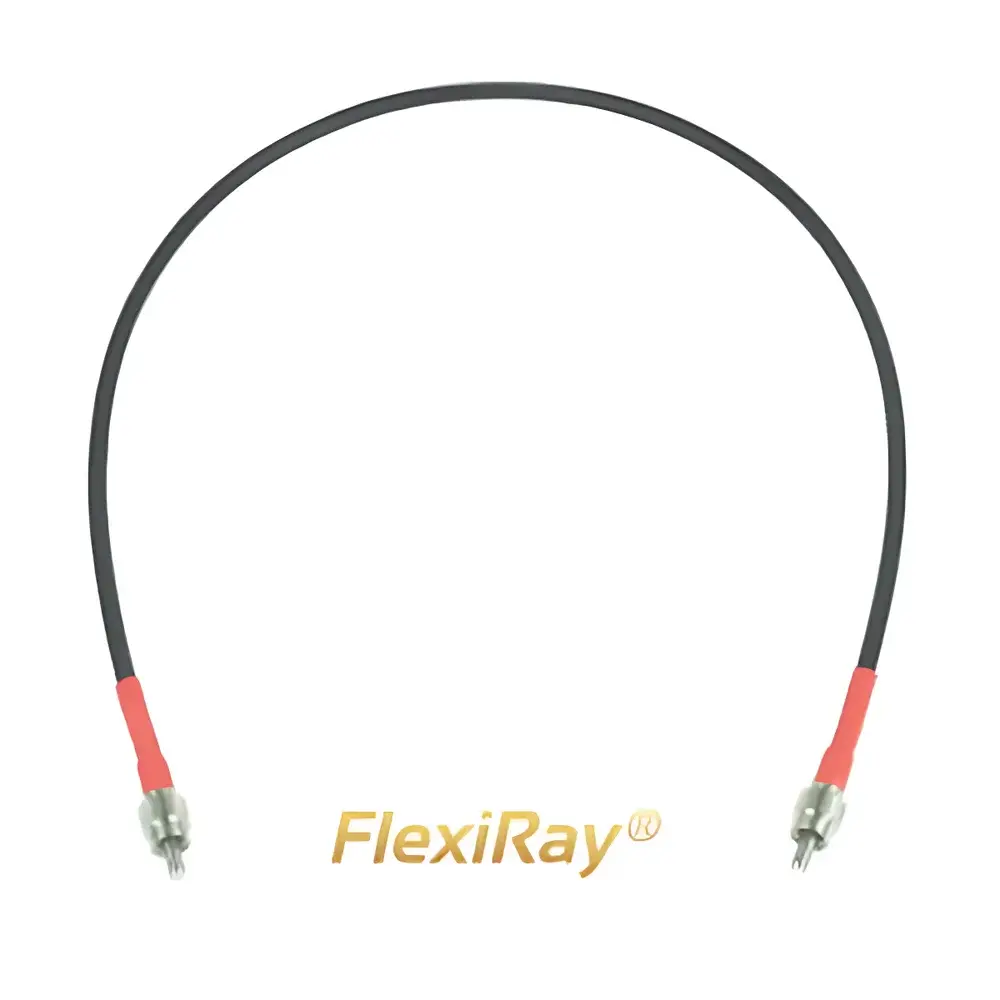
art photonics FlexiRay® Chalcogenide Mid-Infrared Fiber Optic Cable
| Brand | art photonics |
|---|---|
| Origin | Germany |
| Model | FlexiRay® CIR-Series |
| Wavelength Range | 1.1–6.5 µm |
| Core Diameter Options | 8–340 µm |
| Attenuation | 0.2–0.3 dB/m (at 2.5–4 µm and 4.5–5 µm) |
| Operating Temperature | −50 °C to +90 °C |
| Jacket Materials | PEEK, Metal-PVC, Stainless Steel, Stainless Steel with Silicone Coating |
| Connector Types | SMA-905, FC/PC, FC/APC |
| Compliance | ISO 9001-certified manufacturing |
| QC Protocol | 100% end-face inspection, interferometric surface quality verification, spectral transmission validation |
Overview
The art photonics FlexiRay® Chalcogenide Mid-Infrared Fiber Optic Cable is a precision-engineered optical transmission medium designed for reliable signal delivery across the critical 1.1–6.5 µm mid-infrared (MIR) spectral window. Constructed from amorphous chalcogenide glass (As–S/Se-based), this fiber leverages the intrinsic low phonon energy and high refractive index of sulfide/selenide materials to enable low-loss guidance in a region where conventional silica fibers are opaque. Unlike polymer or fluoride-based alternatives, chalcogenide fibers exhibit superior thermal stability and mechanical robustness under sustained MIR irradiation—making them indispensable for high-power quantum cascade laser (QCL) beam delivery, real-time process monitoring, and field-deployable spectroscopic sensing. Each FlexiRay® cable is assembled under controlled cleanroom conditions in Berlin, Germany, with active core centering within the ferrule to minimize insertion loss and back-reflection. All units undergo full spectral transmission profiling, interferometric end-face analysis (surface roughness < 5 nm RMS), and mechanical bend testing per IEC 60793-2-40, ensuring batch-to-batch reproducibility and long-term performance integrity.
Key Features
- Extended spectral transmission from 1.1 µm to 6.5 µm—covering fundamental vibrational bands of CO₂, CH₄, NH₃, NOₓ, and numerous organic functional groups
- Low attenuation of 0.2–0.3 dB/m in two primary operational windows (2.5–4 µm and 4.5–5 µm), optimized for QCLs operating at 4.5 µm (e.g., nitric oxide detection) and 5.2 µm (e.g., formaldehyde monitoring)
- Scalable core geometry: single-mode (8–15 µm), few-mode (25–50 µm), and multimode (100–340 µm) configurations—enabling trade-offs between spatial coherence, power handling (>5 W CW), and numerical aperture (NA = 0.25–0.35)
- Hermetic and thermally stable jacketing options—including PEEK (chemical resistance), stainless steel braid (EMI shielding & crush protection), and silicone-coated metal (flexibility at cryogenic temperatures)
- Interchangeable connectorization with factory-polished, angle-cleaved (FC/APC) or flat-cleaved (SMA-905, FC/PC) terminations—compatible with standard MIR spectrometers, pyrometers, and imaging optics
Sample Compatibility & Compliance
FlexiRay® cables are routinely deployed in regulated environments requiring traceable calibration and documentation. The manufacturing process adheres to ISO 9001:2015 quality management standards, with full lot traceability from raw glass preform to final assembly. Each cable is supplied with a Certificate of Conformance listing measured cut-on wavelength, peak transmission %, and end-face inspection report (including ISO 10110-7 surface quality grade). For applications governed by FDA 21 CFR Part 11 or EU Annex 11, optional electronic batch records and audit trails are available upon request. The fiber’s non-hygroscopic nature eliminates moisture-induced drift—critical for GLP-compliant gas-phase FTIR measurements and continuous emissions monitoring systems (CEMS) compliant with EPA Method 320 and EN 15267.
Software & Data Management
While the FlexiRay® cable itself is a passive component, its integration into automated analytical platforms is facilitated via standardized mechanical interfaces and documented optical coupling efficiencies. art photonics provides detailed spectral transmission datasets (CSV format) for each batch, compatible with common spectroscopy software suites including OPUS (Bruker), GRAMS/AI (Thermo Fisher), and LabVIEW-based DAQ systems. For OEM integration, mechanical drawings (STEP/IGES), thermal expansion coefficients (α = 12 × 10⁻⁶ K⁻¹), and stress-optic coefficients are supplied under NDA. Remote spectral validation services—including on-site MIR source coupling efficiency measurement using calibrated InSb or MCT detectors—are available through art photonics’ Application Support Lab in Berlin.
Applications
- Mid-IR Spectroscopy: Transmission-mode gas cell coupling, evanescent-wave sensing in hollow-core fibers, and attenuated total reflectance (ATR) probe interfacing for liquid and solid sample analysis
- Flexible IR Pyrometry: Non-contact temperature measurement in rotating machinery, vacuum chambers, and hazardous industrial zones—where rigid optics cannot be deployed
- QCL Power Delivery: High-fidelity beam transport from pulsed or CW quantum cascade lasers to reaction cells, photoacoustic cells, or multipass absorption cells (e.g., Herriott-type)
- Flexible IR Imaging: Coherent bundle fabrication for endoscopic MIR imaging, thermal scene relay in defense-grade situational awareness systems, and multispectral thermal mapping in semiconductor wafer inspection
- Medical Diagnostics: Breath analysis (CO, acetone, ethane), tissue ablation guidance, and intraoperative spectroscopic margin assessment—leveraging native MIR molecular fingerprinting
FAQ
What is the maximum continuous power handling capacity of FlexiRay® cables?
For multimode configurations (core ≥ 200 µm) with PEEK or metal-jacketed construction, the recommended maximum average power is 5 W (CW) at 4.5 µm. Pulse energy limits depend on repetition rate and peak fluence; consult the application-specific derating curve provided in the Technical Datasheet.
Can FlexiRay® fibers be spliced or connectorized in-house?
Chalcogenide fibers require specialized fusion splicing equipment (e.g., CO₂ laser or filament-based rigs) and inert atmosphere control. art photonics does not recommend field termination due to sensitivity to oxidation and thermal shock; all connectors are factory-installed and tested.
Is there a difference in performance between As₂S₃ and As₂Se₃ base compositions?
Yes: As₂S₃ offers lower dispersion and higher bandgap (transmission cutoff ~6.5 µm), while As₂Se₃ extends transmission to ~10 µm but exhibits higher thermal expansion and reduced mechanical hardness. FlexiRay® CIR-Series uses proprietary As–S–Se ternary blends optimized for 1.1–6.5 µm balance.
Do these fibers comply with RoHS or REACH regulations?
Yes—art photonics confirms full compliance with EU Directive 2011/65/EU (RoHS2) and Regulation (EC) No 1907/2006 (REACH), including SVHC screening. Material Declarations (IMDS/SDS) are available upon request.
What is the typical lead time for custom-length or hybrid-jacket configurations?
Standard configurations ship within 4–6 weeks from order confirmation. Custom builds (e.g., dual-wavelength bundles, hermetically sealed feedthroughs) require 10–14 weeks and are subject to minimum order quantities (MOQ = 3 units).




