
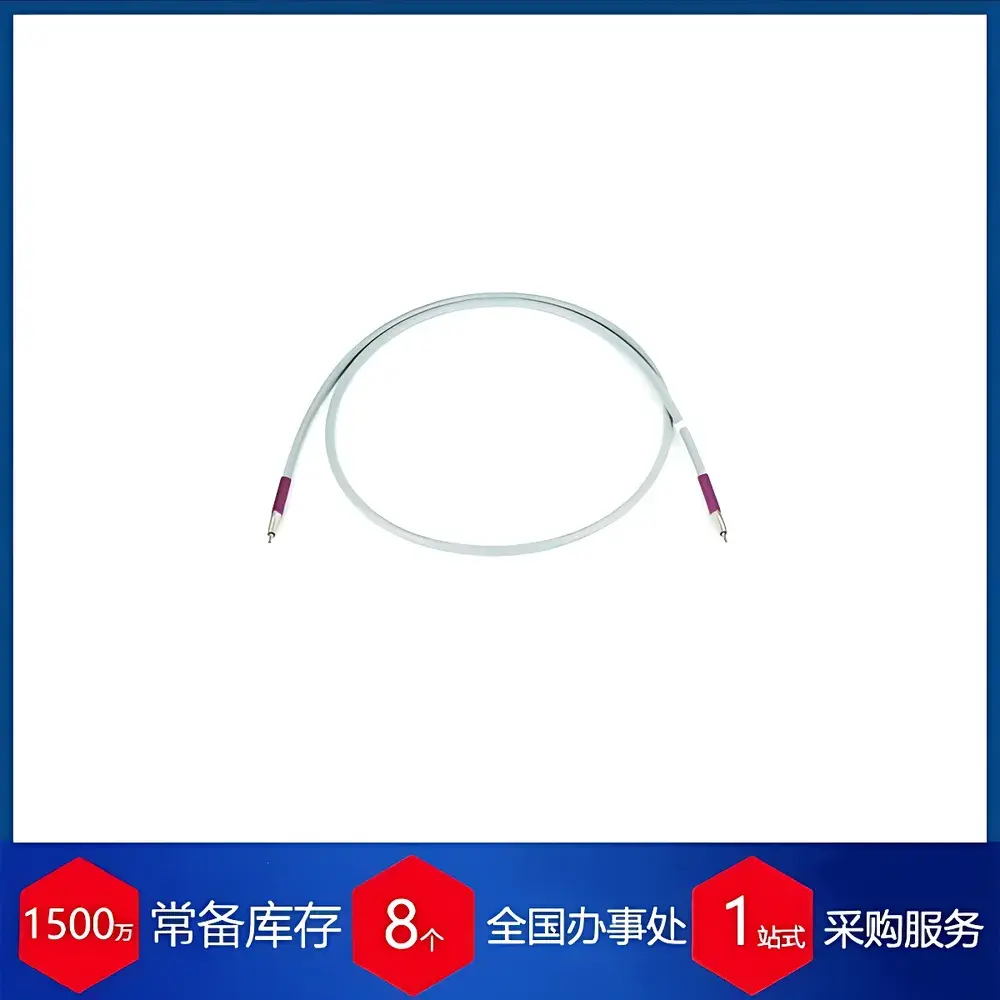
ART Photonics High-Power Quartz Fiber Optic Cable
| Brand | ART Photonics |
|---|---|
| Origin | Germany |
| Model | CIR Fiber 1.5–6 µm |
| Spectral Range | 0.18–1.2 µm (UV-VIS) |
| Detector Type | CCD |
| Resolution | 30 |
| Sensitivity | 400 |
| Signal-to-Noise Ratio | 1001 |
| Core Diameter Options | 200–1500 µm |
| Numerical Aperture | 0.22 ± 0.02 (25° full acceptance angle) |
| Operating Temperature | −40 °C to +600 °C (copper-coated variant) |
| Connector Types | HP-SMA, D-80 |
| Cable Lengths | 1.5 m, 3.0 m (custom lengths from 5 cm to 50 m) |
| Cladding Material | Fluorine-doped fused silica |
| Core Material | High-OH⁻ or Low-OH⁻ fused silica |
| Jacketing Options | Nylon, Tefzel, acrylic, aluminum, copper |
| Protective Sheathing | PVC-coated stainless steel coil, silicone-coated stainless steel bend protection |
Overview
The ART Photonics High-Power Quartz Fiber Optic Cable is an engineered solution for demanding optical signal transmission in spectroscopic, laser delivery, and industrial process monitoring applications. Designed and manufactured in Berlin, Germany, this cable leverages proprietary FlexiRay® metallized fused silica fiber technology to enable stable, low-loss light guidance under extreme thermal, mechanical, and radiative conditions. Unlike standard polymer-clad silica (PCS) or plastic optical fibers, this system utilizes pure fused silica core material—available in both high-hydroxyl (optimized for UV-VIS, 0.18–1.2 µm) and low-hydroxyl (optimized for VIS-NIR, 0.35–2.4 µm) variants—ensuring exceptional transmission stability across ultraviolet, visible, and near-infrared spectral bands. Its operational principle relies on total internal reflection within a precisely controlled refractive index profile, with numerical aperture (NA = 0.22 ± 0.02, optionally 0.12 ± 0.02) calibrated to maximize coupling efficiency with common spectrometers, laser diodes, and broadband sources while maintaining modal consistency.
Key Features
- High-power laser transmission capability up to 900 W (D-80 connector configuration), validated for continuous-wave (CW) and pulsed laser systems
- Thermally robust construction with copper- or aluminum-metallized fiber cladding, enabling sustained operation from −40 °C to +600 °C in vacuum-compatible environments
- HP-SMA and D-80 connector interfaces featuring non-epoxy, metal-to-metal ferrule bonding—eliminating outgassing and thermal delamination risks
- FlexiRay® fiber architecture ensures superior mechanical flexibility without compromising tensile strength or radiation hardness
- Precision cleaved and polished fiber end-faces (λ/10 surface flatness, <5 nm RMS roughness) guarantee minimal back-reflection and optimal coupling efficiency
- Customizable core diameters (200–1500 µm), jacketing (Tefzel®, nylon, metallic braid), and protective sheathing (PEEK-lined stainless steel, silicone-coated coils)
Sample Compatibility & Compliance
This fiber optic cable is compatible with standard fiber-coupled UV-VIS-NIR spectrometers (e.g., Ocean Insight, Avantes, Hamamatsu), FTIR accessories, and OEM laser integration platforms. Its all-silica construction meets ASTM F2758-19 requirements for optical fiber used in medical laser delivery systems and complies with ISO 13485:2016 design controls for Class IIa medical devices when configured with biocompatible coatings. For industrial use, it satisfies IEC 60793-2-40 (category A1a multimode silica fibers) and supports GLP/GMP traceability via batch-specific test reports—including attenuation curves (dB/km vs. wavelength), NA verification, and power handling validation at 1064 nm, 532 nm, and 355 nm. The absence of organic adhesives and epoxy-free terminations ensure compliance with ultra-high-vacuum (UHV) standards (≤1×10⁻⁹ mbar) and reduce contamination risk in semiconductor cleanroom environments.
Software & Data Management
While the cable itself is a passive optical component, its performance integrates seamlessly into spectroscopic data acquisition workflows governed by vendor-neutral protocols such as USB2.0/USB3.0 HID class drivers, GenICam-compliant SDKs, and SCPI command sets. When paired with CCD-based spectrometers (e.g., those referenced in the product specification), it supports full spectral calibration traceable to NIST SRM 2031 and enables quantitative absorbance, reflectance, and fluorescence measurements compliant with USP and ASTM E275-22. All custom configurations include digital manufacturing records—containing interferometric end-face inspection images, spectral attenuation profiles, and power-handling test logs—archived in secure, audit-ready formats compatible with FDA 21 CFR Part 11 electronic record systems.
Applications
- Laser-induced breakdown spectroscopy (LIBS) probe assemblies for in situ elemental analysis in metallurgy and nuclear decommissioning
- High-temperature process monitoring in glass furnaces, cement kilns, and molten metal reactors (up to 600 °C ambient)
- Fiber-coupled Raman spectroscopy in explosive or corrosive chemical synthesis environments
- Multiplexed laser power combining using MCS fiber bundles (3–64 channels) for kW-class industrial laser systems
- Vacuum-ultraviolet (VUV) beam transport in synchrotron beamlines and plasma diagnostics
- Medical photodynamic therapy (PDT) and dermatological laser delivery where biocompatibility and sterilization resistance are critical
FAQ
What spectral ranges does this fiber support?
The standard configuration covers 0.18–1.2 µm (UV-VIS) using high-OH⁻ fused silica core; optional low-OH⁻ versions extend transmission to 2.4 µm (VIS-NIR). CIR fiber variants (1.5–6 µm) are available separately for mid-IR applications.
Can this cable be used in vacuum environments?
Yes—metallized fiber variants with copper or aluminum cladding and epoxy-free HP-SMA/D-80 connectors are certified for UHV operation (≤1×10⁻⁹ mbar) and exhibit negligible outgassing per ASTM E595.
Is the fiber resistant to gamma radiation?
FlexiRay® metallized quartz fibers demonstrate >10⁶ rad(Si) total ionizing dose (TID) tolerance with <10% induced attenuation increase at 600 nm, making them suitable for nuclear instrumentation and space-qualified payloads.
How is power handling validated?
Each production lot undergoes CW laser testing at 1064 nm (Nd:YAG), 532 nm (frequency-doubled), and 355 nm (tripled) wavelengths, with thermal imaging confirming no localized heating above ΔT = 5 °C at rated power levels.
Do you offer OEM integration support?
Yes—ART Photonics provides mechanical drawings, optical interface specifications (ISO 11097 flange compatibility), and RoHS/REACH documentation packages for seamless integration into third-party analytical instruments and laser systems.





