
ART Photonics Metal-Coated Optical Fiber
| Brand | ART Photonics |
|---|---|
| Origin | Germany |
| Product Type | Metal-Coated Silica Optical Fiber |
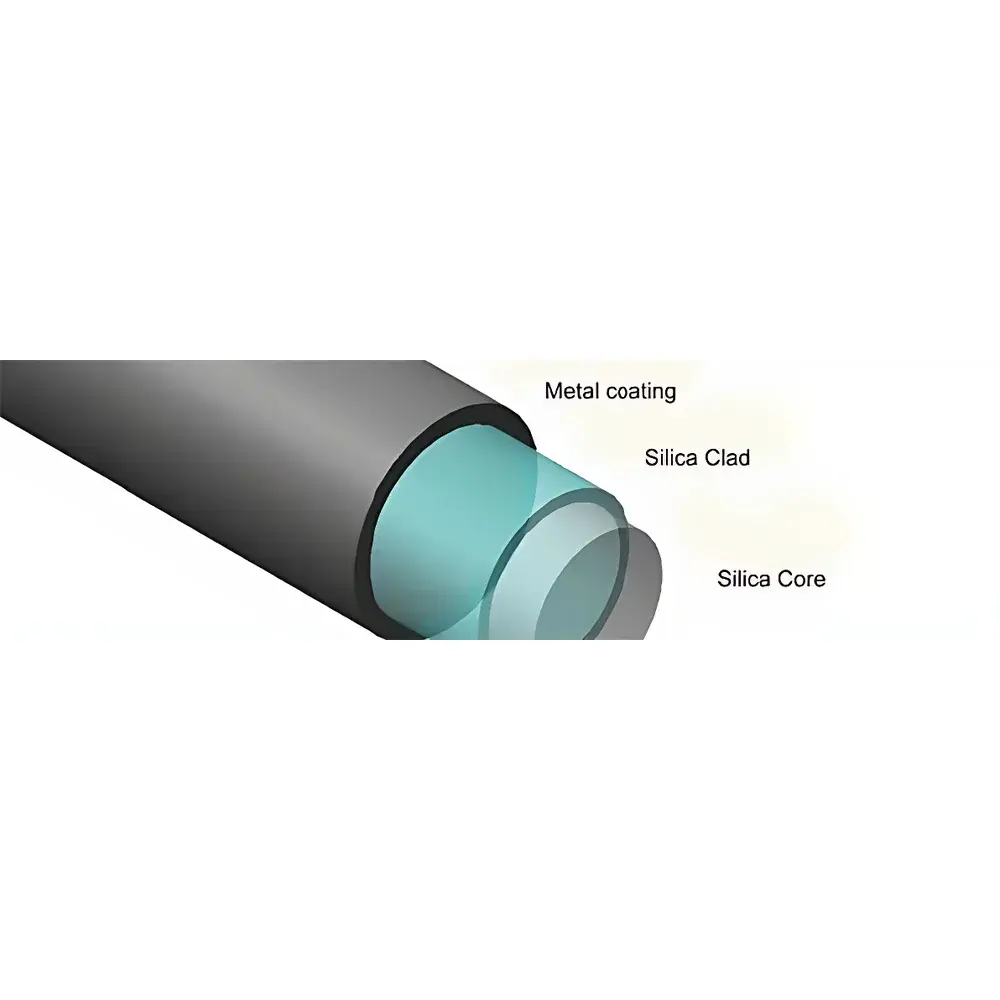
| Core Material | High-OH⁻ Fused Silica (0.18–1.2 µm) / Low-OH⁻ Fused Silica (0.35–2.5 µm) |
| Cladding Material | Fluorine-Doped Fused Silica |
| Numerical Aperture | 0.22 ± 0.02 (standard), 0.12 ± 0.02 or 0.26 ± 0.02 (optional) |
| Coating Materials | Aluminum, Copper |
| Application Environment | High-Temperature, Ultra-High Vacuum (UHV), Aggressive Chemical, Nuclear Radiation, High-Power Laser Delivery |
Overview
ART Photonics Metal-Coated Optical Fibers are engineered for extreme operational environments where conventional polymer-coated or acrylate-coated silica fibers fail. These fibers feature a hermetically sealed metallic cladding—typically aluminum or copper—thermally bonded to the fluorine-doped fused silica cladding via controlled annealing. This metallurgical interface ensures exceptional mechanical adhesion, eliminating delamination under thermal cycling, mechanical stress, or vacuum outgassing. Unlike organic coatings, the metal layer provides intrinsic hermeticity, enabling direct integration into ultra-high vacuum (UHV) systems (down to 10−11 mbar), resistance to hydrogen diffusion, and immunity to solvent exposure, plasma etching, and gamma radiation up to 106 Gy. The fiber’s all-silica structure—comprising either high-OH⁻ (UV-VIS optimized) or low-OH⁻ (NIR-MIR optimized) core—ensures broad spectral transmission with minimal absorption bands, supporting applications from deep-UV spectroscopy to mid-infrared laser delivery.
Key Features
- Hermetic Metallic Coating: Aluminum or copper layers applied via physical vapor deposition (PVD) and diffusion-bonded at elevated temperatures, achieving >99.9% surface coverage and zero pinhole defects per ISO 11146-2 verification.
- Ultra-High Vacuum Compatibility: Certified for UHV use per ESA ECSS-Q-ST-70-08C; outgassing rates <1×10⁻¹² Pa·m3/s·cm2 (24 h, 120 °C), enabling direct feedthrough mounting in particle accelerators and spaceborne spectrometers.
- Thermal Stability: Continuous operation from −196 °C (liquid nitrogen) to +400 °C (aluminum) or +600 °C (copper), with no coating degradation or refractive index shift beyond specification limits.
- Radiation Hardness: Demonstrated performance after 106 Gy (Co-60) gamma irradiation with <5% transmission loss at 633 nm—validated per ASTM E1249 for nuclear instrumentation fiber optics.
- Mechanical Robustness: Bend radius down to 3 mm without microcrack initiation; tensile strength ≥400 kpsi (2.76 GPa) as measured per IEC 60793-1-33.
Sample Compatibility & Compliance
This fiber is supplied in standard lengths (1–10 m) with cleaved or connectorized (FC/PC, SMA905) terminations. It complies with RoHS 2011/65/EU and REACH Annex XVII restrictions on heavy metals. For medical device integration, it meets biocompatibility requirements per ISO 10993-5 (cytotoxicity) when used with inert termination hardware. In regulated analytical environments, the fiber supports audit-ready traceability: each spool carries a unique serial number linked to full manufacturing records—including coating thickness (measured by XRF), NA verification (per ISO 11999), and spectral attenuation curves (200–2500 nm). Documentation packages include certificates of conformance aligned with ISO 9001:2015 and GLP-compliant test reports for critical parameters.
Software & Data Management
While the fiber itself is a passive component, ART Photonics provides optional calibration datasets and spectral transmission profiles in ASCII (.csv) and HDF5 formats for integration into LabVIEW, Python (NumPy/Pandas), or MATLAB-based optical system modeling workflows. All spectral data are referenced to NIST-traceable standards (SRM 2036, SRM 2068). For OEM customers integrating these fibers into FDA-regulated diagnostic instruments, ART Photonics supplies design history files (DHF) and risk analysis documentation compliant with ISO 14971:2019, supporting 21 CFR Part 820 and IEC 62304 lifecycle management.
Applications
- High-power laser beam delivery in industrial cutting/welding systems (up to 5 kW CW @ 1070 nm).
- Fiber-optic sensors embedded in jet engine turbine blades, fusion reactor first-wall diagnostics, and spent nuclear fuel monitoring.
- Vacuum-compatible light guides for synchrotron beamlines, electron microscope sample illumination, and cryogenic Raman spectroscopy.
- Hermetically sealed fiber bundles for endoscopic OCT probes operating in autoclave-sterilized environments.
- Sealed feedthroughs in semiconductor process chambers (ALD, PECVD) requiring zero hydrocarbon contamination.
FAQ
Can this fiber be directly welded to stainless steel vacuum flanges?
Yes—copper-coated variants are routinely laser-welded to 316L SS using pulsed Nd:YAG (1064 nm) with helium shielding gas, achieving leak rates <1×10⁻¹⁰ mbar·L/s per ASTM E499.
Is the aluminum coating compatible with sulfuric acid exposure?
Aluminum-coated fibers withstand short-term immersion (<30 min) in 10% H2SO4 at RT; for prolonged chemical service, copper coating is recommended per ISO 9223 corrosion classification C5-M.
What is the minimum bend radius during UHV bake-out at 200 °C?
The validated static bend radius is 8 mm at 200 °C for 24 h; dynamic bending below 5 mm is not recommended above 150 °C.
Do you provide splice compatibility data with SMF-28 or HI1060 fibers?
Yes—fusion splice loss averages 0.18 dB (±0.05 dB) to SMF-28 at 1550 nm using modified arc parameters (reduced current, extended time); splicing to HI1060 requires mode-field adaptors.
Is there a version with dual-metal coating (e.g., Al/Cu bilayer)?
Custom bilayer configurations are available under NRE agreement; typical stack is 2 µm Al base + 1 µm Cu cap for combined UHV sealing and solderability.





