
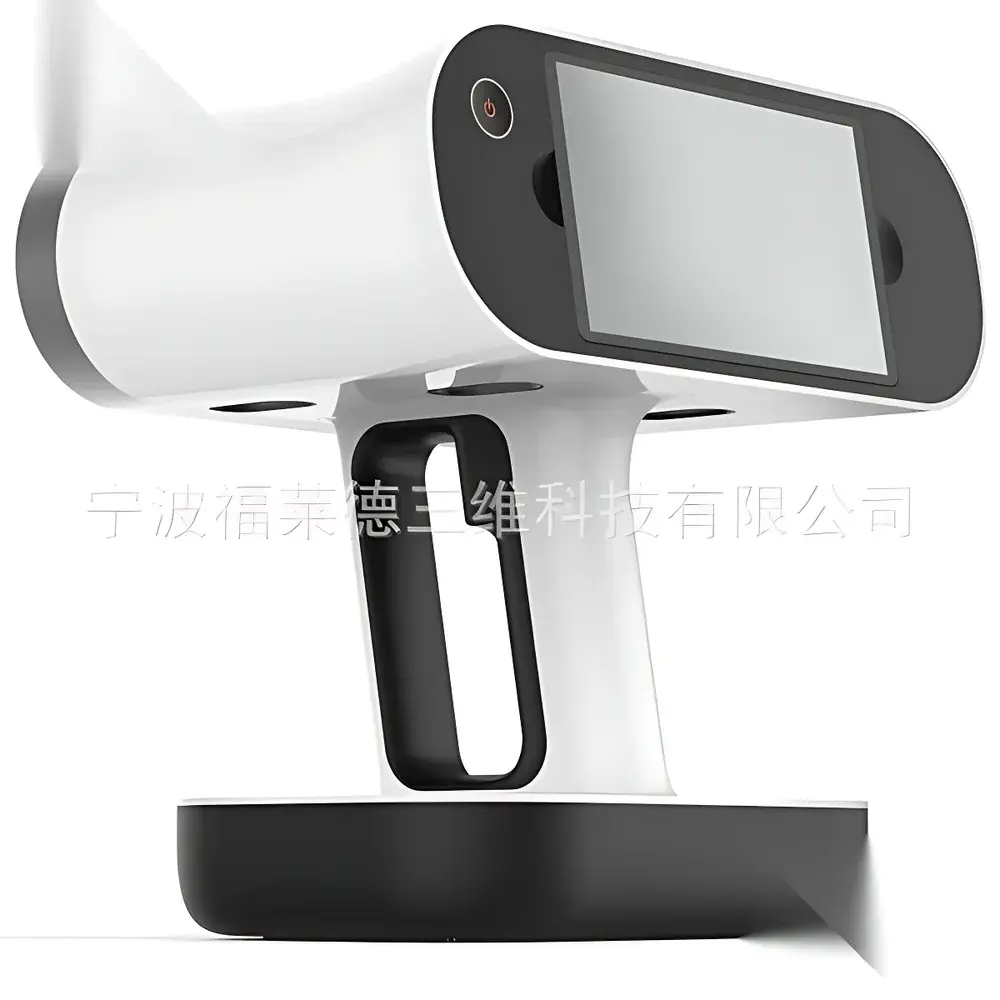
Artec Leo Handheld Full-Color 3D Scanner
| Brand | Artec |
|---|---|
| 3D Resolution | 0.25 mm |
| 3D Point Accuracy | ≤ 0.1 mm |
| Accuracy Drift | ≤ 0.03% per 100 cm |
| Light Source | Dual-mode — White-light LED array (12 LEDs) + VCSEL-based structured light |
| Near-range FOV | 246 × 153 mm |
| Far-range FOV | 843 × 527 mm |
| Working Distance | 0.35–1.2 m |
| Texture Capture | Yes |
| Video Frame Rate | Up to 80 FPS |
| Data Acquisition Time | 0.0002 s per frame |
| Point Cloud Capture Speed | Up to 4 million points/sec |
| Weight | 1.8 kg |
| Power Supply | Internal swappable battery or external 12 V DC |
| Dimensions (H×D×W) | 227 × 163 × 228 mm |
| Connectivity | Wi-Fi, Gigabit Ethernet, SD card slot |
| Onboard Processing | Yes — real-time meshing, alignment, and texturing without external PC |
| Calibration | Self-calibrating |
Overview
The Artec Leo is a professional-grade, handheld full-color 3D scanner engineered for high-fidelity, real-time acquisition of complex surface geometry and photorealistic texture. Utilizing dual illumination architecture—comprising a high-intensity white-light LED array and a precision VCSEL-based structured light projector—the device captures dense point clouds with sub-millimeter resolution while maintaining robust performance across varying surface reflectivity, curvature, and ambient lighting conditions. Unlike traditional laser or single-mode optical scanners, the Leo employs adaptive multi-frequency phase-shift triangulation combined with onboard AI-accelerated processing to deliver immediate visual feedback on its integrated HD touchscreen. This architecture eliminates reliance on external computing hardware during data capture, enabling autonomous operation in field environments, production floors, conservation labs, or mobile forensic units. Its self-calibrating optical path ensures metrological consistency across sessions without periodic recalibration against reference artifacts.
Key Features
- Real-time on-device 3D reconstruction: Full mesh generation, global registration, and texture mapping occur directly on the scanner’s embedded GPU-accelerated platform—no laptop or workstation required during acquisition.
- Intuitive touch interface: A 5.5-inch HD display provides live 3D preview, allowing operators to rotate, pan, and zoom the evolving model mid-scan to verify coverage completeness and identify occluded regions.
- Dual-light adaptive scanning: Automatic switching between white-light and VCSEL modes optimizes capture fidelity on both matte and specular surfaces—including black plastics, polished metals, and human skin—without manual exposure adjustment.
- High-speed volumetric capture: Capable of acquiring up to 4 million 3D points per second at 80 frames per second, supporting dynamic scanning of moderately moving objects such as seated subjects or rotating mechanical parts.
- Modular workflow integration: Supports both guided Smart Mode (for rapid, repeatable results with minimal user input) and fully manual mode (for expert-level control over alignment, fusion, and hole-filling parameters).
- Ruggedized industrial design: IP54-rated enclosure, shock-absorbing housing, and ergonomic grip facilitate extended use in non-laboratory settings including heritage documentation sites, accident reconstruction zones, and aerospace maintenance bays.
Sample Compatibility & Compliance
The Artec Leo is validated for non-contact digitization of objects ranging from small mechanical components (≥5 cm) to full-body human subjects (up to 2.5 m height), with optimal performance observed on surfaces exhibiting Lambertian or semi-diffuse reflectance characteristics. It complies with IEC 62471:2006 for photobiological safety (LED and VCSEL emission classes classified as Exempt and Class 1, respectively) and meets CE, FCC, and RoHS directives. While not certified to ISO/IEC 17025 for metrological traceability, its repeatability—verified per ASTM E2924-18 guidelines—demonstrates ≤0.1 mm intra-session standard deviation under controlled environmental conditions (20–25°C, <60% RH). For regulated industries, raw scan data (in .E57, .OBJ, and proprietary .ART formats) can be archived with full metadata (timestamp, sensor pose, exposure settings) to support GLP-compliant documentation workflows.
Software & Data Management
Artec Studio 19+ serves as the primary post-processing environment, offering both cloud-synced project management and local offline operation. The software implements NIST-traceable algorithms for iterative closest point (ICP) registration, Poisson surface reconstruction, and spectral-based texture blending. Audit trails record all user-initiated modifications—including mesh decimation, outlier removal, and coordinate system transformations—with timestamped operator IDs when integrated with enterprise Active Directory or LDAP authentication. Export modules comply with ASME Y14.41-2019 for Model-Based Definition (MBD), generating STEP AP242 files with GD&T annotations compatible with Siemens NX, PTC Creo, and Autodesk Fusion 360. All processed models retain full-resolution texture maps in sRGB color space, preserving chromatic fidelity for applications in digital twin visualization, forensic reconstruction, or cultural heritage colorimetric analysis.
Applications
- Reverse engineering of legacy parts lacking CAD documentation, especially in automotive and aviation MRO contexts where rapid prototyping timelines demand sub-hour turnaround from physical object to printable mesh.
- Biometric and anthropometric measurement in ergonomics research, prosthetics design, and custom apparel development—leveraging the scanner’s ability to capture anatomical contours without powder coating or fiducial markers.
- Cultural heritage preservation, including high-resolution documentation of fragile sculptures, archaeological finds, and historic architectural elements, with texture fidelity sufficient for pigment analysis and aging simulation.
- Quality assurance in additive manufacturing: Pre-build verification of master patterns and post-build inspection of printed geometries against nominal CAD, with deviation heatmaps referenced to ISO 10360-8 tolerancing standards.
- Forensic scene reconstruction: Rapid capture of vehicle crash deformations, footwear impressions, or toolmark evidence under variable现场 lighting, with georeferenced export options via optional GNSS integration.
FAQ
Does the Artec Leo require a connected computer to operate?
No. All core scanning functions—including real-time alignment, meshing, and texturing—are executed onboard. A computer is only required for advanced post-processing in Artec Studio or CAD interoperability.
Can the scanner capture black or shiny surfaces reliably?
Yes. The dual-light system automatically selects optimal illumination mode: white-light LEDs for low-reflectivity surfaces and VCSEL projection for challenging geometries and reflective materials, minimizing specular saturation and shadowing artifacts.
Is calibration necessary before each use?
No. The Leo performs automatic self-calibration at startup using internal reference patterns. No external calibration plates or laboratory-grade instrumentation are required for routine operation.
What file formats does it export for CAD integration?
Native exports include .OBJ, .STL, .PLY, .FBX, and industry-standard .STEP AP242 with PMI, ensuring seamless import into SolidWorks, CATIA, and other MCAD platforms.
How is data security managed during wireless transfer?
Wi-Fi communication uses WPA3-Enterprise encryption with TLS 1.3 tunneling for remote job queuing and firmware updates. Local SD card storage supports AES-256 full-disk encryption when enabled via Artec Studio policy configuration.




