
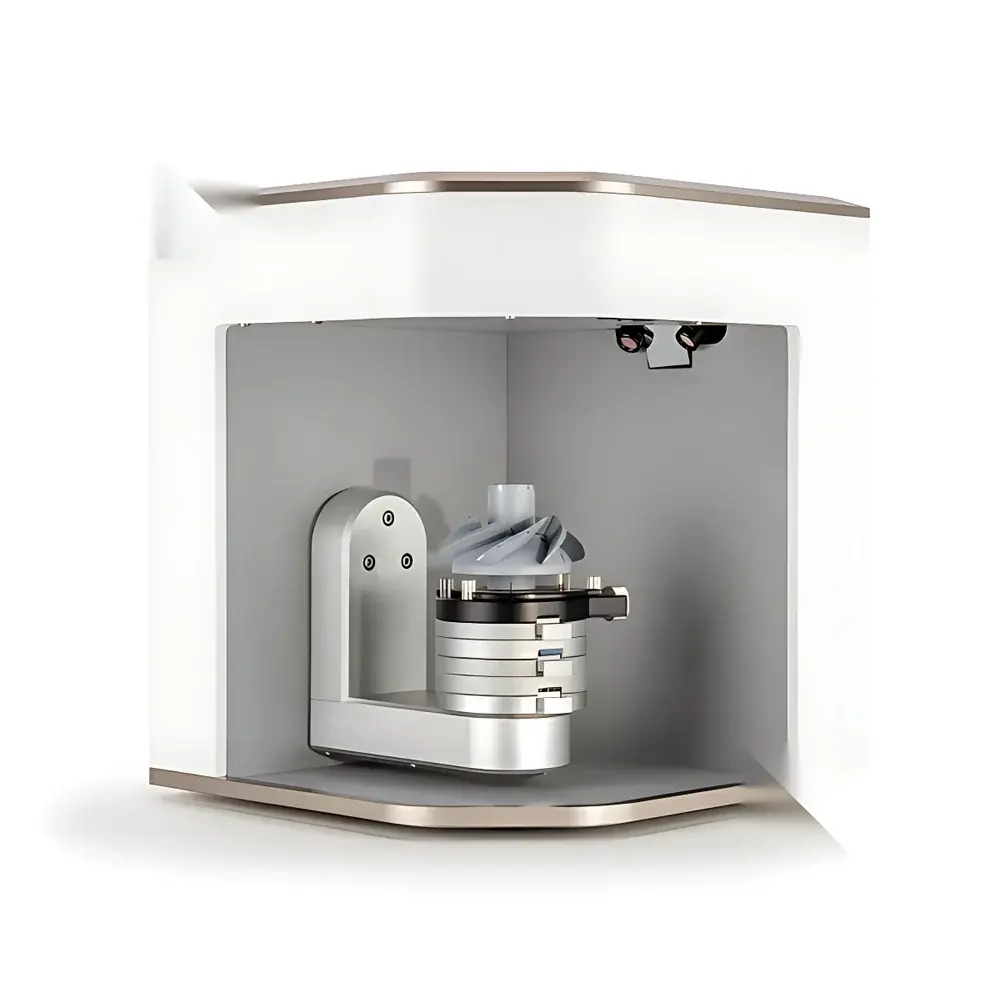
Artec Micro High-Precision Desktop 3D Scanner
| Brand | Artec |
|---|---|
| Measurement Accuracy (Point) | 10 µm |
| Resolution | Up to 5 µm |
| Field of View (FOV) | 90 × 60 × 60 mm |
| Scan Speed | Up to 1.2 million points/sec |
| Light Source | Structured Blue LED Light |
| Automation Level | Fully Automatic Turntable-Based Acquisition |
| Software Platform | Artec Studio 19 (with GD&T, Inspection, Reverse Engineering Modules) |
| Compliance | CE, FCC, RoHS |
| Data Output Formats | STL, OBJ, PLY, AOP, ASC, PDF (Inspection Reports), STEP (via optional CAD plugins) |
Overview
The Artec Micro is a fully automated, metrology-grade desktop 3D scanner engineered for non-contact, high-resolution digitization of small industrial components with dimensional stability and traceable accuracy. Operating on the principle of structured light triangulation—using dual high-resolution cameras and precision-calibrated blue LED projectors—the system captures sub-surface geometric detail without thermal drift or mechanical wear. Its closed-loop motion control architecture integrates a motorized precision turntable and synchronized optical head movement, enabling full 360° coverage with automatic multi-position alignment. Designed specifically for objects under 90 mm in any dimension, the Artec Micro delivers point accuracy of ±10 µm and surface resolution down to 5 µm, meeting foundational requirements for first-article inspection, dimensional validation, and digital twin generation in regulated environments.
Key Features
- Metrology-Grade Accuracy: Validated point accuracy of ±10 µm per measurement, traceable to NIST-traceable calibration artifacts; certified repeatability < 5 µm across repeated scans under controlled lab conditions.
- Fully Automated Workflow: Integrated turntable with programmable angular increments (0.1°–5° steps), auto-alignment algorithms, and one-click scan initiation—eliminating manual repositioning or operator-dependent setup.
- Structured Blue Light Technology: Dual-camera stereo imaging with narrow-band blue LED illumination minimizes ambient light interference and enhances contrast on reflective, translucent, or dark surfaces common in dental prostheses and precious metal jewelry.
- Real-Time Mesh Processing: On-device GPU-accelerated reconstruction delivers clean, watertight polygonal meshes with adaptive density control—no post-processing stitching required for most standard parts.
- Thermally Stable Enclosure: Aluminum alloy chassis with passive thermal management ensures minimal expansion/contraction during extended acquisition sessions (up to 45 min continuous operation).
- Modular Software Integration: Native support for GD&T annotation, deviation color-mapping against CAD references, and export to industry-standard formats including STEP AP242 for downstream CAM and simulation workflows.
Sample Compatibility & Compliance
The Artec Micro accommodates samples ranging from 10 mm to 90 mm in maximum dimension, including machined metallic inserts, ceramic dental crowns, sintered titanium orthodontic brackets, wax patterns for investment casting, and gemstone-set jewelry pieces. Surface finish tolerance spans matte anodized aluminum to polished 18K gold—no spray coating required for most materials due to adaptive exposure control. The system complies with ISO 10360-8 (coordinate measuring machines — Part 8: CMMs with optical distance sensors), EN ISO/IEC 17025:2017 (for accredited calibration laboratories), and supports audit-ready documentation per FDA 21 CFR Part 11 when deployed with Artec Studio’s optional electronic signature and audit trail module. It is routinely validated in GLP-compliant QA labs for medical device component verification (ISO 13485) and aerospace fastener inspection (AS9100 Rev D).
Software & Data Management
Artec Studio 19 serves as the unified software environment, offering calibrated scanning, real-time fusion, noise filtering, sharp edge preservation, and parametric inspection reporting. The software includes built-in GD&T tools compliant with ASME Y14.5–2018 and ISO 1101, enabling direct comparison against nominal CAD models with pass/fail thresholds configurable per feature. All raw scan data, alignment matrices, and inspection logs are stored in a version-controlled project file (.aop), supporting full traceability. Export options include ANSI/ISO-compliant PDF inspection reports with embedded color deviation maps, tessellated mesh files (STL/OBJ/PLY) for additive manufacturing, and neutral CAD exchange formats (STEP, IGES) via licensed CAD plugins. Data integrity is preserved through SHA-256 hashing of all exported deliverables, satisfying internal quality system requirements for electronic record retention.
Applications
- Quality Control & First-Article Inspection: Validation of miniature gears, watch components, MEMS housings, and microfluidic channels against engineering drawings.
- Dental Laboratory Digitization: Accurate capture of gypsum casts, intraoral scans, and milled zirconia frameworks for crown-and-bridge design and fit-check analysis.
- Jewelry Prototyping & Certification: Non-destructive replication of engraved hallmarks, prong geometry, and stone seat contours for hallmark verification and insurance documentation.
- Reverse Engineering of Legacy Parts: Reconstruction of worn or undocumented small-scale mechanical assemblies where original CAD is unavailable.
- Research & Development: Surface topology analysis of additively manufactured lattice structures, surface roughness quantification (Ra/Rz via third-party plugins), and deformation tracking under thermal cycling.
FAQ
What is the smallest feature size the Artec Micro can resolve?
Features as small as 5 µm in lateral dimension are resolvable under optimal lighting and surface conditions; however, reliable detection of geometric features requires ≥3–5 pixels across the feature—translating to practical minimum detectable features of ~15–25 µm depending on object orientation and reflectivity.
Does the system require external calibration before each use?
No. The Artec Micro performs an internal self-calibration sequence at power-on using embedded reference targets. Optional periodic verification with NIST-traceable step gauges or sphere artifacts is recommended every 6 months for ISO/IEC 17025 compliance.
Can it scan highly reflective or black matte surfaces without spray?
Yes. The structured blue light engine and dynamic exposure compensation enable robust capture of polished metals and carbon-fiber composites without surface treatment. However, mirror-finish chrome or deep-black rubber may benefit from ultra-thin matting spray for critical GD&T applications.
Is the Artec Micro compatible with third-party metrology software such as PolyWorks or GOM Inspect?
Yes. Raw point cloud and mesh exports (ASC, STL, PLY) are natively supported. GD&T reports generated in Artec Studio can be imported into PolyWorks Inspector v2023+ and GOM Inspect Pro v2024 via standardized CSV and PDF templates.
What environmental conditions are required for stable operation?
Ambient temperature stability of ±1°C over the scan duration, relative humidity 30–60% RH, and vibration isolation (e.g., granite table or pneumatic isolation platform) are recommended to maintain metrological performance at the 10 µm level.




