
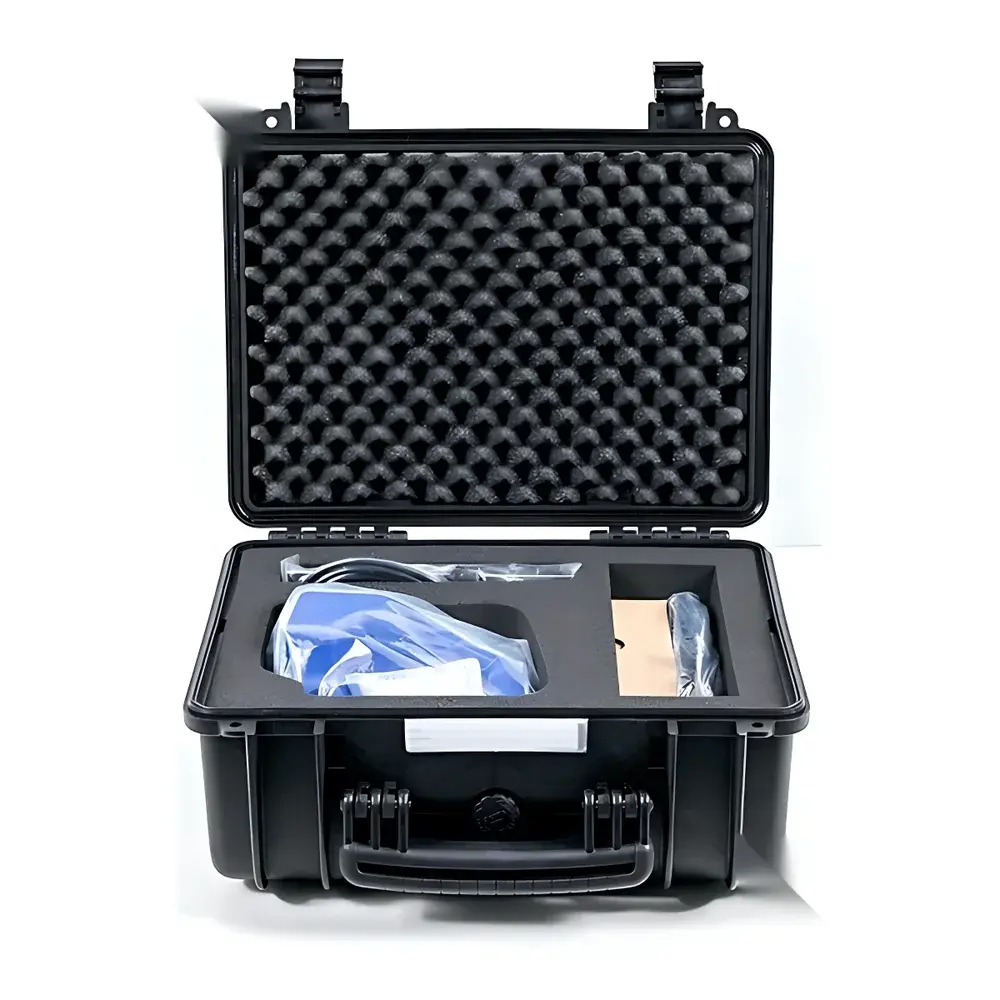
Artec Space Spider Industrial-Grade Handheld 3D Scanner
| Brand | Artec |
|---|---|
| Model | Space Spider |
| Measurement Principle | Structured Blue Light Triangulation |
| Accuracy | Up to 0.05 mm |
| Resolution | Up to 0.1 mm |
| Working Distance | 180–300 mm |
| Field of View (H × V) | 190 × 140 mm |
| Scan Speed | 7.5 fps |
| Texture Capture | Full-color RGB, 1.3 MP |
| Weight | 0.85 kg |
| Operating Temperature | 10–35 °C |
| Certification | CE, FCC, RoHS |
| Software Compatibility | Artec Studio (v14+), CAD Export (STEP, IGES, X_T, STL, OBJ, PLY, FBX, PDF 3D) |
| Compliance | ISO 17025 traceable calibration procedures available |
| Data Security | Local processing only |
Overview
The Artec Space Spider is an industrial-grade handheld 3D scanner engineered for metrology-class accuracy in demanding engineering and manufacturing environments. Built upon high-frequency structured blue light triangulation, it delivers sub-100 µm resolution and certified accuracy of up to 0.05 mm—validated against NIST-traceable reference artifacts. Originally developed under ESA specifications for use aboard the International Space Station, its thermal-stable aluminum-magnesium chassis and aerospace-grade electronics ensure consistent performance across ambient temperature fluctuations (10–35 °C), eliminating warm-up drift and enabling repeatable measurements within ±0.02 mm over extended sessions. Unlike consumer-grade scanners reliant on ambient lighting or infrared patterns, Space Spider’s active blue light projection system operates independently of ambient conditions, ensuring reliable capture of reflective, dark, or low-texture surfaces—including polished metals, anodized alloys, and matte black plastics—without spray or target markers.
Key Features
- Metrology-validated accuracy: Factory-calibrated to ISO 10360-8 and compatible with ISO/IEC 17025-accredited verification protocols.
- Real-time adaptive meshing: On-device GPU-accelerated surface reconstruction delivers clean, watertight polygonal meshes at 7.5 frames per second, with automatic hole-filling and edge preservation for sharp features.
- Thermal compensation architecture: Integrated dual-sensor thermal monitoring adjusts projection and camera parameters dynamically, maintaining dimensional stability during multi-hour scanning sessions.
- Lightweight ergonomic design: Weighing only 0.85 kg with balanced center-of-gravity positioning, optimized for fatigue-free operation during handheld inspection workflows.
- Full-spectrum color texture mapping: 1.3 MP RGB sensor synchronized with geometry capture enables photorealistic texturing—critical for visual inspection, documentation, and AR/VR integration.
- Offline-first data handling: All processing occurs locally; no mandatory cloud connectivity or telemetry transmission—supporting ITAR, GDPR, and internal data governance policies.
Sample Compatibility & Compliance
Space Spider reliably captures geometrically complex parts ranging from miniature components (e.g., PCBs, micro-gears, turbine blades, dental implants) to large-scale assemblies (e.g., engine manifolds, composite tooling, structural brackets) when used with optional turntables or photogrammetry targets. Its blue light wavelength (450 nm) minimizes specular interference and enhances contrast on metallic and ceramic surfaces. The device complies with CE, FCC Part 15 Class B, and RoHS directives. For regulated industries, Artec Studio software supports audit-ready project logs, user access control, and electronic signatures aligned with FDA 21 CFR Part 11 requirements when deployed in validated environments. Calibration certificates include uncertainty budgets per ISO/IEC 17025:2017 Annex A.3.
Software & Data Management
Artec Studio v14+ provides a unified workflow for alignment, global registration, noise filtering, simplification, and deviation analysis against CAD references. It supports GD&T annotation (ISO 1101), cross-sectional slicing, and automated report generation (PDF, HTML, Excel). Native export formats include STEP AP242 (for parametric CAD interoperability), IGES, Parasolid (.x_t), STL (binary/ASCII), OBJ, PLY, and FBX—ensuring compatibility with Siemens NX, SolidWorks, CATIA, Creo, and Geomagic Control X. All raw scan data and processing history are stored in encrypted local project files (.artec), enabling full reproducibility and version control without dependency on proprietary cloud infrastructure.
Applications
- Reverse engineering of legacy parts lacking CAD documentation—enabling rapid digital twin creation and tolerance-driven model refinement.
- In-process quality assurance: Comparative analysis of machined or cast components against nominal geometry, including wall thickness mapping and warpage assessment.
- Tooling and fixture validation: Verification of mold cavity fidelity, electrode wear, and jig repeatability prior to production ramp-up.
- Medical device prototyping: Accurate digitization of anatomical models, hearing aids, and orthopedic implants for regulatory submission packages.
- Aerospace component certification: Dimensional verification of turbine blades, fuel nozzles, and composite airframe sections per AS9100-relevant inspection criteria.
- Academic and R&D labs: Non-contact measurement of deformation under load, thermal expansion studies, and material behavior characterization.
FAQ
Is Space Spider suitable for ISO/IEC 17025-compliant metrology labs?
Yes—when paired with traceable calibration artifacts and documented procedures, Space Spider meets foundational requirements for accredited dimensional testing laboratories.
Does it require external tracking or photogrammetry for large-object scanning?
Photogrammetry targets are optional but recommended for objects >1 m; built-in hybrid tracking fuses visual odometry with geometry constraints for markerless operation on smaller parts.
Can scan data be integrated directly into statistical process control (SPC) systems?
Yes—via Artec Studio’s API and CSV export of deviation metrics, enabling direct ingestion into Minitab, JMP, or custom SPC dashboards.
What is the typical recalibration interval?
Artec recommends annual factory recalibration; interim verification using certified gauge blocks or sphere artifacts is advised per internal QA protocols.
Is USB-C power delivery supported?
No—Space Spider requires its dedicated 24 V DC power adapter; USB-C is used solely for data transfer (USB 3.1 Gen 1).



