
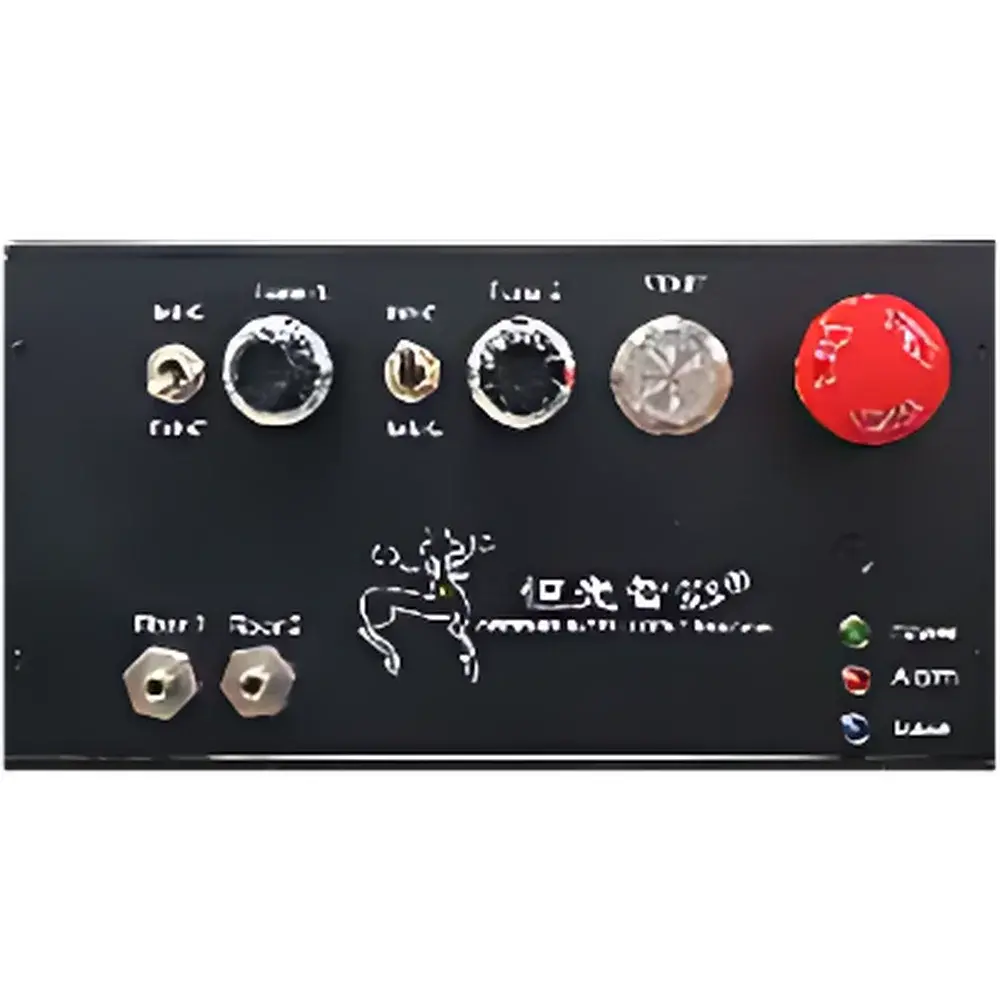
Artemis MARS Series High-Power CW Diode Laser System
| Brand | Artemis |
|---|---|
| Model | MARS-660 / MARS-755 / MARS-808 / MARS-915 / MARS-980 / MARS-1064 |
| Output Configuration | Dual-channel, 15 W per fiber-coupled port |
| Operating Mode | Continuous Wave (CW) |
| Drive Current | 12 A |
| Drive Voltage | 3.6 V (pump-source dependent) |
| Modulation | TTL-compatible, ≤1 µs fall time at 300 Hz |
| Power Stability | <5% RMS over 8 hours |
| Warm-up Time | <5 min |
| Cooling | Integrated water-cooled plate (customer-supplied cold plate) |
| Ambient Operating Temperature | 10–35 °C |
| Control Interface | RS232 |
| Fiber Coupling | Dual liquid-core fiber ports |
| Input Power Efficiency | >90% (80 PLUS Platinum equivalent) |
| Safety Compliance | IEC 60825-1:2014 Class 4 laser system with integrated LD driver protection and interlock circuitry |
Overview
The Artemis MARS Series is a modular, high-reliability continuous-wave (CW) diode laser platform engineered for demanding optical laboratory applications requiring stable, multi-wavelength, fiber-coupled output. Unlike pulsed or Q-switched sources, the MARS system operates exclusively in CW mode—enabling precise photothermal stimulation, pump-probe alignment, fluorescence excitation, and optogenetic actuation where temporal stability and low-noise irradiance are critical. Its core architecture integrates dual independent laser channels onto a single thermally managed water-cooled baseplate, eliminating mechanical drift between emitters and ensuring long-term beam pointing stability. Each channel supports direct modulation via TTL input, with sub-microsecond electrical response optimized for synchronization with external timing systems such as lock-in amplifiers or digital delay generators. The system’s global AC input compatibility (90–264 VAC, 47–63 Hz), combined with >90% power conversion efficiency, reduces thermal load and operational overhead in shared lab environments.
Key Features
- Dual-channel architecture with independent power control—each channel delivers up to 15 W optical output through liquid-core fiber coupling, enabling simultaneous excitation at two distinct wavelengths.
- Modular wavelength selection across six standard emission bands: 660 nm (visible red), 755 nm (near-IR dermatology band), 808 nm (Nd:YAG pumping), 915 nm & 980 nm (high-efficiency Yb-doped fiber pumping), and 1064 nm (fundamental Nd:YAG output).
- Integrated, safety-certified laser diode (LD) driver with real-time current regulation, soft-start sequencing, and hardware-enforced interlock monitoring compliant with IEC 60825-1:2014 Class 4 requirements.
- RS232 serial interface supporting SCPI-like command set for remote control of output enable/disable, analog power scaling (0–100%), and status query—fully compatible with LabVIEW, Python (pySerial), MATLAB, and custom DAQ environments.
- Thermally optimized mechanical design featuring a monolithic aluminum water-cooled baseplate (customer-supplied cold plate required), eliminating thermal expansion mismatch between laser head and PSU.
- Electrical performance validated under sustained operation: <5% RMS power fluctuation over 8-hour continuous run; <5-minute warm-up to full-spec stability; <1 µs TTL fall time at 300 Hz modulation frequency.
Sample Compatibility & Compliance
The MARS Series is designed for integration into ISO/IEC 17025-accredited optical laboratories and regulated R&D environments. Its dual-fiber output configuration supports standard SMA905 or FC/PC liquid-core fibers (core diameter ≥400 µm), compatible with most commercial optical benches, spectrographs, and photobioreactors. All units undergo factory calibration traceable to NIST-traceable power meters and spectral analyzers. Electrical safety complies with IEC 61000-6-3 (EMI) and IEC 61000-6-2 (immunity). Laser safety documentation includes full hazard classification reports, nominal ocular hazard distance (NOHD) calculations, and interlock wiring schematics for GLP/GMP-aligned installations.
Software & Data Management
No proprietary GUI is bundled; instead, the MARS system provides a documented ASCII-based RS232 protocol enabling seamless integration into existing laboratory automation frameworks. Command syntax supports asynchronous querying of internal temperature sensors (TEC and LD junction), real-time power feedback (via integrated photodiode monitor), and fault logging (e.g., overtemperature, interlock open, driver fault). Audit trails generated by host software may be structured to satisfy FDA 21 CFR Part 11 requirements when deployed with electronic signature-capable platforms. Firmware updates are delivered via UART bootloader and verified using CRC32 checksums.
Applications
- Optical pumping of solid-state and fiber lasers (e.g., Nd:YVO₄, Yb:fiber, Tm:fiber)
- In-vitro and in-vivo photobiomodulation (PBM) research across therapeutic NIR windows (755–980 nm)
- Time-resolved fluorescence lifetime imaging (FLIM) excitation source synchronization
- Calibration reference for spectroradiometers and integrating sphere systems
- Industrial process monitoring where stable, multi-spectral illumination is required (e.g., semiconductor wafer inspection)
- Teaching labs for laser physics, photonics engineering, and biomedical optics curricula
FAQ
Is the MARS system suitable for use in cleanroom environments?
Yes—its sealed laser head assembly, absence of consumables, and lack of outgassing materials meet ISO Class 5 cleanroom compatibility when installed with appropriate fiber feedthroughs and grounding.
Can I operate only one channel while leaving the other disabled?
Yes—each channel is electrically isolated and independently addressable via RS232; disabling one channel has no effect on the thermal or electrical behavior of the other.
What type of water cooling is required?
A customer-supplied recirculating chiller delivering deionized water at 18–22 °C, flow rate ≥2 L/min, and pressure drop <1.5 bar across the integrated cold plate is recommended.
Does the system support analog modulation (0–5 V or 0–10 V input)?
No—only TTL-level digital modulation is supported natively; analog control requires external DAC-to-TTL conversion circuitry.
Are OEM integration kits available?
Yes—Artemis provides mechanical drawings, pinout diagrams, firmware revision history, and CE/UKCA declaration of conformity upon NDA execution for volume integrators.






