
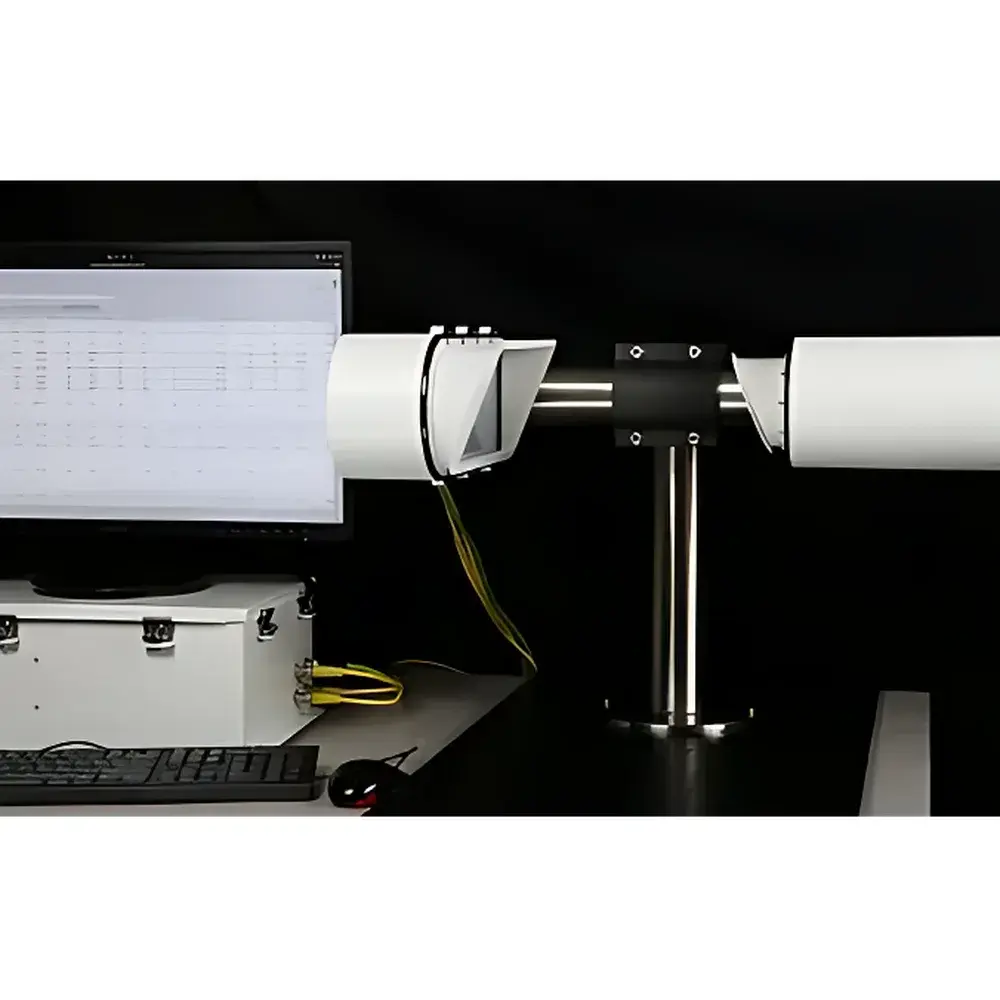
Artium DIS Particle Imaging Disdrometer
| Brand | Artium |
|---|---|
| Origin | USA |
| Model | DIS |
| Application | Droplet & Particle Size, Morphology, Velocity, and Concentration Measurement |
| Technology | Particle Tracking Velocimetry (PTV) |
| Field of View | 140 mm × 70 mm (2:1 aspect ratio) |
| Illumination | Uniform, Homogeneous LED Backlighting |
| Ruggedization | Shock- and Vibration-Resistant Design |
| Compliance Context | Designed for ASTM D6328, ISO 9276-2, and USP <788> particle imaging alignment principles |
| Software Support | Proprietary DIS-Analyzer Suite with timestamped frame capture, binary segmentation, and centroid-based trajectory reconstruction |
Overview
The Artium DIS Particle Imaging Disdrometer is a high-fidelity optical instrument engineered for quantitative in-situ characterization of liquid droplets and solid particles in free-fall or wind-driven atmospheric flows. Operating on the principle of shadowgraphy combined with Particle Tracking Velocimetry (PTV), the DIS captures high-resolution monochrome images of transient hydrometeors—raindrops, snowflakes, hailstones, and aerosolized droplets—as they traverse a precisely defined illumination plane. Unlike laser diffraction or time-of-flight methods, PTV-based imaging delivers simultaneous, non-intrusive measurement of four critical parameters per detected object: equivalent spherical diameter (ESD), two-dimensional morphology (aspect ratio, circularity, convexity), terminal velocity (via inter-frame displacement), and local volumetric concentration (derived from spatial density and sampling volume calibration). The system’s core architecture integrates a scientific-grade CCD sensor with global shutter capability, synchronized pulsed LED backlighting, and real-time triggering logic—ensuring minimal motion blur and high temporal fidelity across dynamic precipitation fields.
Key Features
- Ruggedized mechanical housing rated for field deployment in uncontrolled environments—including mobile meteorological platforms, wind tunnels, and hypersonic test facilities.
- Optimized 140 mm × 70 mm rectangular field of view (2:1 aspect ratio) balances data throughput and optical resolution while reducing susceptibility to window fouling—a critical advantage over square-format imagers in long-duration outdoor operation.
- Uniform, collimated LED backlighting minimizes intensity gradients across the imaging plane, thereby improving segmentation accuracy and reducing dependence on adaptive thresholding algorithms during post-processing.
- Hardware-triggered image acquisition with sub-millisecond timing precision ensures synchronization with external sensors (e.g., pitot tubes, pressure transducers) for multi-modal flow analysis.
- Integrated thermal management and sealed optics path maintain stable focus and MTF performance across ambient temperature fluctuations from −20 °C to +50 °C.
Sample Compatibility & Compliance
The DIS is validated for use with natural and simulated precipitation media, including distilled water droplets, glycol-based coolant mists, ice crystal analogs, and polymer microspheres (10 µm–5 mm diameter range). Its optical design conforms to fundamental requirements of ISO 9276-2 (representation of particle size analysis results) and supports traceable calibration via NIST-traceable glass microspheres and certified reference particle grids. While not a medical device, its imaging methodology aligns with USP guidance for particulate matter assessment in parenteral solutions when adapted for controlled laboratory chamber applications. Data integrity meets GLP-compliant audit trail expectations through embedded firmware logging of acquisition timestamps, exposure settings, and environmental metadata (ambient temperature, relative humidity, barometric pressure if externally interfaced).
Software & Data Management
The DIS-Analyzer software suite provides end-to-end workflow support—from raw image ingestion to statistically robust ensemble reporting. Each acquired frame undergoes automated background subtraction, adaptive contrast enhancement, and Otsu-based binarization. Detected objects are classified using morphological descriptors (solidity, Feret diameter, Hu moments) and linked across sequential frames to reconstruct 2D trajectories. Velocity vectors are computed using least-squares fitting of centroid positions, with uncertainty propagation based on pixel resolution (12 µm/pixel typical) and inter-frame interval (configurable from 1 ms to 100 ms). Export formats include CSV (per-particle metadata), HDF5 (lossless frame stacks with metadata), and PDF summary reports compliant with internal QA documentation standards. All software modules operate under Windows 10/11 x64 and support FDA 21 CFR Part 11–aligned user access controls when deployed in regulated environments.
Applications
- Meteorological research: Quantification of drop size distribution (DSD), rain rate estimation, and microphysical classification of convective vs. stratiform precipitation.
- Aerospace materials testing: Impact damage assessment of thermal protection systems (TPS) and leading-edge composites under simulated rain erosion conditions at Mach 5+ flight envelopes.
- Industrial spray characterization: Validation of nozzle atomization efficiency, droplet breakup regimes, and plume uniformity in fuel injection, agricultural spraying, and pharmaceutical inhaler development.
- Environmental monitoring: Real-time detection of airborne particulates in volcanic ash plumes, wildfire smoke, and industrial stack emissions.
- Calibration transfer: Reference-grade validation of optical disdrometers (e.g., OTT Parsivel, Thies LPM) and radar-derived DSD retrievals.
FAQ
What is the minimum resolvable droplet size under standard operating conditions?
The effective lower detection limit is approximately 25 µm ESD, contingent upon sufficient contrast, illumination stability, and signal-to-noise ratio in the captured shadowgraph.
Can the DIS be integrated with existing weather station networks?
Yes—the system supports RS-485 serial output and Modbus TCP/IP protocols for direct integration into SCADA and NOAA-compatible telemetry infrastructures.
Is remote firmware update supported?
Firmware updates are performed via secure USB connection; network-based updates are not enabled by default to maintain regulatory compliance in controlled environments.
Does the DIS require periodic recalibration?
No routine recalibration is required; however, annual verification using NIST-traceable particle standards is recommended for ISO/IEC 17025-accredited laboratories.
What environmental certifications does the DIS hold?
The enclosure meets IP65 ingress protection and MIL-STD-810G shock/vibration specifications; CE marking is pending final EU conformity assessment under 2014/30/EU EMC Directive.





