
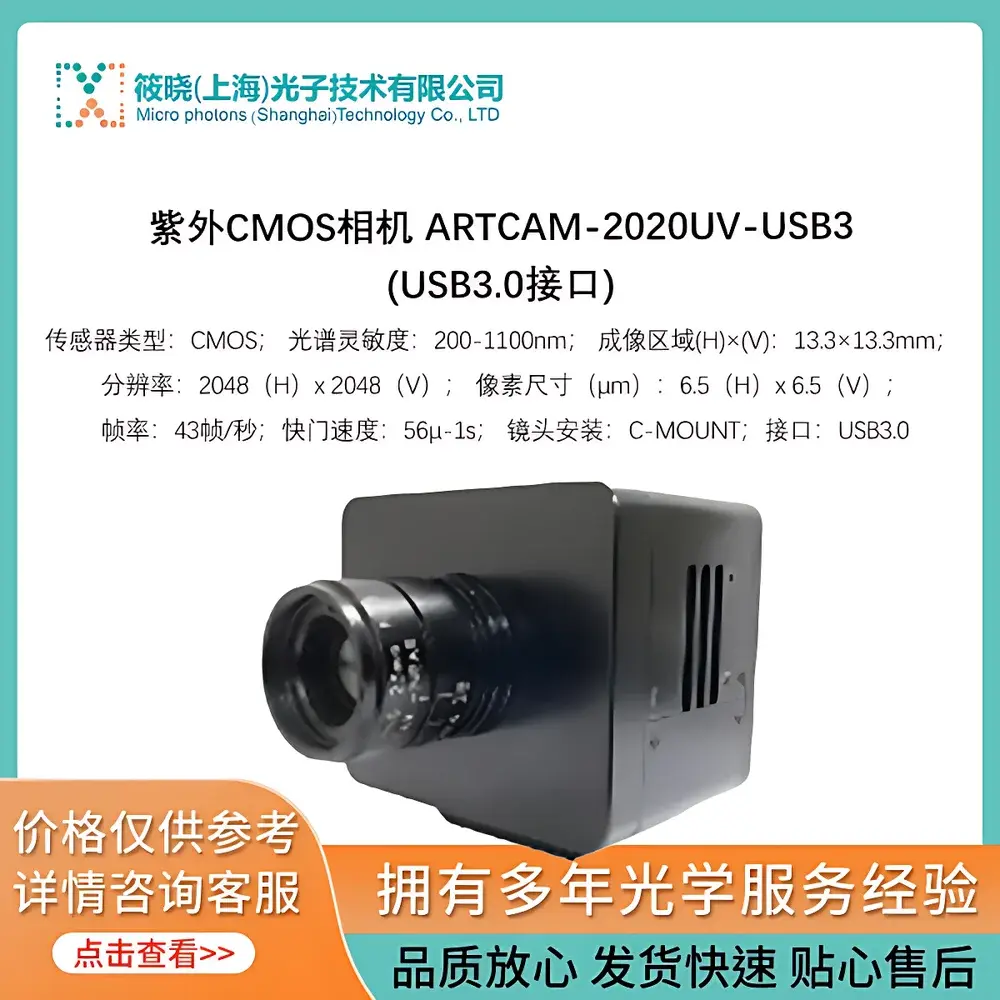
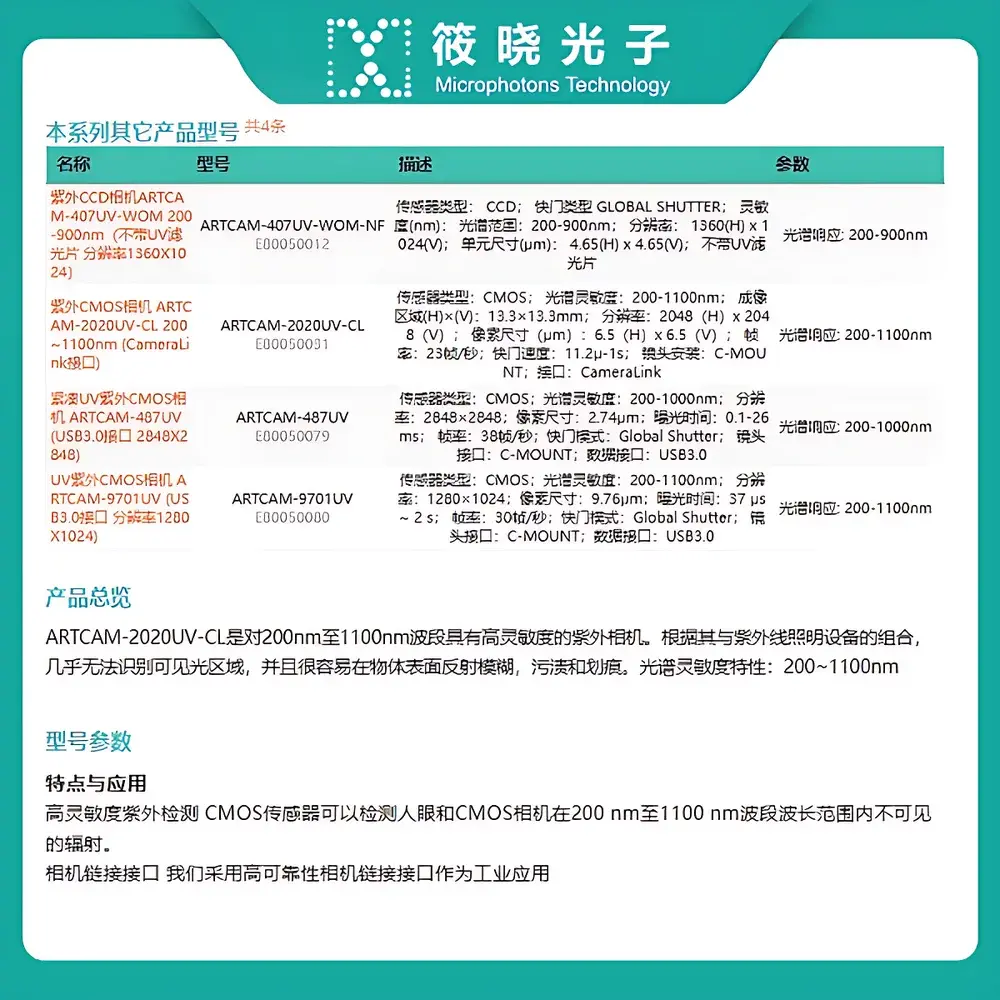
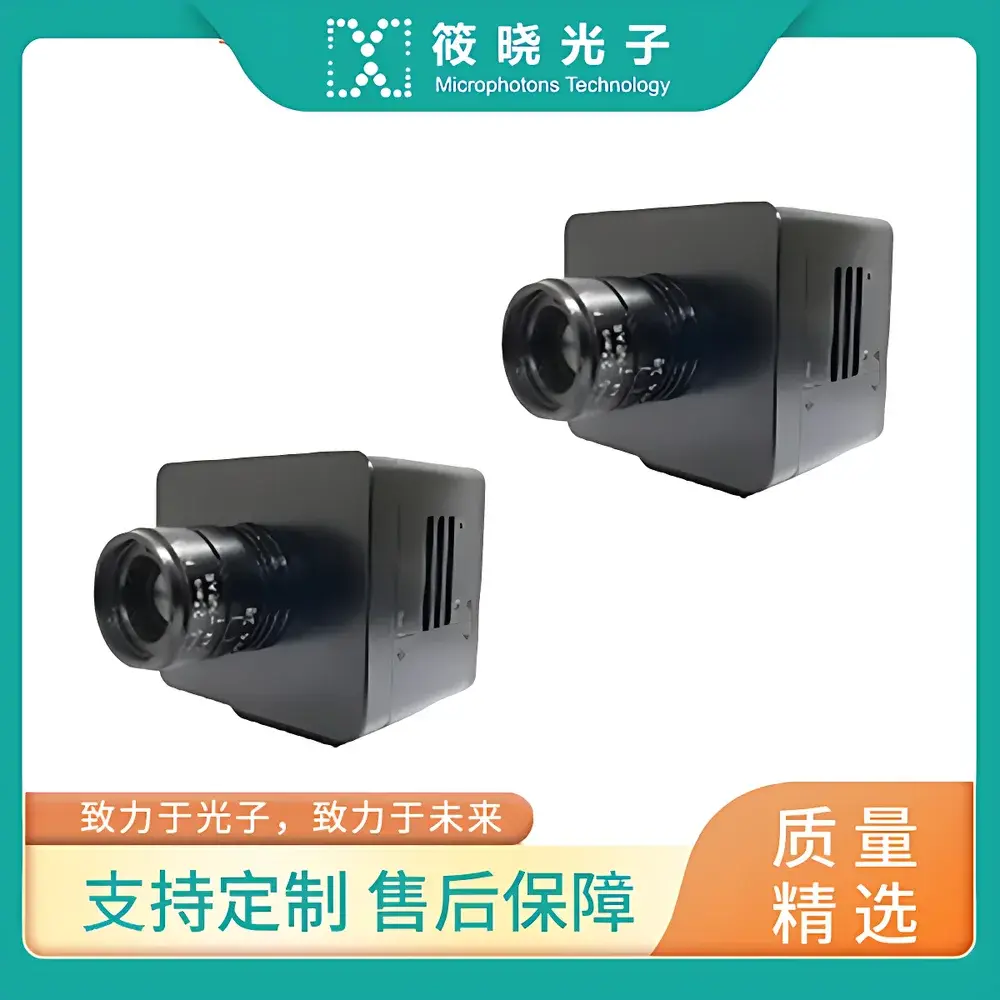
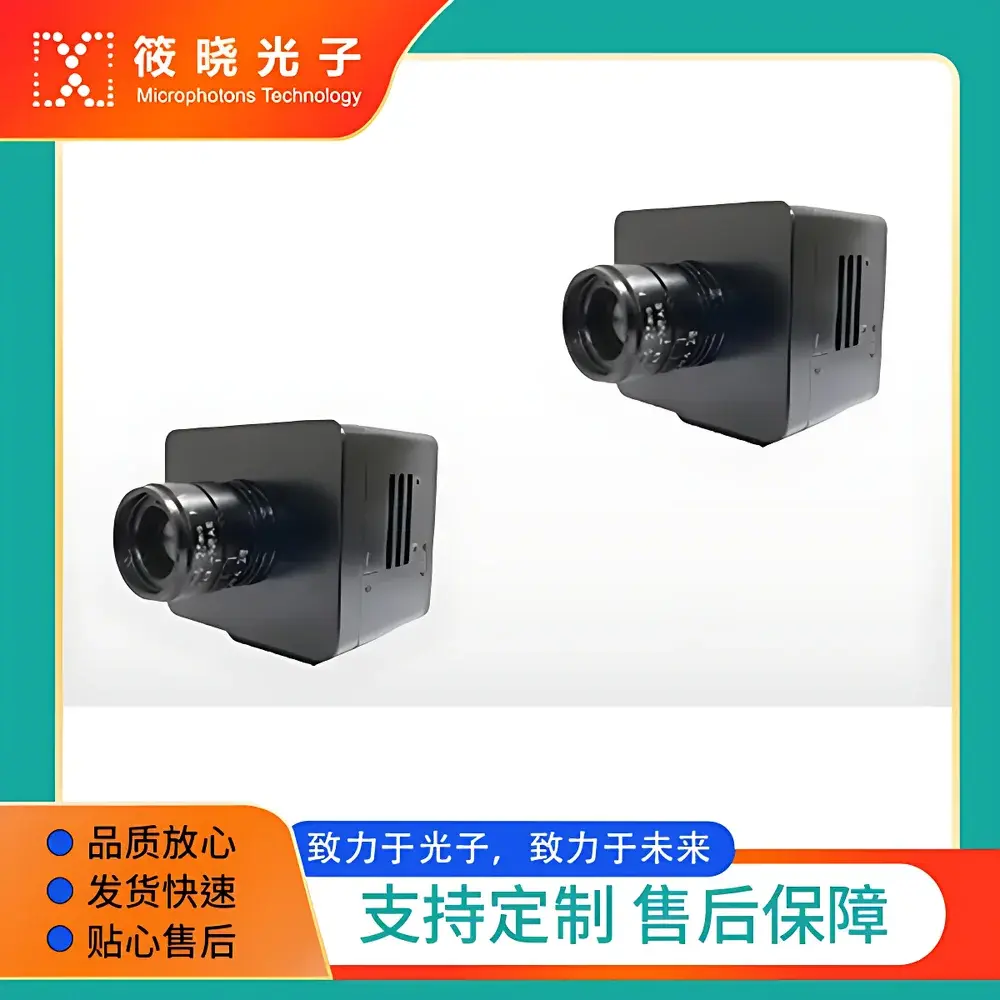
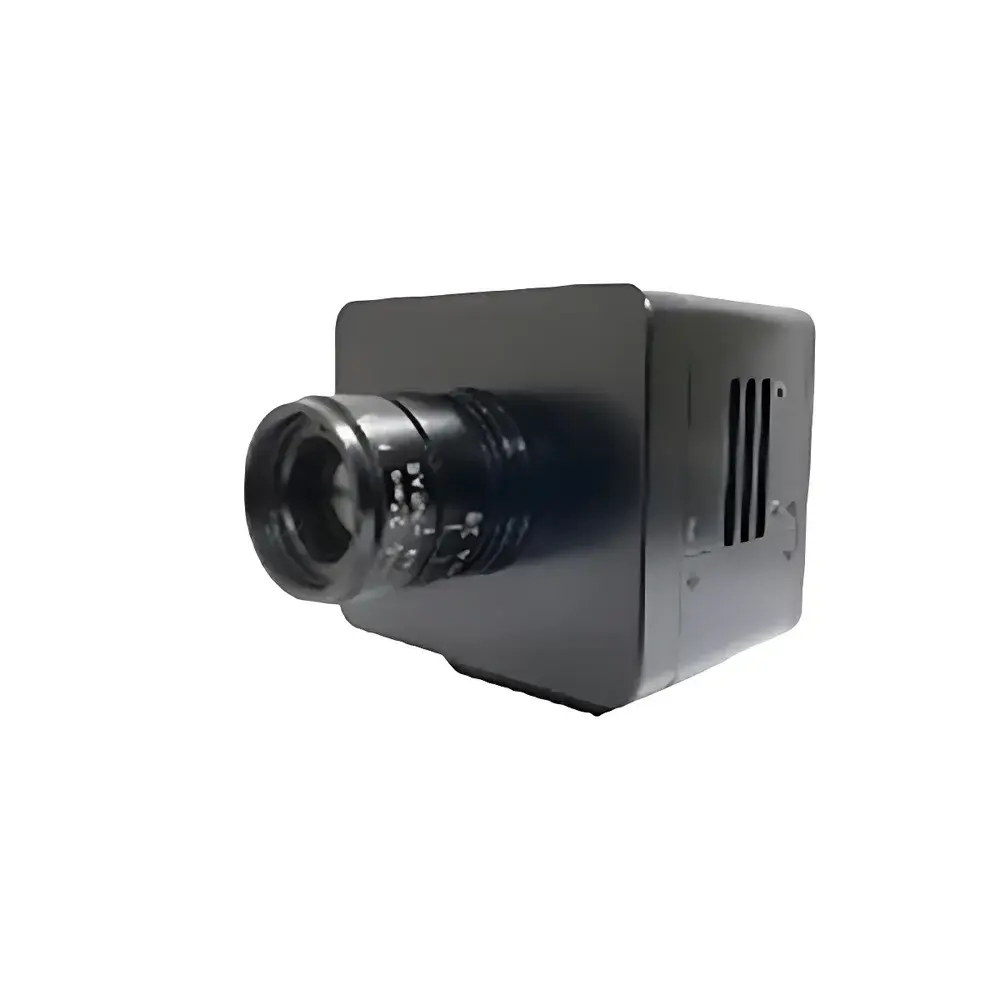
Artray ARTCAM-2020UV-USB3 UV-Sensitive CMOS Imaging Camera with USB 3.0 Interface
| Brand | Artray |
|---|---|
| Origin | Japan |
| Model | ARTCAM-2020UV-USB3 |
| Sensor Type | CMOS (GSENSE2020BSI back-illuminated) |
| Spectral Response | 200–1100 nm |
| Resolution | 2048 × 2048 pixels |
| Pixel Size | 6.5 µm × 6.5 µm |
| Imaging Area | 13.3 mm × 13.3 mm |
| Shutter Mode | Rolling shutter with global reset capability |
| Frame Rate | 23 fps |
| Exposure Time | 11.2 µs – 1 s |
| A/D Resolution | 11/12 bits |
| Output Bit Depth | 12-bit |
| Interface | USB 3.0 |
| Lens Mount | C-mount |
| Power Supply | DC 12 V |
| Power Consumption | ~6 W |
| Operating Temperature | 0–35 °C |
| Dimensions (W×H×D) | 71.6 × 61.5 × 51.5 mm |
| Weight | ~240 g |
Overview
The Artray ARTCAM-2020UV-USB3 is a high-performance, back-illuminated scientific CMOS imaging camera engineered for quantitative ultraviolet (UV) and near-infrared (NIR) spectral detection across a broad 200–1100 nm range. Unlike standard visible-light cameras, this model leverages the GSENSE2020BSI sensor—a monolithic, backside-illuminated CMOS device optimized for quantum efficiency enhancement below 350 nm—enabling reliable photon capture in deep-UV regions where silicon-based sensors typically exhibit steep quantum efficiency roll-off. Its optical architecture supports direct integration with UV-transmissive optics (e.g., fused silica lenses), quartz light guides, and narrowband UV excitation sources, making it suitable for non-destructive surface inspection, fluorescence lifetime mapping, semiconductor wafer defect analysis, and UV-curable resin process monitoring. The camera operates on a rolling shutter with programmable global reset functionality, balancing temporal resolution and spatial fidelity without mechanical shutter constraints.
Key Features
- Back-illuminated GSENSE2020BSI CMOS sensor delivering peak quantum efficiency >65% at 254 nm and sustained sensitivity up to 1100 nm
- True 2048 × 2048 active pixel array with uniform 6.5 µm square pixels and <0.3% pixel response non-uniformity (PRNU)
- 12-bit digitization with dual-gain readout modes (11-bit low-noise / 12-bit high-dynamic-range) and ≤1.6 e⁻ RMS read noise at 12-bit mode
- USB 3.0 Vision-compliant interface ensuring deterministic data transfer at full frame rate (23 fps at full resolution) with minimal host CPU overhead
- C-mount lens interface compatible with industry-standard UV-grade optics; optional UV-pass filter mounting flange available
- Programmable exposure control from 11.2 µs to 1 s with hardware-triggered acquisition support (TTL-compatible external trigger input)
- Robust thermal design enabling stable operation over 0–35 °C ambient range; no active cooling required for typical laboratory duty cycles
Sample Compatibility & Compliance
The ARTCAM-2020UV-USB3 is designed for use in controlled laboratory and industrial environments requiring traceable, repeatable UV imaging. It complies with IEC 61000-6-3 (EMC emission standards) and meets RoHS 2 directive requirements. While not certified under FDA 21 CFR Part 11 or ISO 13485, its firmware architecture supports audit-ready metadata logging—including timestamp, exposure parameters, gain settings, and sensor temperature—for GLP/GMP-aligned documentation workflows. The camera’s spectral response has been validated per ISO 15739:2013 (photographic sensitivity measurement) using NIST-traceable deuterium and tungsten-halogen reference sources. It interfaces seamlessly with UV LED arrays (254 nm, 280 nm, 365 nm), mercury-vapor lamps, and synchrotron beamlines when coupled with appropriate bandpass filtering.
Software & Data Management
The camera ships with Artray’s proprietary ART-VIEWER software suite, supporting real-time preview, histogram analysis, region-of-interest (ROI) statistics, and multi-frame averaging. Device drivers are provided for Windows 10/11 (x64) and Linux (Ubuntu 20.04+, kernel 5.4+), with full GenICam-compliant XML feature description files. An open-source SDK (C/C++, Python bindings) enables integration into custom image acquisition pipelines compliant with OpenCV 4.8+, HALCON 22.11, or LabVIEW 2022 SP1. All acquired frames embed EXIF-like metadata tags (exposure time, analog gain, black level offset, sensor temperature) for downstream traceability. Raw 12-bit linear data is saved in TIFF or HDF5 format, preserving bit-depth integrity for quantitative photometric analysis.
Applications
- Surface contamination detection on silicon wafers, glass substrates, and polymer films using UV-induced fluorescence contrast
- Non-contact inspection of microcracks, delamination, and coating thickness variation in aerospace composites under UV reflectance imaging
- Time-resolved UV fluorescence decay profiling in pharmaceutical tablet coating uniformity assessment
- In-line monitoring of UV-curing kinetics in 3D printing resins and adhesive dispensing systems
- Forensic document examination via UV-excited ink luminescence and substrate fiber structure visualization
- Plasma diagnostics in low-pressure discharge chambers through spectral line imaging at 254 nm (Hg line) and 308 nm (XeCl excimer)
FAQ
Does the ARTCAM-2020UV-USB3 include a UV-pass filter?
No—the camera is supplied without built-in spectral filtering. Users must select and install appropriate UV-bandpass filters (e.g., 254 nm ±5 nm, 365 nm ±10 nm) based on application-specific excitation source and target emission characteristics.
Is the sensor sensitive to ozone-producing vacuum-UV (<200 nm)?
No—the GSENSE2020BSI sensor’s native cutoff begins at ~200 nm due to atmospheric oxygen absorption and quartz window transmission limits; operation below 200 nm requires purged or vacuum-compatible housings and MgF₂ optics, which are not included.
Can this camera synchronize with pulsed UV lasers?
Yes—via TTL-compatible external trigger input with ≤100 ns jitter; supports both rising-edge and falling-edge triggering with programmable delay (0–100 ms) for precise laser-gated acquisition.
What is the maximum sustained frame rate at reduced ROI sizes?
At 1024 × 1024 ROI, frame rate increases to ≥45 fps; at 512 × 512, it exceeds 90 fps—subject to host system PCIe bandwidth and buffer management configuration.
Is calibration data (flat-field, dark current) provided with the unit?
Yes—each unit ships with factory-acquired dark frame libraries (at multiple temperatures and exposure times) and flat-field correction maps, accessible via the SDK for pixel-level radiometric correction.




