
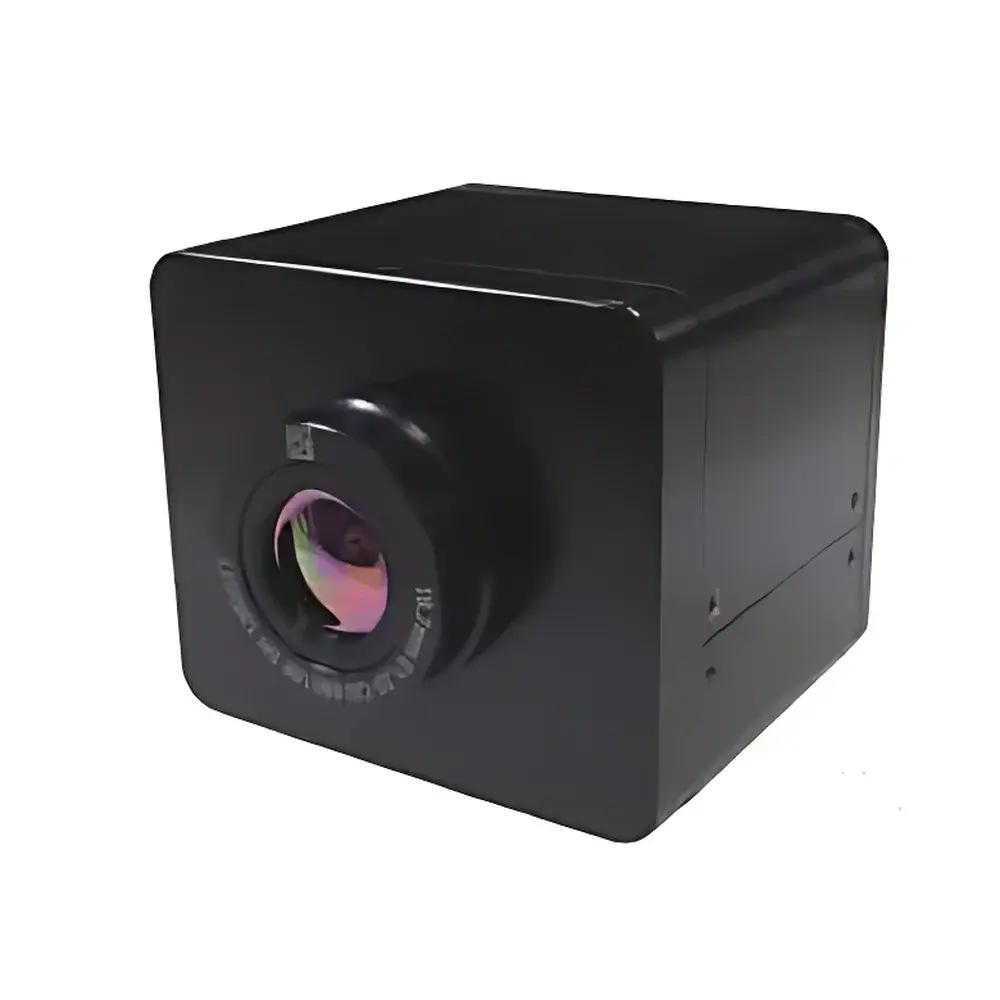
Artray ARTCAM-640P-THERMO Uncooled Microbolometer Infrared Thermal Imaging Camera
| Brand | Artray |
|---|---|
| Origin | Japan |
| Model | ARTCAM-640P-THERMO |
| Detector Type | Uncooled Microbolometer |
| Spectral Response Range | 8–14 µm |
| Pixel Pitch | 17 µm |
| Thermal Sensitivity (NETD) | <75 mK |
| Operating Pixel Ratio | >99.5% |
| Temperature Measurement Range | 0–150 °C |
| Interface | USB 3.0 / Gigabit Ethernet |
| Resolution | 640 × 480 (VGA) |
Overview
The Artray ARTCAM-640P-THERMO is a high-performance uncooled microbolometer-based infrared thermal imaging camera engineered for precision non-contact temperature measurement and thermographic analysis in industrial R&D, quality assurance, electronics validation, and preventive maintenance applications. Operating within the long-wave infrared (LWIR) atmospheric transmission window (8–14 µm), the camera leverages a vacuum-packaged VOx microbolometer focal plane array (FPA) to detect minute thermal emissions without requiring cryogenic cooling. Its VGA-resolution (640 × 480) detector delivers spatial fidelity suitable for identifying localized hotspots on PCBs, thermal bridging in building envelopes, or transient anomalies in motor windings. The system adheres to fundamental radiometric principles—calibrating raw digital counts to absolute temperature values via Planck’s law, emissivity compensation, and ambient background correction—ensuring traceable, repeatable measurements compliant with ISO 18434-1 (Condition monitoring — Thermography) guidelines.
Key Features
- VGA-format (640 × 480) uncooled microbolometer detector with 17 µm pixel pitch, optimized for high spatial resolution and thermal uniformity
- Thermal sensitivity (NETD) <75 mK at f/1.0, enabling reliable detection of sub-degree temperature differentials under ambient conditions
- Full radiometric output: every pixel delivers calibrated temperature data (°C), supporting quantitative thermal profiling and time-series delta-T analysis
- Dual high-bandwidth interface options: USB 3.0 for plug-and-play integration with portable workstations; Gigabit Ethernet for deterministic streaming in networked lab or factory-floor environments
- Robust mechanical architecture with aluminum housing, IP54-rated ingress protection, and operational stability across 0–45 °C ambient range
- Factory-calibrated across the full 0–150 °C measurement span, with NIST-traceable calibration documentation available upon request
Sample Compatibility & Compliance
The ARTCAM-640P-THERMO is compatible with static and slowly dynamic thermal scenes typical of electronic component testing, material thermal conductivity assessment, HVAC duct inspection, and low-speed mechanical systems. It supports user-defined emissivity input (0.01–1.00, 0.001 increments) and reflected apparent temperature compensation—critical for accurate readings on polished metals, composites, or coated surfaces. The device conforms to IEC 61000-6-3 (EMC emission limits) and IEC 61000-6-2 (immunity requirements). Its radiometric firmware architecture supports audit-ready data logging aligned with GLP/GMP documentation practices, including timestamped metadata (exposure time, lens ID, calibration date) embedded in each thermal image file (radiometric TIFF or proprietary .art format).
Software & Data Management
Artray provides the cross-platform ARTView software suite (Windows/macOS/Linux), offering real-time thermal video capture, region-of-interest (ROI) statistics (min/max/mean/std dev), isotherm overlays, and customizable color palettes (ironbow, grayscale, high-contrast). Export formats include radiometric TIFF (with embedded temperature metadata), CSV (pixel-wise temperature matrices), and AVI (non-radiometric visualization). For integration into automated QA workflows, the SDK supports C/C++, Python, and LabVIEW APIs—enabling synchronization with external triggers, PLC signals, or environmental sensors. All captured radiometric data includes immutable acquisition headers required for FDA 21 CFR Part 11-compliant environments when deployed with appropriate electronic signature and audit trail configurations.
Applications
- Electronics reliability testing: Junction temperature mapping of ICs, thermal stress screening of solder joints, and thermal runaway detection in battery modules
- Industrial predictive maintenance: Bearing temperature trending, insulation degradation assessment in transformers, and steam trap functionality verification
- R&D thermal characterization: Heat dissipation analysis of heat sinks, thermal interface material (TIM) performance validation, and additive manufacturing process monitoring
- Building diagnostics: Detection of moisture infiltration, thermal bridging, and envelope air leakage per ASTM C1060 and ISO 6781-3 standards
- Academic research: Convective heat transfer coefficient estimation, phase-change material behavior, and low-power device thermal modeling
FAQ
Is the ARTCAM-640P-THERMO suitable for measuring temperatures below 0 °C or above 150 °C?
No—the specified calibrated measurement range is strictly 0–150 °C. Operation outside this span compromises radiometric accuracy and may invalidate factory calibration.
Does the camera support real-time temperature alarms or hardware-triggered capture?
Yes—ARTView software enables user-defined thermal thresholds with audible/visual alerts; the SDK exposes GPIO-compatible trigger inputs for synchronized multi-sensor acquisition.
Can radiometric data be exported for third-party analysis in MATLAB or Python?
Yes—TIFF exports retain full 16-bit per-pixel temperature values; Python users can directly load .art files using the provided NumPy-compatible reader module.
What lens options are available for field-of-view customization?
Standard configuration includes a 24° × 18° f/1.0 lens; optional wide-angle (45° × 34°) and telephoto (12° × 9°) lenses are available with calibrated distortion correction profiles.
Is firmware upgradability supported, and how are calibration updates handled?
Firmware updates are delivered via Artray’s secure portal; recalibration services—including drift compensation and extended-range validation—are offered through authorized service centers with NIST-traceable reference sources.




