
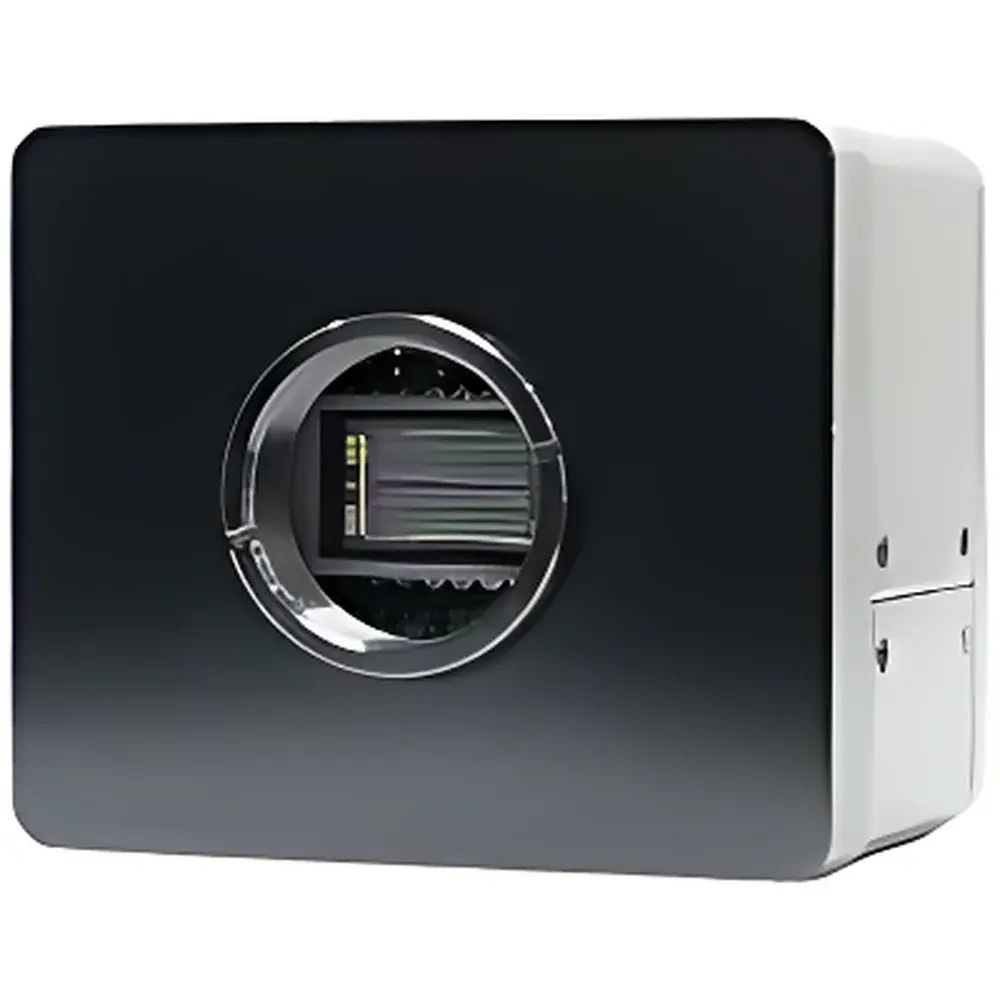
ARTRAY ARTCAM-L1024DTNIR InGaAs Linear Array Camera
| Brand | ARTRAY |
|---|---|
| Sensor Type | InGaAs linear array |
| Spectral Range | 900–1700 nm |
| Resolution Options | 1024, 512, or 258 pixels |
| Pixel Pitch | 25 × 100 µm (L1024DTNIR), 25 × 25 µm (L512DTNIR/L258DTNIR), 50 × 50 µm (L258DTNIR) |
| Active Area | up to 25.6 × 0.1 mm |
| Interface | USB 3.0 |
| A/D Resolution | 14-bit |
| Quantum Efficiency | High across SWIR band (peak >70% at 1300–1550 nm) |
| Cooling | Thermoelectric (TE) stabilized |
| Compliance | CE, RoHS, ISO 9001-manufactured |
Overview
The ARTRAY ARTCAM-L1024DTNIR is a high-performance short-wave infrared (SWIR) linear array camera engineered for precision spectral and imaging applications in the 900–1700 nm wavelength range. Based on monolithic InGaAs photodiode array technology, it operates on the principle of photoconductive detection with optimized charge integration and low-noise correlated double sampling (CDS). Unlike area-scan sensors, its linear architecture enables continuous, high-speed line-scan acquisition—ideal for real-time process monitoring, hyperspectral line imaging, and Fourier-transform-based spectrometer integration. Designed and manufactured in Japan under stringent ISO 9001 quality management systems, the camera delivers stable dark current performance, high quantum efficiency (>70% typical at 1300–1550 nm), and excellent pixel-to-pixel uniformity—critical for quantitative radiometric analysis and calibration traceability in R&D and industrial QA/QC environments.
Key Features
- InGaAs linear sensor with selectable configurations: 1024-, 512-, or 258-pixel variants, supporting flexible optical design and system integration
- High sensitivity with large effective pixel area (e.g., 25 × 100 µm for L1024DTNIR) and low read noise (<15 e⁻ RMS at 100 kHz line rate)
- 14-bit analog-to-digital conversion ensures dynamic range exceeding 84 dB, enabling simultaneous capture of weak and strong SWIR signals
- Integrated thermoelectric (TE) cooler maintains sensor temperature stability within ±0.1 °C—reducing thermal drift and dark current variability over extended acquisitions
- USB 3.0 interface provides sustained data throughput up to 320 MB/s, supporting real-time line rates up to 12 kHz (full 1024-pixel mode) without frame buffering bottlenecks
- Factory-calibrated non-uniformity correction (NUC) tables embedded in firmware; optional user NUC update via provided SDK
Sample Compatibility & Compliance
The ARTCAM-L1024DTNIR is compatible with standard C-mount and M42-thread optics optimized for SWIR transmission (e.g., ZnSe, Ge, or CaF₂ lenses). Its spectral response is validated per IEC 62471 for LED/laser safety classification and conforms to EN 61326-1 (EMC for laboratory equipment) and EN 61000-6-3 (emission limits). For regulated environments—including pharmaceutical process analytical technology (PAT), semiconductor wafer inspection, and defense-related spectral sensing—the camera supports audit-ready metadata logging (timestamp, exposure, gain, sensor temp) and is deployable under GLP-compliant workflows. While not intrinsically FDA 21 CFR Part 11 compliant, its deterministic data output and SDK-based control enable integration into validated systems meeting Part 11 requirements when paired with appropriate electronic signature and audit trail middleware.
Software & Data Management
ARTRAY provides a native Windows/Linux SDK (C/C++, Python bindings) with full register-level access to exposure timing, gain staging, TE control, and trigger synchronization (TTL input/output). The included ARTCAM Control Studio offers real-time line-profile visualization, histogram analysis, ROI averaging, and export to HDF5, TIFF, or CSV formats with embedded EXIF-like metadata. All acquired frames retain precise time-stamping synchronized to internal oscillator (±50 ppm stability). For OEM integration, DLL/so libraries support deterministic latency control (<100 µs jitter on trigger-to-readout), essential for closed-loop sorting or laser-gated acquisition. Raw 14-bit data is preserved end-to-end—no on-board gamma correction or lossy compression applied—ensuring fidelity for post-acquisition spectral deconvolution or machine learning feature extraction.
Applications
- Spectroscopy: Core detector in grating- or prism-based SWIR spectrometers (e.g., for polymer identification, moisture quantification in agricultural products, or hydrocarbon mapping)
- Industrial Inspection: Real-time web inspection of plastic films, battery electrode coatings, and silicon wafers—leveraging SWIR contrast for subsurface defect detection and thickness uniformity analysis
- Scientific Imaging: Fluorescence lifetime imaging (FLIM) support in NIR-II window (1000–1700 nm), particularly for indocyanine green (ICG) and IR-26 dyes
- Machine Vision: High-speed sorting of recyclables (e.g., distinguishing black plastics by spectral reflectance), food quality grading (bruise detection in apples, sugar content in citrus), and pharmaceutical tablet coating uniformity assessment
- Defense & Security: Covert surveillance and laser beam profiling in eye-safe SWIR bands; compatible with active illumination systems using 1550 nm VCSELs
FAQ
What is the maximum line rate achievable at full resolution (1024 pixels) with 14-bit output?
The ARTCAM-L1024DTNIR achieves up to 12,000 lines per second when configured with minimum inter-line delay and USB 3.0 bulk transfer optimization.
Does the camera support hardware triggering with external synchronization?
Yes—it features TTL-compatible trigger-in and trigger-out ports with programmable polarity and pulse width, enabling precise synchronization with motion stages, lasers, or illumination sources.
Is cooling mandatory for stable operation?
Thermoelectric cooling is integrated and active by default; disabling it increases dark current by ~3× and reduces dynamic range by ~12 dB—recommended only for short-duration, ambient-temperature-limited applications.
Can I perform radiometric calibration with this camera?
Yes—NIST-traceable calibration services are available from ARTRAY; users may also apply custom flat-field and dark-frame correction using SDK-provided routines.
Which optical interfaces are mechanically supported?
Standard C-mount (17.526 mm flange focal distance) and optional M42 × 1 mm thread adapters are provided; custom mounts available upon request.





