
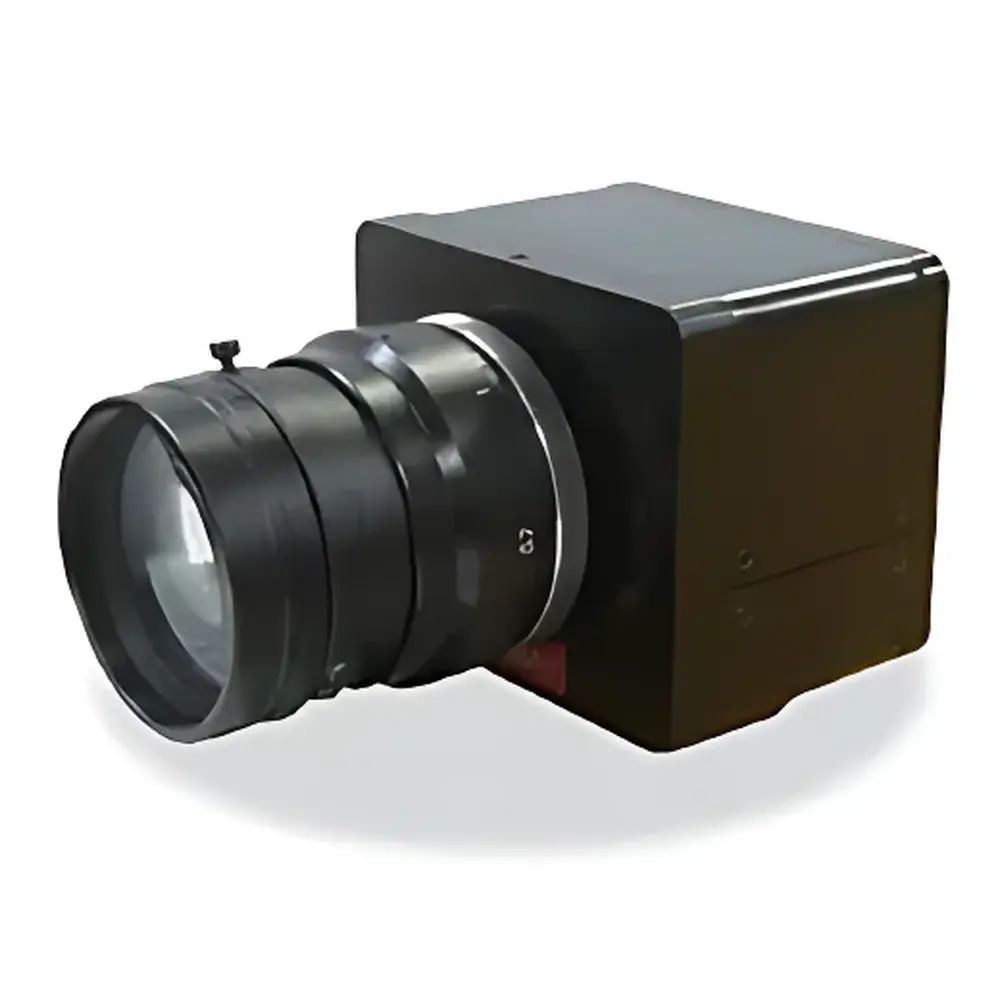
Artray ARTCAM TNIR Uncooled InGaAs Area-Scan Camera
| Brand | Artray |
|---|---|
| Origin | Japan |
| Model | ARTCAM TNIR Series |
| Spectral Range | 900–1700 nm |
| Resolution Options | 640×512, 320×256, 128×128 pixels |
| Pixel Pitch | 20 µm (standard), up to 30 µm |
| Frame Rate | up to 258 fps |
| Interface | USB 3.0 / USB 2.0 |
| Analog Video Output | Optional |
| A/D Resolution | 12–14 bit |
| Shutter Type | Global |
| Target Applications | SWIR imaging, industrial inspection, laser beam profiling, semiconductor metrology, R&D |
Overview
The Artray ARTCAM TNIR series represents a family of uncooled indium gallium arsenide (InGaAs) area-scan cameras engineered for high-fidelity short-wave infrared (SWIR) imaging in the 900–1700 nm spectral band. Unlike cooled InGaAs detectors that rely on thermoelectric or cryogenic stabilization, the ARTCAM TNIR utilizes a thermally stabilized, uncooled focal plane array (FPA) architecture—enabling rapid deployment, low power consumption, and long-term operational reliability without vacuum enclosures or mechanical coolers. Its core measurement principle is photon detection via lattice-matched In0.53Ga0.47As photodiodes grown on InP substrates, delivering linear photoresponse and high quantum efficiency (>70% at 1300–1550 nm). Designed for integration into automated optical systems, the camera supports both digital acquisition via high-throughput USB interfaces and real-time analog video output—making it suitable for embedded vision applications where latency, synchronization, and interoperability with legacy equipment are critical.
Key Features
- Uncooled InGaAs sensor with global shutter operation—eliminates motion blur and ensures pixel-synchronous exposure across all resolutions.
- Multiple resolution configurations: 640×512 (12.8 mm × 10.24 mm active area), 320×256 (6.4 mm × 5.12 mm), and 128×128 (2.56 mm × 2.56 mm), each optimized for specific trade-offs between spatial resolution, frame rate, and system footprint.
- Configurable pixel pitch options (20 µm standard; 25 µm and 30 µm variants available) to balance sensitivity, modulation transfer function (MTF), and diffraction-limited performance under varying f-number conditions.
- Dual-interface architecture: USB 3.0 (for high-speed data streaming and host-controlled parameter adjustment) and optional composite analog video (CVBS) output compliant with NTSC/PAL standards—enabling compatibility with oscilloscopes, frame grabbers, and industrial monitors.
- 14-bit analog-to-digital conversion with programmable gain and offset—supporting dynamic range optimization for low-light SWIR scenes and high-contrast laser diagnostics.
- Onboard FPGA-based preprocessing including non-uniformity correction (NUC), bad-pixel replacement, and real-time histogram equalization—reducing host CPU load and enabling deterministic latency in closed-loop control environments.
Sample Compatibility & Compliance
The ARTCAM TNIR is compatible with standard C-mount and M42-threaded optics designed for SWIR transmission (e.g., CaF2, ZnSe, Ge-coated lenses). It operates within ambient temperature ranges of −10 °C to +50 °C and meets IEC 60950-1 safety requirements for information technology equipment. While not certified for medical or aerospace use out-of-the-box, its firmware architecture supports traceable calibration workflows aligned with ISO/IEC 17025 laboratory accreditation guidelines. The analog video output conforms to SMPTE 170M and ITU-R BT.601 standards, facilitating integration into regulated manufacturing environments requiring audit-ready signal chains. For GLP/GMP-aligned deployments, users may implement external timestamping and metadata logging via USB interface triggers synchronized to external TTL signals.
Software & Data Management
Artray provides a native SDK (Windows/Linux/macOS) supporting C/C++, Python, MATLAB, and LabVIEW APIs—enabling full control over exposure time, region-of-interest (ROI), binning, and NUC table loading. Acquired image data is delivered in raw 16-bit TIFF or memory-mapped binary formats, preserving bit-depth fidelity for quantitative radiometric analysis. The SDK includes built-in support for multi-camera synchronization using hardware trigger lines, essential for stereo SWIR imaging or pump-probe experiments. All configuration parameters are stored in non-volatile memory and persist across power cycles. For regulatory-compliant environments, third-party software integrations (e.g., HALCON, OpenCV with custom drivers) can be extended to support FDA 21 CFR Part 11 electronic signature and audit trail functionality when deployed with validated middleware layers.
Applications
- Laser beam profiling and M² characterization of fiber lasers operating at 1064 nm, 1310 nm, and 1550 nm wavelengths.
- Non-destructive testing (NDT) of silicon wafers, solar cells, and polymer composites—leveraging SWIR transparency for subsurface defect detection.
- Industrial process monitoring: real-time inspection of hot glass, molten metals, and thermal barrier coatings using intrinsic SWIR emissivity contrast.
- Defense and security: covert surveillance under low-visibility conditions (e.g., fog, smoke, or camouflage penetration) exploiting atmospheric transmission windows near 1550 nm.
- Academic research: time-resolved spectroscopy, hyperspectral line-scan expansion, and quantum optics experiments requiring precise photon counting timing with minimal dark current drift.
FAQ
Does the ARTCAM TNIR require external cooling or vacuum housing?
No. The sensor is uncooled and thermally stabilized via passive heat sinking and internal temperature monitoring—operating reliably without cryocoolers or sealed dewar assemblies.
Can I perform radiometric calibration with this camera?
Yes. The SDK provides access to factory-measured responsivity maps and supports user-defined NUC tables. For absolute radiometry, users must integrate calibrated blackbody sources traceable to NIST or PTB standards.
Is USB 3.0 mandatory for maximum frame rate?
For the 640×512 model at 62 fps, USB 3.0 is required. Lower-resolution variants (e.g., 128×128 at 258 fps) operate at full speed over USB 2.0, though bandwidth limitations may affect sustained throughput in burst-mode acquisition.
What is the typical dark current specification at room temperature?
Typical median dark current is <100 e⁻/pixel/s at 25 °C for the 20 µm pixel variant—sufficient for most industrial and R&D applications without active cooling.
Are lens mounts standardized across all ARTCAM TNIR models?
Yes. All models feature industry-standard C-mount threading (1″–32 UN-2A) with 17.526 mm flange focal distance, ensuring optical compatibility with SWIR-optimized lenses from Edmund Optics, Thorlabs, and Navitar.






