
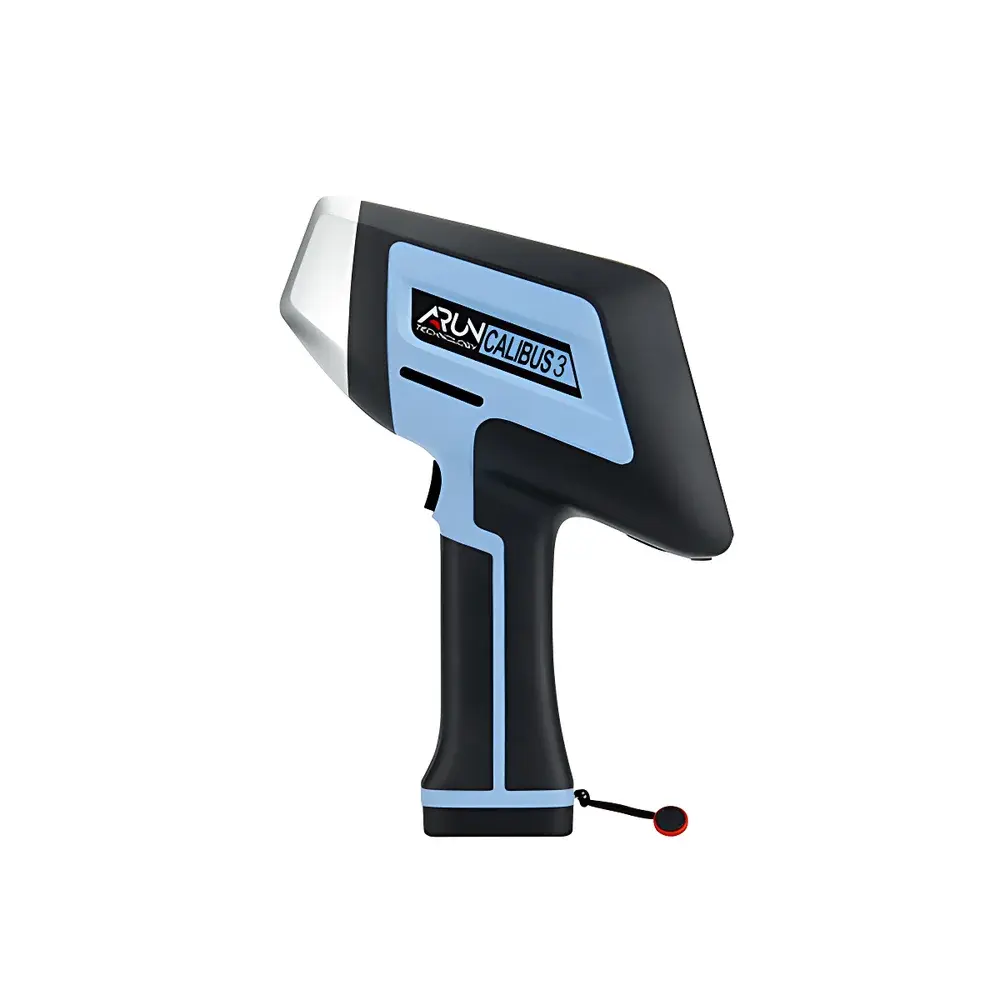
ARUN Calibus 3 Handheld Laser-Induced Breakdown Spectroscopy (LIBS) Analyzer
| Brand | ARUN TECHNOLOGY LTD. |
|---|---|
| Origin | United Kingdom |
| Manufacturer Type | Authorized Distributor |
| Product Category | Imported Instrument |
| Model | Calibus 3 |
| Instrument Type | Handheld |
| Integration | Fully Integrated |
| Laser Pulse Energy | Not Specified (Nanosecond-Pulsed Solid-State Laser) |
| Wavelength Coverage | 190–700 nm |
| Detector | CMOS Array |
| Optical Stabilization | Active Temperature Control (PID) |
| Gas Purge | Argon (Recirculating System) |
| Quantification Method | Empirical Calibration Curve (Intensity-to-Concentration Mapping) |
Overview
The ARUN Calibus 3 is a fully integrated, handheld Laser-Induced Breakdown Spectroscopy (LIBS) analyzer engineered for rapid, in-situ elemental analysis of metallic alloys in industrial field environments. It operates on the fundamental LIBS principle: a focused nanosecond-pulsed solid-state laser ablates a micro-volume of sample surface, generating a transient plasma plume; emitted atomic and ionic spectral lines from the cooling plasma are dispersed and detected across a broad spectral range (190–700 nm), enabling qualitative identification and quantitative determination of constituent elements. Designed specifically for metallurgical process control, scrap sorting, and quality assurance in steel production, mechanical fabrication, and metal recycling facilities, the Calibus 3 delivers laboratory-grade spectral fidelity in a ruggedized portable platform—without X-ray emission or regulatory licensing requirements.
Key Features
- Nanosecond-pulsed, high-repetition-rate all-solid-state laser with sub-0.1 °C thermal stabilization, ensuring plasma signal reproducibility and long-term pulse energy consistency
- Triple-chamber optical architecture delivering extended spectral coverage (190–700 nm), high optical resolution, and minimized inter-element spectral interference
- Back-illuminated CMOS linear array detector with low readout noise and enhanced signal-to-noise ratio, supporting lower detection limits for trace alloying elements (e.g., C, P, S, B)
- Proprietary argon recirculation purge system: eliminates consumable gas cylinders, enables >200 consecutive analyses per charge, and reduces background continuum emission for improved carbon quantification
- Active optical temperature control via precision PID algorithm—maintains optical path stability across ambient temperatures from −10 °C to +40 °C
- Dedicated carbon peak background subtraction algorithm, optimized for low-carbon steel and cast iron applications where C content governs material grade classification
- Integrated high-resolution imaging module with real-time visual targeting, micro-area positioning capability, and onboard image storage (>1,000 frames)
Sample Compatibility & Compliance
The Calibus 3 is validated for direct analysis of conductive and non-conductive solid metals—including ferrous and non-ferrous alloys, stainless steels, aluminum, copper, titanium, and nickel-based superalloys—without vacuum or electrode contact. Surface preparation requirements are minimal (e.g., removal of heavy oxide or paint layers). Its measurement methodology aligns with ASTM E2926-22 (“Standard Test Method for Determination of Elemental Composition by Laser-Induced Breakdown Spectroscopy”) and supports traceability under ISO/IEC 17025:2017 accredited laboratories. While not an X-ray device, its Class 4 laser subsystem complies with IEC 60825-1:2014 safety standards, incorporating redundant hardware interlocks, beam shuttering upon proximity detection, and automatic power cutoff if misalignment or obstruction is sensed.
Software & Data Management
The embedded firmware runs ARUN’s proprietary analytical suite, preloaded with over 1,000 certified reference materials covering >300 alloy grades (ASTM, EN, JIS, GB standards). Quantitative analysis employs empirically derived calibration curves—each element mapped via intensity-to-concentration regression using matrix-matched standards. Advanced spectral processing includes real-time spectral drift correction, background continuum subtraction, inter-element interference compensation, and substrate signal deconvolution. Data export supports CSV, XML, and PDF report generation (including annotated images and full spectra); optional integration with LIMS via TCP/IP or USB host mode satisfies GLP/GMP audit trail requirements per FDA 21 CFR Part 11 when configured with user authentication and electronic signature modules.
Applications
- Rapid positive material identification (PMI) for piping, valves, and pressure vessels in oil & gas and power generation infrastructure
- Scrap metal sorting and segregation at recycling facilities based on alloy family (e.g., 304 vs. 316 stainless, 6061 vs. 7075 aluminum)
- In-process verification of heat-treated or welded joints for elemental homogeneity and decarburization assessment
- Quality gate inspection in foundries and forging plants prior to shipment
- Field verification of supplier-provided mill test reports (MTRs) against actual composition
- Forensic metallurgical investigation of failed components without destructive sampling
FAQ
Does the Calibus 3 require external gas supply or consumables?
No—its integrated argon recirculation system eliminates disposable gas cylinders and refills. A single charge supports ≥200 analyses.
Is calibration required before each use?
No—factory-calibrated models ship with application-specific methods preloaded. Periodic verification using certified reference samples is recommended per ISO 17025 internal quality procedures.
Can it quantify carbon in low-alloy steels?
Yes—optimized optical throughput, argon purging, and proprietary background subtraction enable reliable C quantification down to ~0.02 wt% in carbon steels and cast irons.
What environmental conditions affect measurement accuracy?
The active thermal management system ensures spectral stability from −10 °C to +40 °C ambient; however, excessive surface moisture, thick oxide layers, or strong ambient light may necessitate localized cleaning or shading.
Is spectral data export compliant with regulatory reporting requirements?
Yes—raw spectra, processed results, metadata (time stamp, GPS coordinates if enabled, operator ID), and audit logs can be exported in formats compatible with FDA 21 CFR Part 11, EU Annex 11, and ISO 17025 documentation workflows.




