
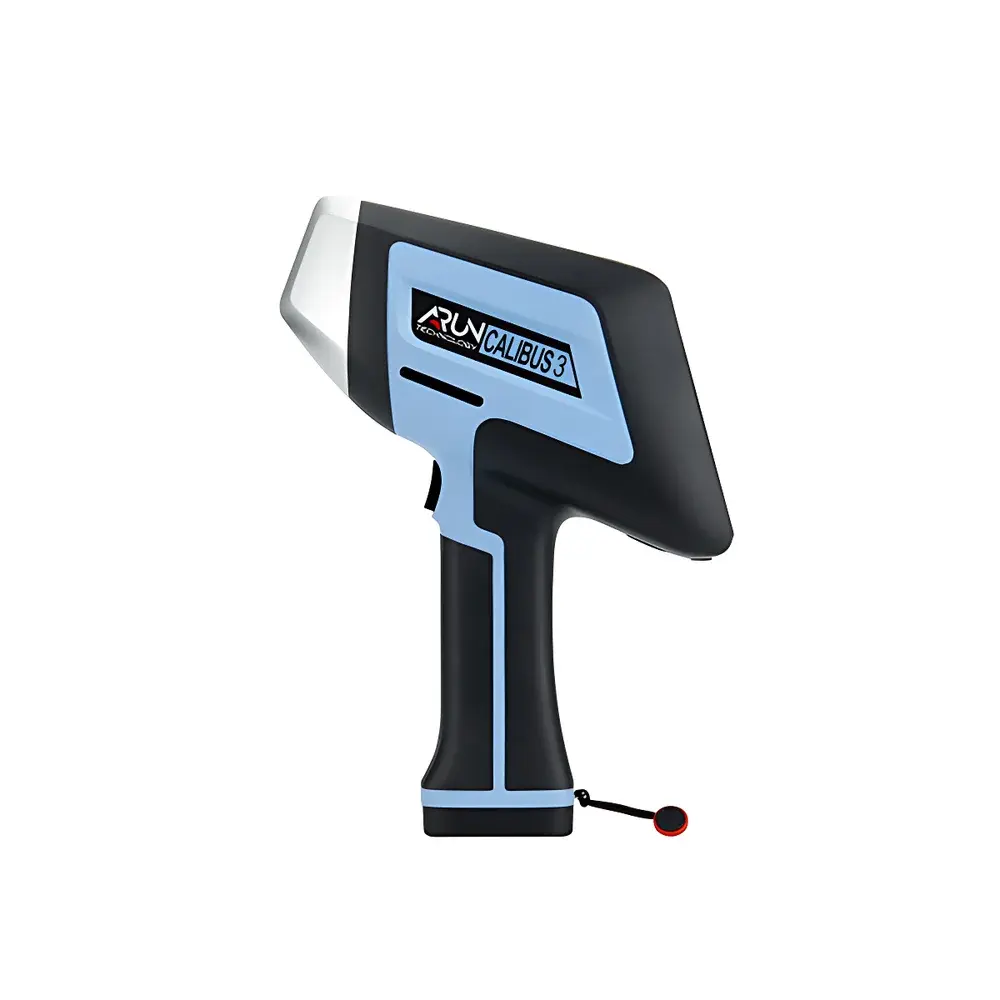
ARUN Calibus 3S PLUS Handheld Laser-Induced Breakdown Spectroscopy (LIBS) Analyzer
| Brand | ARUN TECHNOLOGY LTD. |
|---|---|
| Origin | United Kingdom |
| Manufacturer Type | Authorized Distributor |
| Product Category | Imported Instrument |
| Model | Calibus 3S PLUS |
| Instrument Type | Handheld |
| Integration | Fully Integrated |
| Laser Pulse Energy | Not Specified (Nanosecond-Pulsed Solid-State Laser) |
| Wavelength Range | 190–700 nm |
| Detector | CMOS Array |
| Optical Architecture | Triple-Chamber Spectrograph |
| Cooling | Active PID-Controlled Thermal Stabilization (±0.1 °C) |
| Gas Purge | Recirculating Argon Flush System |
| Analysis Speed | <1 Second per Measurement |
| Operating Temperature Range | −10 °C to +40 °C |
| Imaging | Integrated HD Camera with Micro-Region Targeting and Image Logging |
Overview
The ARUN Calibus 3S PLUS is a fully integrated, handheld Laser-Induced Breakdown Spectroscopy (LIBS) analyzer engineered for rapid, in-situ elemental analysis of metallic alloys in industrial environments. It operates on the fundamental principle of LIBS: a focused nanosecond-pulsed solid-state laser ablates a micro-volume of sample surface, generating a transient plasma plume whose emitted optical spectrum is collected and resolved by a high-fidelity triple-chamber spectrograph. The resulting atomic and ionic emission lines—spanning 190–700 nm—are quantitatively interpreted using empirically calibrated intensity-to-concentration relationships. Designed for field-deployable precision, the Calibus 3S PLUS delivers laboratory-grade compositional data without requiring sample preparation, vacuum enclosures, or X-ray sources—making it compliant with international safety standards including IEC 60825-1 (Laser Safety) and exempt from regulatory licensing under national radiation protection frameworks.
Key Features
- Nanosecond-pulsed, all-solid-state laser with active thermal stabilization (±0.1 °C), ensuring plasma reproducibility across ambient temperature fluctuations from −10 °C to +40 °C.
- Triple-chamber Czerny–Turner spectrograph architecture delivering broad spectral coverage (190–700 nm), high optical resolution, and minimal inter-element spectral interference.
- Back-thinned CMOS detector array with low readout noise and extended dynamic range, enabling sub-ppm detection limits for key alloying elements (e.g., C, Cr, Ni, Mo, Mn, Si, Al).
- Integrated argon recirculation purge system: eliminates atmospheric nitrogen/oxygen absorption bands, suppresses continuum background, and enhances signal-to-noise ratio—no disposable gas cylinders required.
- Real-time spectral processing suite: includes automatic background subtraction (including proprietary carbon-peak-specific baseline correction), matrix-matched interference correction, spectral drift compensation, and iterative peak deconvolution.
- HD coaxial imaging module with 5 MP resolution and real-time overlay of laser spot position—enabling precise micro-area targeting (<100 µm spot size), spatial documentation, and image-anchored result archiving (≥1,000 images stored onboard).
Sample Compatibility & Compliance
The Calibus 3S PLUS is validated for direct analysis of conductive and non-conductive solid metal samples—including ferrous and non-ferrous alloys, stainless steels, aluminum, titanium, copper, and superalloys—without surface polishing or electrical grounding. Its analytical performance conforms to ASTM E2926-22 (Standard Test Method for Determination of Elemental Composition by LIBS) and supports traceability under ISO/IEC 17025:2017 requirements when deployed within documented QA/QC workflows. The instrument’s firmware incorporates audit-trail logging (user actions, calibration events, spectral acquisition timestamps) aligned with GLP principles. No radioactive sources or ionizing radiation are employed; therefore, it requires no regulatory registration under 21 CFR Part 1000 or EU Directive 2013/59/Euratom.
Software & Data Management
Embedded firmware runs ARUN’s proprietary SpectraLink OS, supporting both qualitative screening (library-based alloy grade identification against >1,200 reference spectra) and quantitative analysis via multi-point empirical calibration curves derived from >1,000 certified reference materials (CRMs). All calibrations are traceable to NIST SRMs and include uncertainty estimation per element. Data export formats include CSV, XML, and PDF reports compliant with internal QA documentation protocols. Optional cloud synchronization enables centralized fleet management, remote method deployment, and version-controlled calibration updates. Software features full 21 CFR Part 11 compliance mode—enabling electronic signatures, role-based access control, and immutable audit logs for regulated manufacturing environments.
Applications
- On-site positive material identification (PMI) for piping, valves, pressure vessels, and structural components in oil & gas, power generation, and pharmaceutical infrastructure.
- Rapid scrap sorting and recycling stream optimization based on alloy classification and residual element detection (e.g., Cu, Sn, Pb in aluminum scrap).
- In-process quality assurance during metal fabrication, welding verification, and heat treatment validation.
- Field-based failure analysis where traditional lab sampling is impractical—e.g., offshore platforms, rail infrastructure, or aerospace MRO facilities.
- Educational and research use in metallurgy labs requiring portable, non-destructive elemental mapping capabilities.
FAQ
Does the Calibus 3S PLUS require external gas supply or consumables?
No. It utilizes a sealed, recirculating argon purge system with an integrated rechargeable gas reservoir—capable of ≥200 consecutive analyses per charge, eliminating recurring gas costs or cylinder handling.
How is carbon quantified in steel with LIBS, given its weak emission lines?
The instrument employs ARUN’s proprietary carbon-specific background subtraction algorithm, combined with optimized plasma conditions (pulse energy, delay time, gate width) and triple-chamber spectral isolation of the C I 247.86 nm line—achieving typical carbon LODs of 0.015 wt% in low-alloy steels.
Can calibration models be customized for proprietary alloys?
Yes. Users may import custom CRM datasets and generate application-specific calibrations via the desktop SpectraLink Calibration Studio software, with full traceability and uncertainty propagation.
Is the device suitable for outdoor use in variable lighting or dusty conditions?
The optical path is hermetically sealed and thermally stabilized; the ruggedized IP54-rated enclosure and anti-glare display ensure reliable operation in direct sunlight, rain, or industrial particulate environments.
What safety certifications does the Calibus 3S PLUS hold?
It complies with IEC 60825-1:2014 (Class 4 laser product with embedded interlocks), CE marking (EMC & LVD directives), UKCA, and RoHS 3. No X-ray shielding or radiation licensing is required.




