
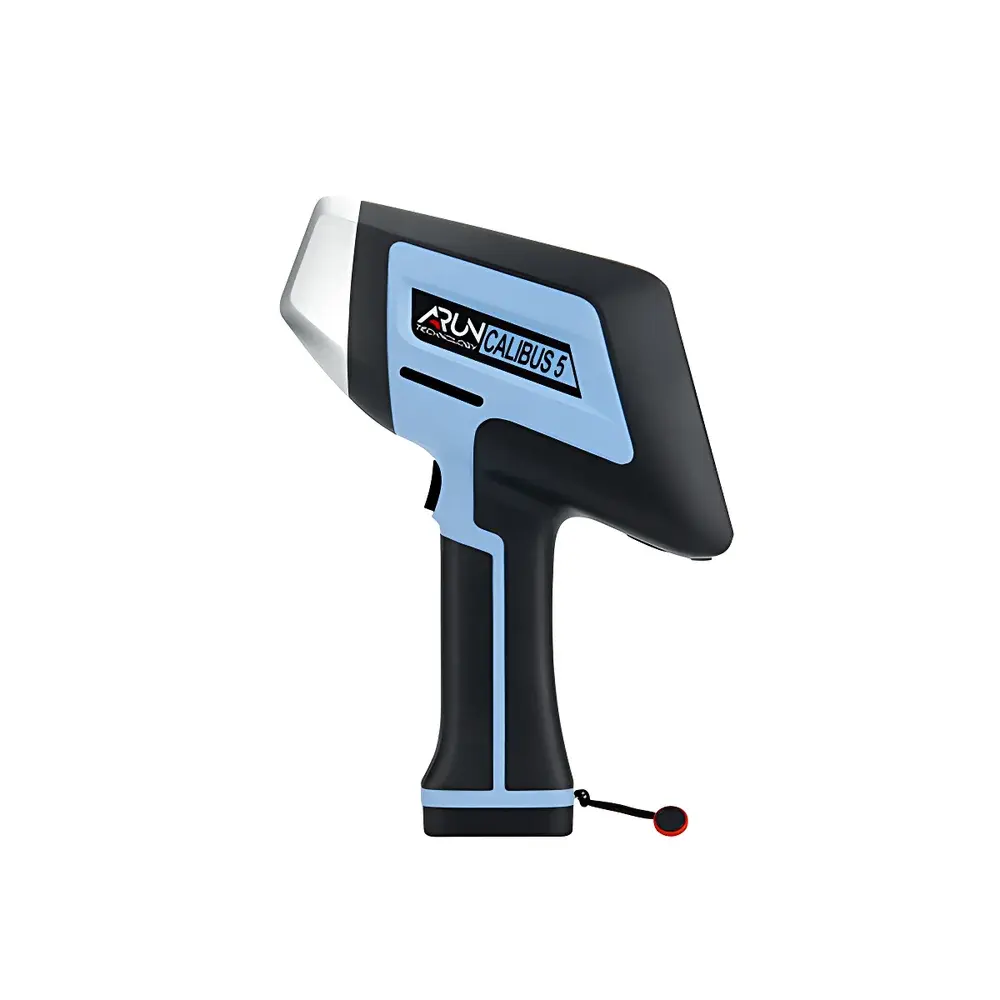
ARUN Calibus 5/9 Handheld Laser-Induced Breakdown Spectroscopy (LIBS) Analyzer
| Brand | ARUN TECHNOLOGY LTD. |
|---|---|
| Origin | United Kingdom |
| Manufacturer Type | Authorized Distributor |
| Product Origin | Imported |
| Model | Calibus 5/9 |
| Instrument Type | Handheld |
| Integration | Fully Integrated |
| Laser Pulse Energy | Not Specified (Nanosecond-Pulsed Solid-State Laser) |
| Spectral Range | 190–700 nm |
| Detector | CMOS Array |
| Cooling | Active PID-Controlled Thermal Stabilization |
| Gas Purge | Integrated Argon Circulation System |
| Operating Temperature Range | –10 °C to +40 °C |
| Analysis Time | < 1 s per measurement |
| Elemental Coverage | >30 elements including C, Li, Be, B, Si, Fe, Al, Cu, Ni, Zn, Mg, Ti, Co, Pb, Sn, and others |
Overview
The ARUN Calibus 5/9 is a handheld Laser-Induced Breakdown Spectroscopy (LIBS) analyzer engineered for rapid, in-situ elemental analysis of metallic and inorganic materials in industrial environments. LIBS operates by focusing a high-intensity nanosecond pulsed laser onto the sample surface, generating a transient microplasma (>10,000 K). The emitted atomic and ionic emission spectra—characteristic of constituent elements—are collected and resolved across a broad spectral range (190–700 nm) using a triple-chamber optical architecture. Unlike X-ray fluorescence (XRF), LIBS requires no ionizing radiation licensing and enables direct detection of light elements such as carbon, lithium, beryllium, boron, and silicon—critical for alloy grade identification, heat treatment verification, and quality control in metallurgy and advanced manufacturing.
Key Features
- Nanosecond-pulsed solid-state laser with active thermal stabilization (< ±0.1 °C), ensuring plasma reproducibility and long-term signal stability without laser diode degradation or consumable replacement.
- Triple-optical-chamber spectrometer design delivering high spectral resolution and minimal line overlap across 190–700 nm—enabling simultaneous quantification of >30 elements, including challenging low-Z analytes.
- Back-illuminated CMOS detector with ultra-low readout noise and enhanced quantum efficiency in UV-VIS range, improving detection limits for trace and matrix-sensitive elements.
- Integrated argon circulation system with proprietary refill-on-demand cylinder; single charge supports ≥200 consecutive analyses with consistent signal-to-background ratio and reduced continuum emission.
- Real-time spectral processing algorithms: background subtraction (including dynamic carbon peak modeling), matrix interference correction, spectral drift compensation, and baseline normalization—all inherited from ARUN’s benchtop OES platforms.
- Ruggedized handheld form factor with IP54-rated enclosure, integrated HD imaging module (5 MP autofocus), and on-device ROI annotation—supporting micro-area analysis, spatial mapping, and image-anchored result archiving.
Sample Compatibility & Compliance
The Calibus 5/9 is validated for direct analysis of solid conductive and semi-conductive samples—including castings, forgings, welds, powders, oxides, and salts—without vacuum or electrode contact. It complies with IEC 60825-1:2014 Class 4 laser safety requirements, incorporating dual hardware interlocks, beam shutter redundancy, and proximity-sensing activation. No regulatory exemption is required for operation, as it emits zero ionizing radiation. Data integrity meets GLP/GMP expectations through audit-trail-enabled firmware (21 CFR Part 11-ready configuration available), and calibration traceability aligns with ISO/IEC 17025 principles via ARUN’s certified reference material library (>1,000 CRM-matched alloys).
Software & Data Management
The embedded ARM-based OS runs ARUN’s CaliSuite™ v4.2 software, supporting both qualitative screening and quantitative analysis modes. Quantitative models are built using empirical calibration curves derived from certified reference materials (CRMs), with cross-validation against ASTM E2926 and ISO 11577 standards. All spectral acquisitions include timestamp, GPS coordinates (optional), operator ID, and image metadata. Data export supports CSV, SPC, and XML formats compatible with LIMS integration. Firmware updates and method libraries are distributed via encrypted USB or secure OTA channels, with version-controlled change logs retained locally for audit purposes.
Applications
- Metal scrap sorting and PMI (Positive Material Identification) in petrochemical and power generation facilities.
- On-site verification of aerospace-grade titanium and nickel superalloys during maintenance, repair, and overhaul (MRO).
- Carbon content monitoring in steel billets and automotive castings—enabling real-time furnace feed adjustment.
- Quality assurance of battery cathode powders (e.g., NMC, LFP) and recycling feedstock in EV supply chains.
- Field-based inspection of rail track components, structural welds, and fire-damaged infrastructure per EN 10204 Type 3.1 documentation requirements.
FAQ
Does the Calibus 5/9 require external gas supply or consumables?
No—its integrated argon circulation system uses a sealed, refillable cylinder with no disposable cartridges or external regulators.
Can it quantify carbon in low-alloy steels with acceptable precision?
Yes—via optimized UV-line selection (193.0 nm C I), dynamic background modeling, and matrix-matched calibration, typical RSD ≤3.5% at 0.05–0.5 wt% C.
Is spectral data export compliant with laboratory information management systems (LIMS)?
Yes—CSV and XML outputs include full spectral metadata, uncertainty estimates, and instrument configuration parameters for seamless LIMS ingestion.
What environmental conditions affect measurement repeatability?
The PID-controlled optical chamber maintains thermal equilibrium from –10 °C to +40 °C ambient; no recalibration is required within this range.
How is user authentication and data security managed?
Role-based access control (RBAC), AES-256 encrypted local storage, and optional 21 CFR Part 11-compliant electronic signatures are supported via enterprise firmware package.





