
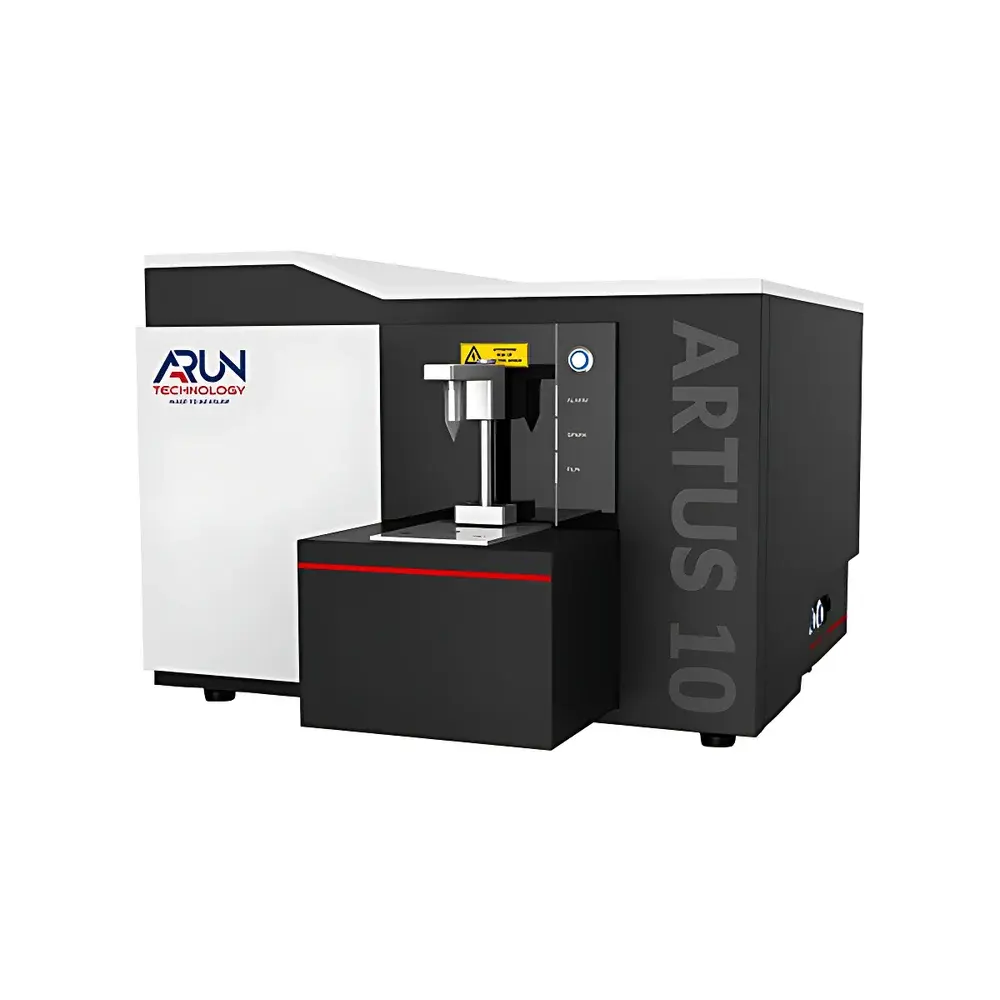
Arun Technology ARTUS 10 B Benchtop Direct-Reading Spark Optical Emission Spectrometer
| Brand | Arun Technology Ltd. |
|---|---|
| Origin | United Kingdom |
| Instrument Type | Benchtop |
| Excitation Source | Spark Discharge |
| Detector Type | Cooled Scientific-Grade CMOS |
| Wavelength Range | Configurable (UV–Vis, down to ~130 nm) |
| Optical System | Dual-Chamber Paschen–Runge Mount |
| Cooling | Thermoelectric (Peltier) |
| Detection Limit | ≤1 ppm for C, P, S, N, and other metallic/non-metallic elements |
| Stability | Drift-Free Operation (No Recalibration Required Under Normal Conditions) |
| Analysis Time | <10 s per sample |
| Argon Consumption | Reduced by ~67% vs. conventional systems |
| Compliance | Designed for ISO/IEC 17025, ASTM E415, E1086, E3061, and EN 10315 environments |
Overview
The Arun Technology ARTUS 10 B is a benchtop direct-reading spark optical emission spectrometer engineered for high-precision elemental analysis of metals and alloys in laboratory and production QC environments. Based on the Paschen–Runge optical layout with dual-chamber architecture, it employs a thermoelectrically cooled scientific-grade CMOS detector — custom-designed for enhanced quantum efficiency in the deep ultraviolet (DUV) region (down to 130 nm). This enables reliable quantification of critical non-metals including carbon (C), phosphorus (P), sulfur (S), and nitrogen (N) without vacuum or purge gas dependency in the UV chamber. Unlike traditional PMT-based systems, the ARTUS 10 B leverages pixel-level spectral acquisition and real-time signal processing to eliminate inter-element interference and suppress spectral drift — achieving intrinsic long-term stability without routine recalibration or wavelength alignment. Its solid aluminum alloy optical chamber undergoes four-stage stress-relief annealing and active temperature stabilization (±0.1 °C), ensuring reproducible spectral line positioning over extended operational cycles.
Key Features
- Scientific-grade A-CMOS detector with Peltier cooling: Delivers superior signal-to-noise ratio (SNR) and dynamic range across UV–Vis wavelengths, especially below 190 nm.
- OEO (Optimal Element-Oriented) acquisition: Enables independent integration time, gain, and gating parameters per element — maximizing sensitivity and precision for each analyte.
- RTMC (Real-Time Multi-Channel) spectral optimization: Dynamically adjusts background correction and peak deconvolution during acquisition using embedded calibration-free algorithms.
- “Clamp-and-Hold” electrode mechanism: Ensures mechanical rigidity during spark discharge, minimizing positional variance and improving shot-to-shot repeatability.
- High-energy digital spark source: Fully programmable pre-ignition pulse and analytical discharge profile; supports multi-phase excitation for heterogeneous or coated samples.
- Dual optical chambers: One optimized for UV-sensitive elements (C, P, S, N); the other for visible-range metallic lines — eliminating cross-talk and preserving resolution.
- No vacuum pump or oil-based components: The sealed, argon-purged UV chamber eliminates contamination risk and mechanical drift associated with moving parts.
Sample Compatibility & Compliance
The ARTUS 10 B is validated for solid metallic samples conforming to ASTM E415 (carbon and low-alloy steels), ASTM E1086 (stainless steels), ASTM E3061 (aluminum alloys), and EN 10315 (copper and copper alloys). It accepts standard Ø10–16 mm pins, discs, and cut pieces with flat, ground surfaces (Ra ≤ 0.8 µm). Sample introduction requires no consumables beyond argon (99.998% purity); flow is precisely regulated via integrated mass-flow controllers. The system complies with electromagnetic compatibility (EMC) standards IEC 61326-1 and safety requirements IEC 61010-1. Its firmware architecture supports audit trails, electronic signatures, and data integrity features aligned with FDA 21 CFR Part 11 and EU Annex 11 expectations for regulated laboratories.
Software & Data Management
The ARTUS Control Suite provides a role-based GUI with tabular and graphical result visualization, customizable report templates (PDF/CSV/XLSX), and full traceability of instrument parameters, calibration history, and spark statistics. ASR (Aberrant Spark Removal) algorithm automatically identifies and excludes outlier discharges caused by surface defects, micro-cracks, or oxide layers — reducing dependence on perfect sample prep. A-Care Cloud Connect enables secure remote diagnostics, firmware updates, and predictive health monitoring (e.g., detector temperature drift, spark energy decay, argon pressure trends). All raw spectra and processed results are stored with SHA-256 hashing and timestamped metadata to support GLP/GMP documentation workflows.
Applications
Typical use cases include incoming material inspection, melt shop process control, heat treatment verification, scrap sorting, and failure analysis in foundries, aerospace component manufacturers, and metal service centers. The instrument delivers certified accuracy for grade identification of stainless steels (e.g., 304 vs. 316), aluminum alloys (e.g., 6061 vs. 7075), titanium grades (e.g., Grade 2 vs. Grade 5), and high-purity copper. Its sub-ppm detection capability supports specification compliance for residual elements (e.g., Sn, Pb, Bi in electrical copper) and trace contaminants in additive manufacturing feedstock powders.
FAQ
Does the ARTUS 10 B require daily wavelength calibration?
No. Its thermally stabilized optical bench and drift-compensated CMOS readout eliminate the need for routine wavelength recalibration under stable ambient conditions.
Can it analyze coated or painted metal samples?
Surface coatings must be removed prior to analysis; however, ASR technology tolerates minor surface oxidation or micro-cracking without compromising quantitative accuracy.
Is vacuum pumping required for UV analysis?
No. The dedicated UV chamber is continuously purged with high-purity argon, enabling stable detection of C, P, S, and N without vacuum hardware.
What argon purity is recommended?
99.998% minimum (ISO 8573-1 Class 2:2:2); moisture and hydrocarbon content must be <0.1 ppmv to prevent spectral absorption artifacts.
How is data integrity ensured during remote operation?
All cloud-synchronized actions are logged with user ID, timestamp, IP address, and cryptographic hash; local storage retains immutable raw spectra independent of network status.



