
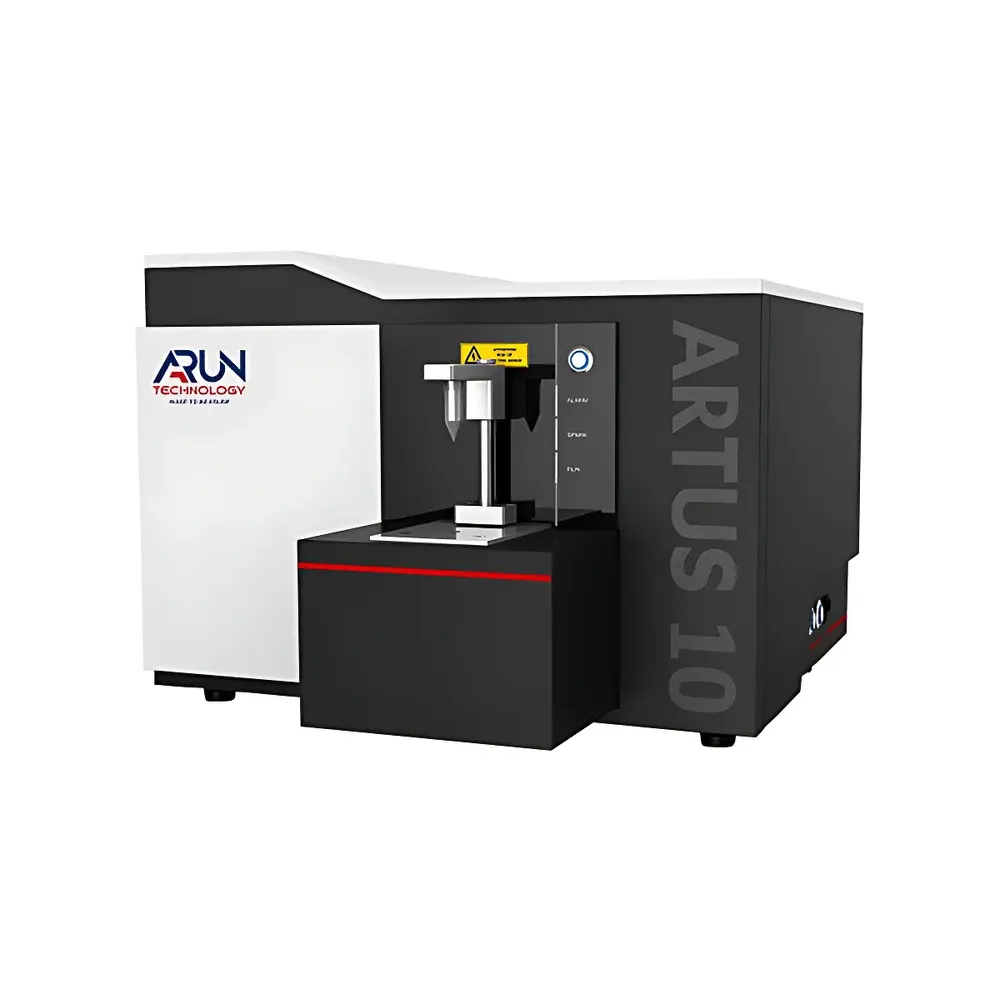
ARUN TECHNOLOGY ARTUS 10 S Direct-Reading Optical Emission Spectrometer (Spark OES)
| Brand | ARUN TECHNOLOGY LTD. |
|---|---|
| Origin | United Kingdom |
| Instrument Type | Benchtop |
| Excitation Source | Spark |
| Detector | Cooled Scientific CMOS (A-CMOS) |
| Wavelength Range | Configurable (UV–Vis, down to ~130 nm) |
| Optical System | Dual Chamber Design |
| Cooling | Thermoelectric (Peltier) |
| Stability | Drift-Free Operation (No Recalibration Required) |
| Detection Limit | ≤1 ppm for key elements (C, P, S, N, Al, Cu, etc.) |
| Analysis Time | <10 s per sample |
| Argon Consumption | Reduced by ~67% vs. conventional systems |
| Compliance | Designed for ISO/IEC 17025, ASTM E415, E1086, E3061, and USP <730> trace metal analysis workflows |
Overview
The ARUN TECHNOLOGY ARTUS 10 S is a benchtop direct-reading optical emission spectrometer (Spark OES) engineered for high-precision elemental analysis of metallic alloys in quality control, foundry, scrap sorting, and R&D laboratories. It operates on the principle of spark-induced plasma excitation: a controlled high-energy spark vaporizes a micro-volume of conductive solid sample, generating excited atoms and ions whose characteristic atomic emission lines are dispersed and quantified across the ultraviolet–visible spectrum. Unlike traditional PMT-based OES systems, the ARTUS 10 S employs a custom-developed, thermoelectrically cooled scientific-grade A-CMOS detector — enabling full-spectrum acquisition with pixel-level wavelength registration, high dynamic range (>10⁵), and exceptional signal-to-noise ratio in the critical deep-UV region (<190 nm). This architecture eliminates mechanical drift associated with moving gratings or photomultiplier tube aging, delivering intrinsic long-term stability without routine recalibration — a fundamental advancement in analytical robustness for regulated environments.
Key Features
- Scientific CMOS detection platform with Peltier cooling to –20 °C, ensuring thermal noise suppression and UV sensitivity for C, P, S, and N analysis
- OEO (Optimal Element-Oriented) acquisition algorithm: independent integration time, gain, and background correction per element — maximizing precision across concentration ranges
- Dual optical chamber design: one optimized for UV elements (130–190 nm), the other for visible-range elements (190–800 nm), preserving resolution and minimizing cross-talk
- RTMC (Real-Time Multi-Channel) spectral optimization: real-time intensity normalization and peak centroid tracking for enhanced reproducibility
- “Clamp-and-Hold” electrode mechanism: rigid, zero-play tungsten electrode fixation preventing positional shift during sparking — critical for shot-to-shot repeatability
- High-energy digital spark source with pre-ignition pulse synthesis: delivers stable, reproducible plasma initiation even on rough or oxidized surfaces
- No vacuum pump or oil-lubricated mechanisms: sealed argon-purged optical chambers eliminate contamination risk and mechanical maintenance
- ASR (Aberrant Spark Removal) logic: real-time rejection of non-representative sparks (e.g., from surface cracks or inclusions), reducing dependence on perfect sample preparation
Sample Compatibility & Compliance
The ARTUS 10 S supports standardized solid metal samples per ISO 11577, ASTM E415 (carbon and low-alloy steels), ASTM E1086 (stainless steels), and ASTM E3061 (aluminum alloys). It accommodates flat, cylindrical, and irregular geometries up to Ø40 mm × 30 mm height, with optional accessories for small parts and wires. The system meets electromagnetic compatibility (EMC) requirements per IEC 61326-1 and safety standards per IEC 61010-1. Its firmware and data handling architecture support audit trails, electronic signatures, and secure user access control — facilitating alignment with FDA 21 CFR Part 11, EU Annex 11, and GLP/GMP documentation requirements when deployed in regulated manufacturing or contract testing labs.
Software & Data Management
Controlled via the ARUN ASPECT software suite, the ARTUS 10 S provides intuitive graphical workflow navigation, real-time spectral visualization, and multi-level user permissions (Operator, Supervisor, Administrator). All measurement data — including raw spectra, spark histograms, calibration curves, and QC reports — are stored in an encrypted SQLite database with configurable backup intervals. A-Care Cloud Service enables secure remote firmware updates, predictive diagnostics (e.g., detector temperature drift trending, argon pressure decay modeling), and instrument health dashboards accessible via web browser. Export formats include CSV, PDF analytical reports, and ASTM E135-compliant XML for LIMS integration.
Applications
- High-accuracy grade identification and certification of stainless steels, tool steels, nickel superalloys, and titanium grades
- Low-level carbon, sulfur, phosphorus, and nitrogen quantification in aluminum die-castings and automotive lightweight alloys
- Scrap metal sorting and recycling verification with rapid pass/fail decisioning against specification limits
- Process validation in heat treatment and casting operations where trace element segregation affects mechanical properties
- Research into micro-alloying effects, inclusion analysis correlation, and intermetallic phase composition mapping
FAQ
Does the ARTUS 10 S require vacuum pumping or external cooling water?
No — it uses sealed, argon-purged optical chambers with thermoelectric (Peltier) detector cooling. No vacuum pumps, chillers, or compressed air are required.
Can it analyze non-conductive materials such as ceramics or coatings?
No — the ARTUS 10 S is designed exclusively for electrically conductive solid metals. Non-conductors require alternative techniques such as LA-ICP-MS or XRF.
How often must calibration standards be re-measured?
Calibration remains stable for ≥6 months under normal operating conditions; no daily drift correction is needed. Periodic verification using certified reference materials (CRMs) is recommended per ISO/IEC 17025 internal QA protocols.
Is method transfer possible between different ARTUS 10 S units?
Yes — spectral libraries, calibration models, and OEO parameter sets are fully portable via encrypted USB export/import, supporting consistent cross-site analysis.
What argon purity and pressure specifications are required?
Grade 4.8 (99.998% pure) argon at 0.4–0.6 MPa inlet pressure is recommended; flow rate is dynamically adjusted during analysis and averages ≤0.8 L/min, significantly lower than conventional OES systems.



