
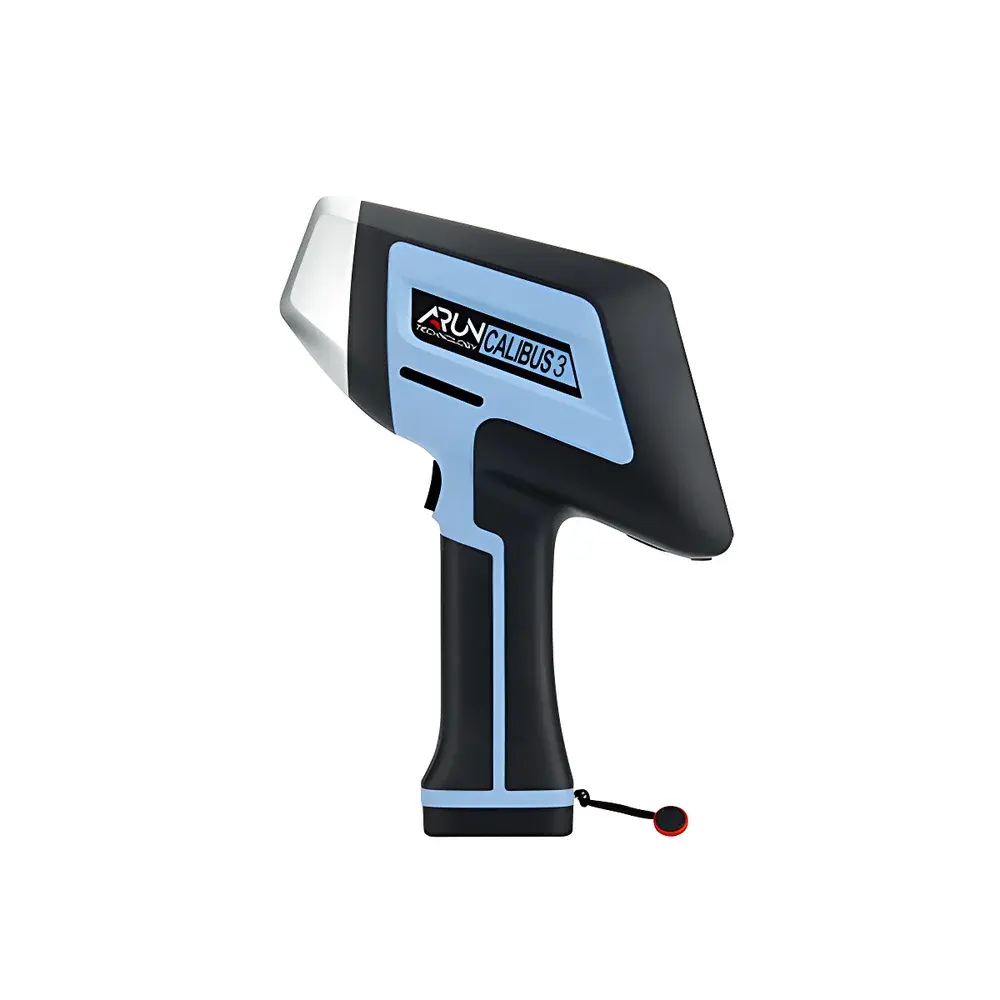
Arun Technology Calibus 3B Handheld Laser-Induced Breakdown Spectroscopy (LIBS) Analyzer
| Brand | Arun Technology Ltd. |
|---|---|
| Origin | United Kingdom |
| Manufacturer Type | Authorized Distributor |
| Product Origin | Imported |
| Model | Calibus 3B |
| Instrument Type | Handheld |
| Integration | Fully Integrated |
| Laser Pulse Energy | Not Specified (Nanosecond-Pulsed Solid-State Laser) |
| Wavelength Range | 190–700 nm |
| Detector | CMOS Array |
| Cooling | Active PID-Controlled Thermal Stabilization |
| Gas Purge | Argon Circulation System |
| Operating Temperature Range | −10 °C to +40 °C |
Overview
The Arun Technology Calibus 3B is a fully integrated, handheld Laser-Induced Breakdown Spectroscopy (LIBS) analyzer engineered for rapid, in-situ elemental analysis of metallic alloys in industrial environments. It operates on the fundamental LIBS principle: a high-energy, nanosecond-pulsed solid-state laser is focused onto the sample surface, generating a transient microplasma (~10,000 K). Emitted atomic and ionic spectral lines from the plasma are collected and dispersed across a triple-optical-chamber spectrometer system, enabling simultaneous detection of elements from light metals (e.g., Li, Be, C, Mg, Al) to transition metals (e.g., Fe, Cr, Ni, Mn, Mo, Cu, Ti, V) and trace impurities. Designed for field-deployable metal identification and quantitative grade verification, the Calibus 3B delivers laboratory-grade spectral fidelity without requiring vacuum or inert gas enclosures—leveraging argon circulation for ambient-air suppression and enhanced signal-to-background ratio.
Key Features
- Nanosecond-pulsed, all-solid-state laser with active thermal stabilization (<±0.1 °C), ensuring plasma reproducibility and long-term pulse-to-pulse energy consistency
- Triple-grating optical architecture covering 190–700 nm with CMOS linear array detector, delivering high spectral resolution (<0.1 nm FWHM) and low readout noise (<3 e⁻ RMS)
- Proprietary carbon peak background subtraction algorithm optimized for accurate C quantification in low-alloy steels and cast irons
- Integrated argon recirculation system: single charge supports >200 consecutive analyses; no consumable cylinders or external gas supply required
- Real-time spectral drift correction using internal reference lines and dynamic baseline subtraction (including matrix background and inter-element interference compensation)
- Embedded high-resolution imaging module (5 MP) with autofocus and crosshair overlay for precise micro-area targeting and spatial documentation
- Ruggedized IP54-rated enclosure with MIL-STD-810G shock/vibration compliance; operational across −10 °C to +40 °C ambient conditions
Sample Compatibility & Compliance
The Calibus 3B is validated for direct analysis of conductive and non-conductive solid metal samples—including ferrous and non-ferrous alloys, welds, castings, forgings, and scrap—without surface preparation beyond minimal cleaning. It complies with IEC 60825-1:2014 Class 4 laser safety requirements, incorporating redundant hardware interlocks (distance sensor + beam shutter + emission indicator) that prevent laser firing unless proper standoff distance (≥1.5 mm) and surface contact are confirmed. No ionizing radiation is emitted; therefore, it requires no regulatory licensing under FDA 21 CFR 1020.40 or EU Directive 2013/59/Euratom. The instrument’s firmware supports audit-trail logging per GLP/GMP guidelines, and spectral data files embed full metadata (timestamp, GPS coordinates, operator ID, environmental parameters).
Software & Data Management
Calibus Control Suite v4.x provides intuitive touch-based operation with preloaded alloy libraries (ASTM A1058, ISO 17577, UNS, EN 10027) and customizable grade-matching thresholds. Quantitative analysis employs empirically calibrated intensity–concentration curves derived from >1,000 certified reference materials (CRMs), traceable to NIST SRMs. All algorithms—including spectral deconvolution, continuum background removal, and multivariate interference correction—are ported from Arun’s benchtop OES platforms and validated per ASTM E2926-22. Data export supports CSV, XML, and PDF report generation with embedded spectra images; optional integration with LIMS via OPC UA or RESTful API enables automated QA/QC workflow synchronization.
Applications
- Scrap yard sorting and POS material verification in metal recycling facilities
- In-line grade confirmation during pipe fabrication, pressure vessel manufacturing, and aerospace component machining
- Field inspection of piping systems, structural steel, and offshore platform components per API RP 578 / ASME B31.4
- Quality assurance of incoming raw materials against purchase specifications (e.g., ASTM A36, AISI 304, Inconel 625)
- Forensic metallurgical investigation of failed components, including inclusion mapping and segregation analysis
FAQ
Does the Calibus 3B require external argon gas cylinders?
No—it features an integrated, rechargeable argon reservoir with automatic pressure regulation; one fill supports ≥200 analyses.
Can it quantify carbon in stainless steels below 0.03 wt%?
Yes—using its dedicated carbon background correction model and optimized 193 nm spectral window, typical LOD for C is 0.008 wt% in austenitic grades.
Is calibration transfer possible between different Calibus units?
Yes—cross-unit calibration alignment is supported via standardized spectral reference tiles and factory-maintained CRM correlation matrices.
What regulatory standards does its software meet for data integrity?
Firmware implements ALCOA+ principles: attributable, legible, contemporaneous, original, accurate, complete, consistent, enduring, and available—with electronic signature support compliant with 21 CFR Part 11.
How is thermal drift managed during extended outdoor use?
A dual-stage thermal management system combines passive heat-sink design with closed-loop PID-controlled Peltier modules, maintaining optical path stability within ±0.05 nm over full operating temperature range.
Related Products





