
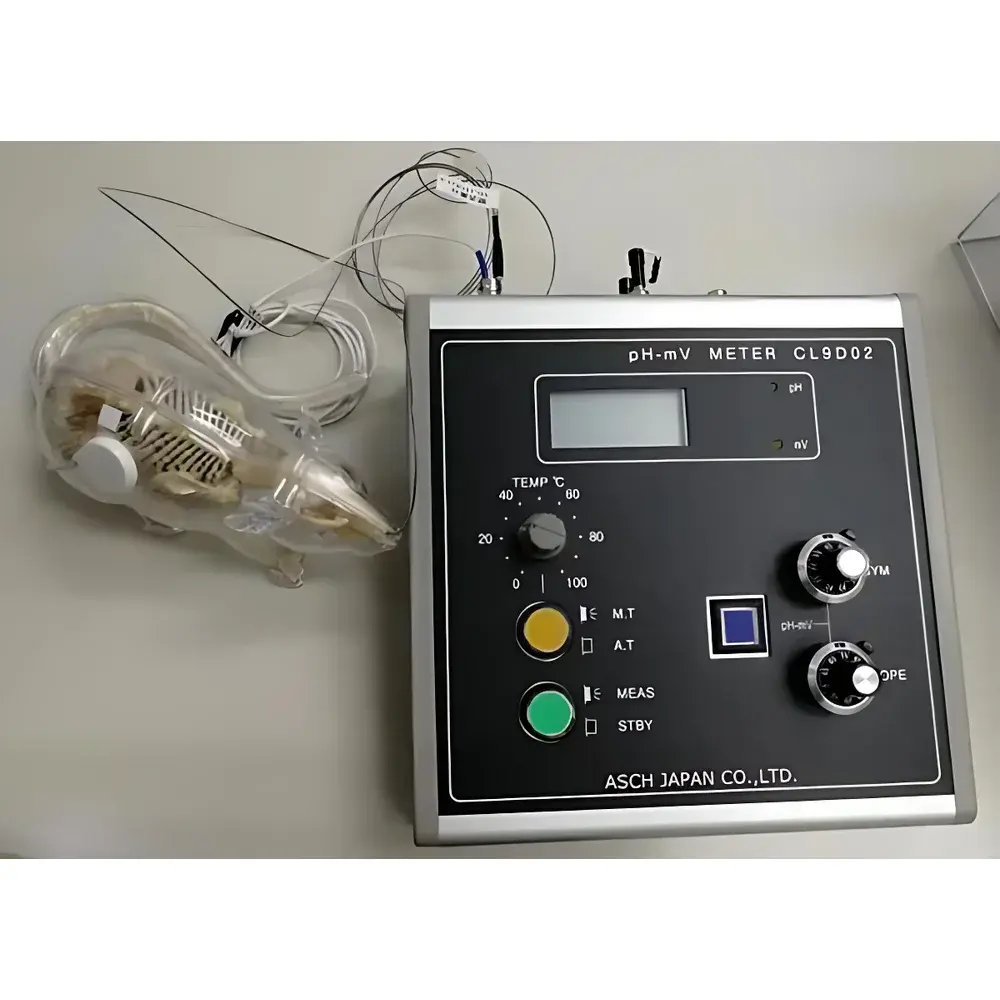
ASCH CM-191 In Vivo Gastric pH Monitor for Laboratory Animals
| Brand | ASCH |
|---|---|
| Origin | Japan |
| Model | CM-191 |
| Measurement Principle | Antimony Electrode Potentiometry (pH 4.00–9.00) & Glass Electrode Potentiometry (pH 0.00–14.00) |
| Temperature Compensation | Automatic/Manual (0°C to 100°C) |
| Input Impedance | >10¹³ Ω |
| Resolution | 0.01 pH / 1 mV |
| Accuracy (pH) | ±0.01 pH |
| Accuracy (mV) | ±1 mV |
| Display | Digital LCD |
| Power Supply | AC 100 V, 50/60 Hz (12 V DC adapter) |
| Power Consumption | ~1 VA |
| Dimensions (W×D×H) | 165 × 180 × 70 mm |
| Weight | ~1000 g |
| Data Output | 0–1.4 V analog signal (compatible with external data loggers) |
| Standard Accessories | pH 4.01 & 6.86 calibration buffers (1× each), 12 V AC adapter, 0–100°C thermometer |
| Optional Electrodes | CMS-191 antimony micro-catheter electrode (1.0 mm OD), CM-181 glass electrode (2.4 mm OD) |
Overview
The ASCH CM-191 In Vivo Gastric pH Monitor is a specialized potentiometric instrument engineered for non-invasive, real-time measurement of intragastric pH in conscious or lightly restrained laboratory animals. Unlike terminal ex vivo gastric fluid collection methods, the CM-191 enables longitudinal, dynamic pH profiling—critical for modeling gastroesophageal reflux disease (GERD), duodenogastric reflux (DGR), and pharmacokinetic/pharmacodynamic (PK/PD) studies of acid-suppressive agents. Its core architecture integrates a high-impedance (>10¹³ Ω) analog front-end with dual-electrode compatibility: antimony-based micro-catheter electrodes (e.g., CMS-191, 1.0 mm OD) for minimally invasive intraluminal placement in murine or rabbit models, and conventional glass electrodes (e.g., CM-181, 2.4 mm OD) for larger species including dogs, non-human primates, and bovines. The system operates on standardized hydrogen-ion activity principles per IUPAC recommendations, with Nernstian response validated across physiological pH ranges (4.00–9.00 for antimony; 0.00–14.00 for glass). Temperature compensation—either automatic via integrated thermistor or manual input—is essential for maintaining measurement fidelity under varying physiological conditions.
Key Features
- Minimally invasive intragastric monitoring using 1.0 mm outer-diameter antimony micro-catheter electrodes (CMS-191), enabling repeated measurements without surgical intervention or tissue disruption
- Dual-electrode support: seamless switching between antimony (optimized for acidic-to-neutral gastric lumen) and glass electrodes (broad-range validation and calibration traceability)
- High-resolution digital display (0.01 pH / 1 mV) with ±0.01 pH repeatability and ±1 mV mV stability—meeting ISO 3696 Class 3 water purity reference requirements for calibration consistency
- Integrated analog output (0–1.4 V) compatible with third-party data acquisition systems (e.g., LabChart, DI-158U) for continuous time-series logging at user-defined sampling intervals
- Robust electrical isolation and noise-rejection circuitry, minimizing interference from electromyographic (EMG) or respiratory artifacts during chronic recordings
- Compact benchtop form factor (165 × 180 × 70 mm) with low power draw (~1 VA), suitable for use within biosafety cabinets, ventilated caging systems, or mobile field labs
Sample Compatibility & Compliance
The CM-191 supports acute and chronic pH monitoring across standard preclinical species: mice, rats, rabbits, dogs, cynomolgus monkeys, and calves. Electrode selection is empirically matched to anatomical constraints—CMS-191 for rodents (nasogastric or surgically implanted catheterization), CM-181 for large-animal translational studies requiring higher mechanical durability and thermal stability. All measurements adhere to GLP-aligned documentation practices: calibration logs (using NIST-traceable pH 4.01 and 6.86 buffers), electrode performance verification prior to each session, and temperature-stamped raw output. While not FDA 21 CFR Part 11-certified as a standalone device, the system’s analog output and manual calibration workflow are fully compatible with validated LIMS and electronic lab notebook (ELN) platforms used in regulated drug development environments (e.g., USP <791>, JP 17, EP 2.2.3).
Software & Data Management
The CM-191 operates as a hardware sensor interface rather than a closed software ecosystem. Its 0–1.4 V analog output provides direct integration with industry-standard DAQ hardware (National Instruments, ADInstruments) and open-format analysis tools (MATLAB, Python SciPy, R). This architecture ensures full audit trail control: raw voltage streams are timestamped externally, metadata (animal ID, dose time, electrode type) is entered manually or via CSV import, and calibration coefficients are stored separately per electrode lot—supporting ALCOA+ (Attributable, Legible, Contemporaneous, Original, Accurate, Complete, Consistent, Enduring, Available) data integrity principles. No proprietary drivers or cloud dependencies are required, reducing validation burden in GxP-regulated laboratories.
Applications
- Longitudinal assessment of gastric acid secretion kinetics in genetically modified murine GERD models
- Pharmacodynamic evaluation of proton pump inhibitors (PPIs), H₂-receptor antagonists, and novel antisecretory biologics
- Nutritional intervention studies quantifying gastric pH shifts following dietary fiber or probiotic supplementation in swine and ruminant models
- Validation of esophageal pH-metry catheters against concurrent intragastric baselines in canine DGR models
- Toxicology screening for gastric mucosal irritancy of oral drug candidates (ICH S5(R3)-aligned endpoints)
FAQ
Can the CMS-191 micro-catheter electrode be sterilized and reused across animals?
Yes—CMS-191 electrodes may be autoclaved (121°C, 15 min) or ethylene oxide sterilized. However, repeated sterilization cycles degrade antimony surface sensitivity; ASCH recommends ≤5 uses per electrode with post-sterilization recalibration against certified buffers.
Is temperature compensation mandatory for gastric pH accuracy?
Yes—gastric lumen temperature varies significantly across species (e.g., 36.5°C in mice vs. 39.2°C in cattle). The CM-191’s automatic compensation (via integrated probe) corrects for Nernst slope deviation, improving inter-species comparability by ≥0.15 pH units.
Does the CM-191 meet ISO/IEC 17025 calibration traceability requirements?
The instrument itself is not accredited, but its calibration protocol—using NIST-traceable pH standards and documented electrode slope/offset verification—fully satisfies ISO/IEC 17025 Clause 6.6 for in-house measurement system validation.
How is electrode drift monitored during extended recordings?
Drift is assessed by periodic zero-point checks using pH 7.00 buffer (or isotonic saline for in vivo baseline verification) and slope verification every 2–4 hours. Deviations >2% from initial slope trigger recalibration or electrode replacement.
Can the CM-191 interface with automated animal housing systems?
Yes—the 0–1.4 V analog output is compatible with most commercial telemetry and environmental monitoring platforms (e.g., Tecniplast GRANT, Promethion) via standard BNC or screw-terminal connections, enabling synchronized pH + activity + temperature correlation.
Related Products




