
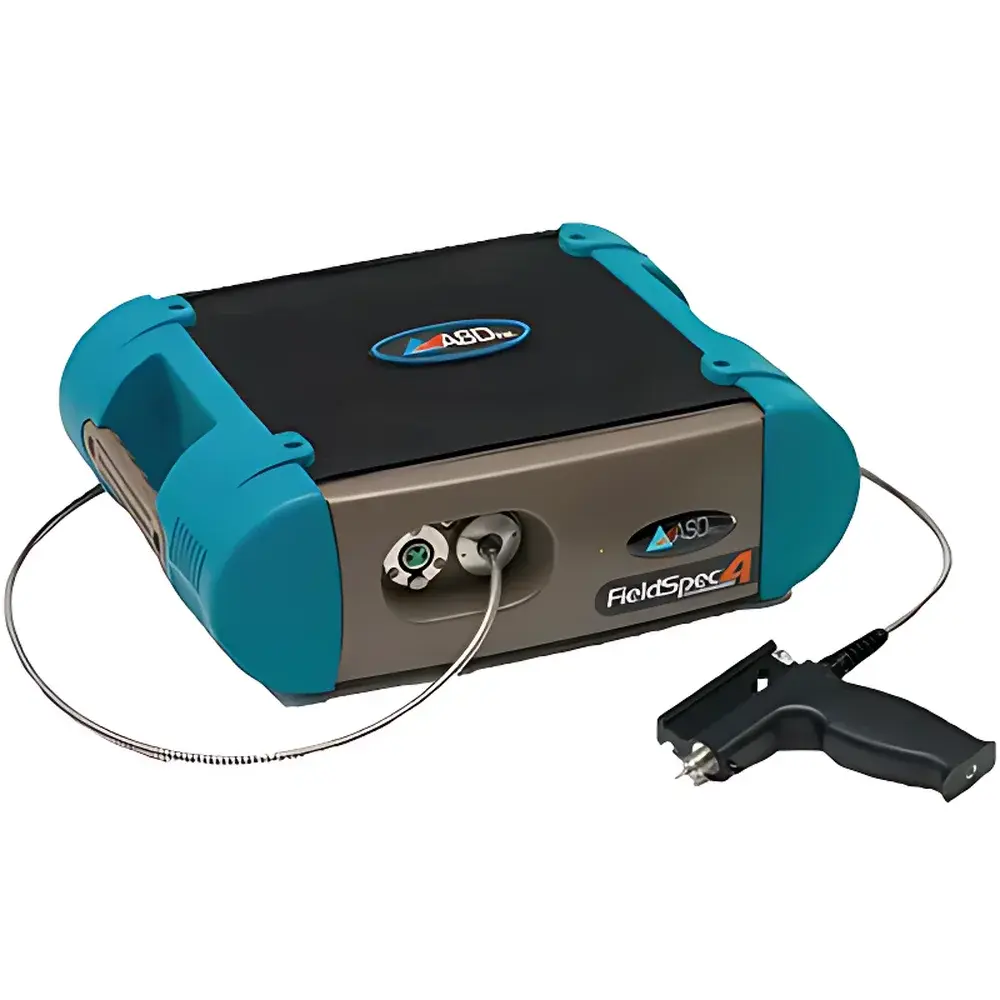
ASD FieldSpec 4 Hi-Res NG Portable Field Spectroradiometer
| Brand | ASD |
|---|---|
| Origin | UK |
| Manufacturer Type | Authorized Distributor |
| Import Status | Imported |
| Model | Hi-Res NG |
| Spectral Range | 350–2500 nm |
| Detector | InGaAs (SWIR 1 & 2), Si Array (VNIR) |
| Resolution | 3 nm @ 700 nm |
| Sensitivity | 3 nm @ 700 nm |
| SNR | VNIR: 1.0 × 10⁻⁹ W/cm²/nm/sr @ 700 nm |
| SWIR 1 | 8.0 × 10⁻⁹ W/cm²/nm/sr @ 1400 nm |
| SWIR 2 | 8.0 × 10⁻⁹ W/cm²/nm/sr @ 2100 nm |
| Dynamic Range | 16-bit |
| Stray Light | VNIR: 0.02% |
| SWIR 1 & 2 | 0.01% |
| Sampling Interval | 1.4 nm (350–1000 nm) |
| Scan Time | 100 ms |
| Wavelength Repeatability | ±0.1 nm |
| Wavelength Accuracy | ±0.5 nm |
| Max Radiance | VNIR: 2× solar |
| SWIR | 10× solar |
| Channels | 2151 |
| FOV | 25° (standard 1.5 m fiber optic cable) |
| Calibration Traceability | NIST-traceable reflectance, radiance, and irradiance (radiometric calibration optional) |
| Weight | 5.44 kg |
| Warranty | 12 months comprehensive coverage including technical support |
Overview
The ASD FieldSpec 4 Hi-Res NG is a high-performance portable field spectroradiometer engineered for rigorous ground-based spectral characterization in remote sensing validation, precision agriculture, environmental monitoring, mineralogical mapping, and vegetation biophysical parameter retrieval. Designed to meet and exceed the spectral resolution requirements of next-generation airborne and spaceborne hyperspectral imagers—including AVIRIS-NG, HySpex ODIN-1024, and PRISMA—the instrument operates across a continuous spectral range from 350 to 2500 nm using three optically coupled detector arrays: a 512-pixel silicon CCD for the visible and near-infrared (VNIR: 350–1000 nm), and two thermoelectrically (TE) cooled indium gallium arsenide (InGaAs) detectors for shortwave infrared bands (SWIR 1: 1001–1800 nm; SWIR 2: 1801–2500 nm). Its core measurement principle relies on diffraction grating-based dispersion coupled with pixel-resolved photodetection, enabling high-fidelity radiometric and reflectance measurements under variable ambient illumination conditions.
Key Features
- Enhanced spectral resolution: 3 nm FWHM at 700 nm and 6 nm FWHM at 1400 nm and 2100 nm—optimized to match or surpass the resolving power of modern push-broom hyperspectral sensors.
- High-density spectral sampling: 1.4 nm sampling interval in VNIR and 1.1 nm in SWIR regions, delivering 2151 calibrated spectral channels for robust feature detection and derivative analysis.
- Low stray light performance: ≤0.02% in VNIR and ≤0.01% in both SWIR sub-bands—critical for accurate identification of narrow absorption features (e.g., water, cellulose, lignin, carbonate, and hydroxyl bands).
- NIST-traceable calibration: Factory-calibrated for absolute reflectance, radiance, and irradiance; optional radiometric calibration available with full uncertainty budget documentation.
- Thermoelectric cooling: Stabilized InGaAs detectors maintain consistent quantum efficiency and dark current characteristics across extended field deployments.
- Ruggedized portable architecture: 5.44 kg total mass, integrated GPS interface, and compatibility with tripod mounting, fore-optics (e.g., cosine correctors, lens attachments), and external GNSS receivers for georeferenced spectral libraries.
Sample Compatibility & Compliance
The FieldSpec 4 Hi-Res NG supports non-contact, in situ measurement of natural and engineered surfaces—including soils, vegetation canopies, rock outcrops, snow/ice, painted targets, and calibration panels—without sample preparation. Its 25° field-of-view fiber optic input (1.5 m standard length) ensures representative areal sampling while minimizing shadowing and angular artifacts. The system complies with ASTM E275, ISO 17123-7, and USGS Spectral Library acquisition protocols. All calibrations adhere to ISO/IEC 17025 requirements for testing laboratories, and raw spectral data files include embedded metadata compliant with the PDS4 Planetary Data System standard. For regulated environments, the instrument supports audit-ready data logging when paired with ASD’s ViewSpec Pro software configured for 21 CFR Part 11-compliant workflows (electronic signatures, change control, and user access management).
Software & Data Management
Controlled via ViewSpec Pro v6.x (Windows® only), the FieldSpec 4 Hi-Res NG enables real-time spectral preview, automated dark/light reference capture, spectral averaging, and on-the-fly atmospheric correction using empirical line method (ELM) or radiative transfer modeling (e.g., MODTRAN integration). Data exports support ENVI .hdr/.sli, ASCII, CSV, and NASA’s HDF5 formats. The software includes built-in spectral indices calculators (NDVI, PRI, NDWI, etc.), spectral angle mapper (SAM), and derivative spectroscopy tools. All raw and processed spectra retain full calibration metadata, including timestamp, GPS coordinates, instrument temperature, integration time, and lamp status—ensuring traceability for GLP/GMP-aligned studies and peer-reviewed publication workflows.
Applications
- Validation and vicarious calibration of airborne/satellite hyperspectral sensors (e.g., PRISMA, EnMAP, EMIT)
- Quantitative estimation of leaf chlorophyll content, nitrogen concentration, and water stress indicators
- Discrimination of mineral assemblages in exploration geochemistry and regolith mapping
- Soil organic carbon and moisture profiling using SWIR absorption features
- Development of spectral libraries for machine learning training in land-cover classification
- Monitoring post-fire vegetation recovery and invasive species detection
- Calibration target characterization for UAV-based multispectral/hyperspectral payloads
FAQ
Is the FieldSpec 4 Hi-Res NG compatible with third-party radiometric calibration sources?
Yes—it accepts standardized integrating sphere sources (e.g., Labsphere Spectralon® panels, OL 750-7500 series lamps) and supports custom calibration routines via ViewSpec Pro’s external reference module.
Can the instrument operate under direct sunlight without saturation?
Yes—its dynamic range extends up to 2× solar radiance in VNIR and 10× solar radiance in SWIR, enabling stable operation during midday acquisitions without neutral density filtering.
What is the typical warm-up time for TE-cooled detectors?
Less than 5 minutes to thermal equilibrium at ambient temperatures between −10 °C and +40 °C.
Does the system support real-time GPS geotagging?
Yes—integrated NMEA 0183-compatible GPS port allows synchronized position/time stamping at 1 Hz update rate.
Are firmware updates and software patches provided post-purchase?
Yes—ASD (now Malvern Panalytical) provides free firmware and ViewSpec Pro updates for the duration of the 12-month warranty period, with extended support available under service contracts.





