
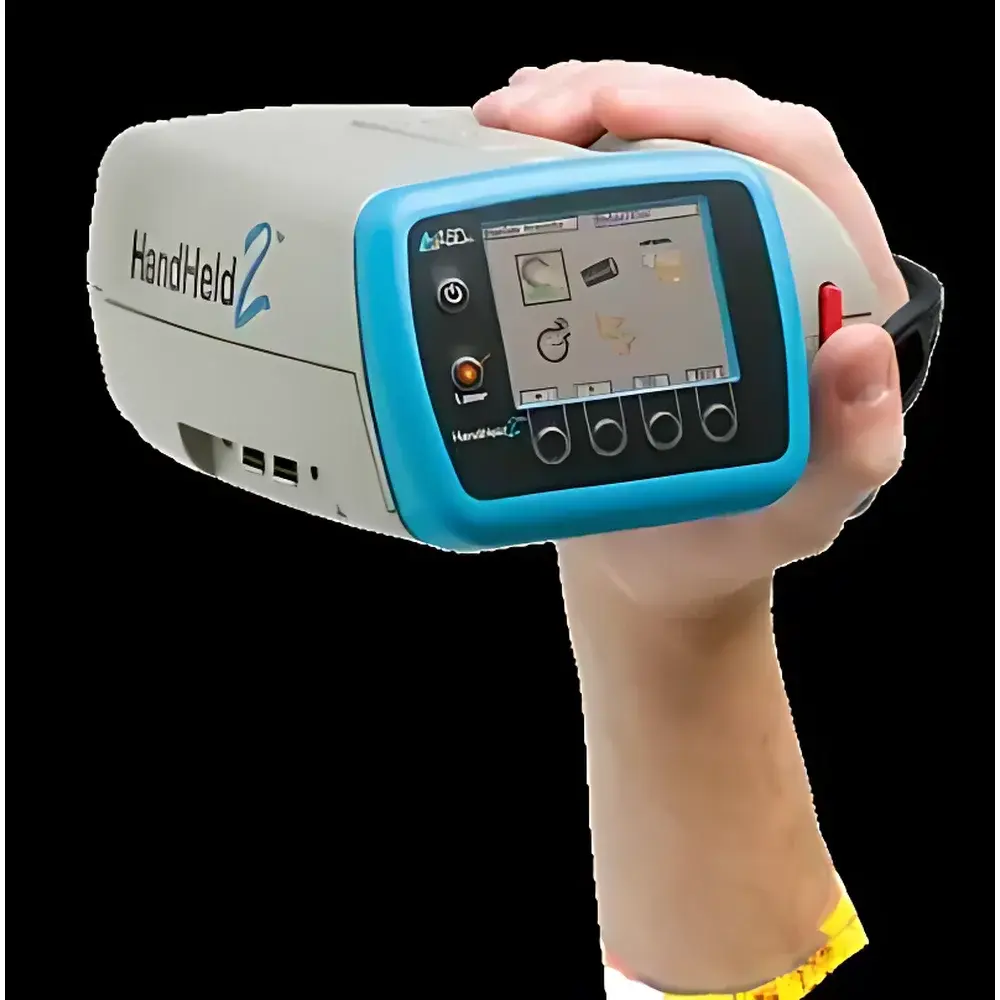
ASD FieldSpec® HandHeld 2™ Portable Field Spectroradiometer
| Brand | ASD |
|---|---|
| Origin | USA |
| Model | FieldSpec® HandHeld 2™ |
| Detector Type | PDA |
| Wavelength Range | 325–1075 nm |
| Wavelength Accuracy | ±1 nm |
| Spectral Resolution | <3.0 nm @ 700 nm |
| NEdL | 5×10⁻⁹ W/cm²/nm/sr @ 700 nm |
| FOV | 25° |
| Integration Time | 8.5 ms (min, adjustable) |
| Memory Capacity | Up to 2000 spectra |
| Display | 2.7″ tilting color LCD |
| Power | 4×AA batteries (rechargeable or alkaline) or 5 V / 1.5 A AC/DC adapter |
| Battery Life | up to 5 h (Li-ion), 2.5 h (NiMH), ~1.5 h (alkaline) |
| Dimensions (H×W×D) | 90 × 140 × 215 mm |
| Weight | 1.2 kg (incl. batteries) |
| Operating Temperature | 0–40 °C |
| Mounting | 1/4″-20 tripod thread |
| Software | RS3™, ViewSpecPro™, HH2 Sync Interface |
Overview
The ASD FieldSpec® HandHeld 2™ is a high-performance, field-deployable spectroradiometer engineered for rapid, non-contact, non-destructive acquisition of reflectance, radiance, and irradiance spectra across the ultraviolet–visible–near-infrared (UV–Vis–NIR) spectral region (325–1075 nm). Built upon a PDA (photodiode array) detection architecture with optimized optical throughput and thermally stabilized grating optics, it delivers laboratory-grade spectral fidelity under variable environmental conditions—including direct sunlight, low-light forest understory, and dynamic atmospheric conditions. Its core measurement principle relies on calibrated spectral radiometric response traceable to NIST standards, enabling quantitative remote sensing validation, vegetation biophysical parameter retrieval (e.g., chlorophyll content, leaf water index), soil property mapping, and material identification in geoscience and precision agriculture applications.
Key Features
- Integrated DriftLock™ technology actively compensates for thermal and electronic baseline drift, significantly reducing dark current variability and improving long-term spectral stability without requiring frequent dark reference acquisitions.
- 25° full field-of-view (FOV) lens provides consistent spatial sampling across heterogeneous targets—ideal for canopy-level measurements, soil surface characterization, and mixed-pixel field calibration.
- Onboard 2.7″ tilting color LCD display enables real-time spectral preview, immediate quality assessment, and in-field decision-making without external computing hardware.
- Internal storage supports up to 2000 spectra with timestamp, GPS metadata (when paired with optional GNSS module), and user-defined annotation fields—ensuring full traceability and audit readiness.
- Ergonomic D-handle design, laser-assisted targeting (adjustable IR aiming beam), and 1.2 kg mass optimize single-operator usability during extended field campaigns.
- Modular power architecture accepts standard AA cells (alkaline, NiMH, or Li-ion), delivering operational flexibility across logistical constraints—from vehicle-based surveys to backpack-mounted transects.
Sample Compatibility & Compliance
The FieldSpec HandHeld 2™ is compatible with a broad range of natural and engineered surfaces, including vegetative canopies, bare soils, mineral outcrops, asphalt, painted surfaces, and calibration standards such as Spectralon® reference panels. It meets ASTM E275, ISO 2859-1, and USP requirements for spectral instrument qualification when used with certified reference materials and documented calibration protocols. Data acquisition workflows support GLP-compliant documentation through RS3™ software’s audit trail logging, electronic signature capability, and 21 CFR Part 11–ready configuration options (when deployed with validated IT infrastructure).
Software & Data Management
Data acquisition, real-time visualization, and post-processing are supported by three interoperable software tools: RS3™ (instrument control, spectral library management, and automated calibration routines), ViewSpecPro™ (advanced spectral analysis including derivative spectroscopy, spectral angle mapper, and vegetation index calculation), and HH2 Sync Interface (for time-synchronized multi-sensor deployments, e.g., UAV-ground coordination or flux tower integration). All software packages export data in ENVI-compatible BIL/BIP formats, ASCII CSV, and HDF5—ensuring seamless ingestion into GIS platforms (ArcGIS, QGIS), statistical environments (R, Python SciPy), and machine learning pipelines.
Applications
- Field validation of satellite and airborne hyperspectral imagery (e.g., Sentinel-2, PRISMA, AVIRIS-NG)
- Phenotyping and stress monitoring in crop breeding trials via spectral vegetation indices (NDVI, PRI, MCARI)
- Soil organic carbon and iron oxide quantification using continuum-removed absorption features near 600–900 nm
- Mineralogical mapping in exploration geology through diagnostic absorption band depth and position analysis
- Calibration and validation of unmanned aerial system (UAS)-based multispectral sensors
- Forensic material identification and pigment analysis in cultural heritage studies
FAQ
Is the FieldSpec HandHeld 2™ suitable for outdoor use in direct sunlight?
Yes—the optical path includes built-in stray light suppression, and the PDA detector’s high dynamic range ensures stable performance even under high-irradiance conditions. Users are advised to perform regular white/dark reference measurements per ASTM E275 guidelines.
Does the instrument require external cooling or temperature stabilization?
No—its solid-state PDA detector and passive thermal management enable reliable operation from 0–40 °C without active cooling; DriftLock™ mitigates temperature-induced baseline shifts in real time.
Can spectral data be exported in formats compatible with MATLAB or Python?
Yes—all native output formats (CSV, ENVI, HDF5) are directly readable by NumPy, SciPy, and MATLAB’s hyperspectral toolbox, supporting reproducible spectral analysis workflows.
What calibration standards are recommended for field deployment?
Spectralon® 99% reflectance panels (certified per NIST SRM 2035) are supplied as standard; users should also maintain dark reference measurements at ambient temperature before each acquisition session.
Is firmware upgradable in the field?
Yes—firmware updates are delivered via USB and applied using RS3™ software, ensuring compatibility with evolving spectral processing algorithms and regulatory requirements.




