
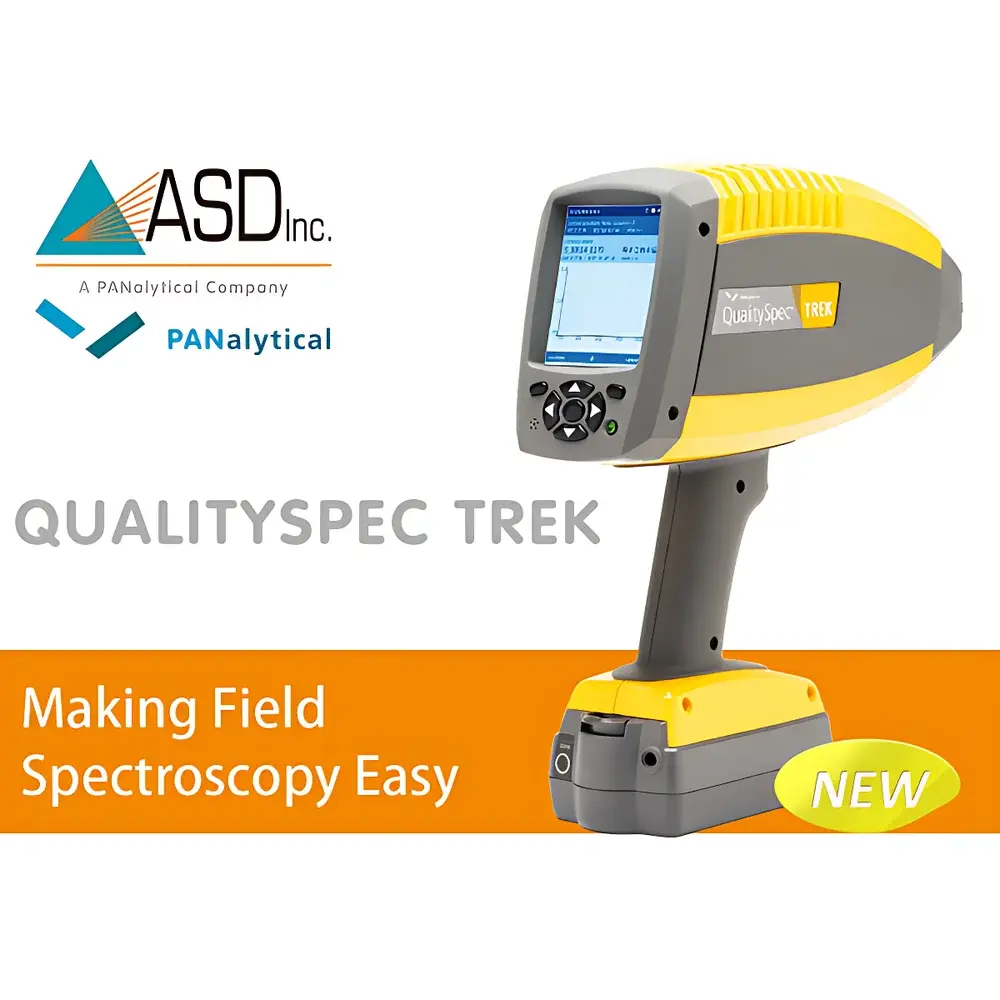
ASD QualitySpec Trek Handheld Full-Range Near-Infrared Spectrometer
| Brand | ASD |
|---|---|
| Origin | United Kingdom |
| Manufacturer Type | Authorized Distributor |
| Origin Category | Imported |
| Model | QualitySpec Trek |
| Price | Upon Request |
| Wavelength Range | 350–2500 nm |
| Spectral Resolution | 3 nm @ 700 nm, 9.8 nm @ 1400 nm, 8.1 nm @ 2100 nm |
| Dimensions (L×W×H) | 775 mm × 250 mm × 750 mm |
| Weight with Battery | 2.5 kg (5.5 lbs) |
| Weight without Battery | 2.0 kg (4.3 lbs) |
| Operating Languages | English, Spanish, Chinese |
| Integrated GPS | Yes |
| Voice Memo Function | Yes |
| Display | Integrated LCD |
| Connectivity | Wireless (Wi-Fi/Bluetooth) |
Overview
The ASD QualitySpec Trek Handheld Full-Range Near-Infrared Spectrometer is an engineered solution for field-deployable, high-fidelity spectral acquisition across the ultraviolet–visible–near-infrared (UV–Vis–NIR) domain. Based on diffraction grating spectrometry with thermoelectrically cooled silicon and InGaAs detector arrays, the instrument delivers calibrated radiance and reflectance spectra from 350 nm to 2500 nm in a single, non-scanning measurement cycle. Its optical architecture follows the proven heritage of ASD’s FieldSpec, LabSpec, and TerraSpec platforms—designed for rigorous scientific use in geoscience, agronomy, environmental monitoring, and materials characterization. Unlike benchtop or tripod-mounted systems, the QualitySpec Trek integrates all optical, electronic, and computational subsystems into a self-contained handheld form factor, enabling real-time spectral collection under variable ambient lighting, temperature, and terrain conditions—without external power or tethered computing.
Key Features
- Full-spectrum coverage from 350 nm to 2500 nm in one acquisition—enabling simultaneous analysis of electronic transitions (UV–Vis), vibrational overtones (NIR), and combination bands critical for organic functional group identification.
- Optimized spectral resolution: ≤3 nm at 700 nm (visible region), 9.8 nm at 1400 nm, and 8.1 nm at 2100 nm—meeting ASTM E1777 and ISO 11664-3 requirements for spectral fidelity in field-based reflectance spectroscopy.
- Integrated 5.5-inch sunlight-readable LCD display with touchscreen interface—eliminating dependency on external tablets or laptops during data collection.
- Onboard Wi-Fi and Bluetooth 5.0 connectivity for wireless synchronization with cloud-based spectral libraries, GIS platforms, or laboratory LIMS systems.
- Dual-band GNSS receiver (GPS + GLONASS) with sub-5-meter horizontal accuracy (CEP), providing georeferenced metadata compliant with ISO 19115-1 for spatial data interoperability.
- Voice memo recording synchronized to each spectrum—supporting contextual annotation traceable under GLP and GMP audit requirements.
- Ruggedized magnesium alloy chassis rated IP54 for dust and water resistance; operational temperature range: –10 °C to +50 °C.
Sample Compatibility & Compliance
The QualitySpec Trek is optimized for non-contact, non-destructive reflectance measurements of heterogeneous natural and synthetic surfaces—including soils, vegetation canopies, mineral outcrops, snow/ice interfaces, painted composites, and polymer films. It supports both contact (via optional calibration cap) and standoff (up to 1 m) configurations. All spectral outputs are radiometrically calibrated using NIST-traceable standards and conform to ASTM E275, ASTM E1312, and ISO 13406-2 for measurement repeatability and inter-instrument comparability. Firmware and embedded software comply with FDA 21 CFR Part 11 requirements for electronic records and signatures, including secure user authentication, audit trail logging, and data integrity validation.
Software & Data Management
The instrument operates natively on ASD’s proprietary SpectraSuite v4.x firmware, supporting real-time spectral preview, automatic dark-current subtraction, and onboard spectral smoothing (Savitzky–Golay). Raw data exports in ENVI-compatible .hdr/.sli format and ASTM E1312-compliant CSV. Integration with ASD’s cloud-based Spectral Intelligence Platform enables automated spectral library matching (e.g., USGS Mineral Library, ECOSTRESS Soil Spectral Database), PCA-based anomaly detection, and batch processing workflows. All metadata—including GPS coordinates, UTC timestamps, instrument temperature, integration time, and user-defined tags—are embedded in spectral headers per ISO 19115-2 standards.
Applications
- Soil property mapping: estimation of organic carbon, clay content, iron oxide abundance, and moisture via PLSR and machine learning models trained on reference spectra.
- Vegetation phenotyping: chlorophyll-a/b ratio, carotenoid index, NDVI, PRI, and water band indices derived directly from reflectance curves.
- Mineral identification in exploration geology: discrimination of kaolinite, smectite, gypsum, and carbonate phases using diagnostic absorption features near 1400, 1900, and 2200 nm.
- Snow and ice characterization: grain size, impurity loading (e.g., black carbon), and albedo modeling for cryospheric climate studies.
- Industrial QA/QC: verification of pigment consistency, polymer degradation, coating thickness, and counterfeit material detection in manufacturing supply chains.
FAQ
Is the QualitySpec Trek suitable for regulatory-compliant environmental monitoring programs?
Yes—it meets ISO/IEC 17025 requirements for field instrumentation when used with documented calibration protocols and traceable reference standards.
Can spectral data be exported to third-party chemometric software such as Unscrambler or MATLAB?
Yes—native support for ASCII, ENVI, and ASTM E1312 formats ensures full compatibility with industry-standard multivariate analysis environments.
Does the device require annual factory recalibration?
No—field recalibration using ASD’s certified white reference panel is sufficient; factory recalibration is recommended every 24 months or after mechanical shock events.
Is spectral data acquisition compliant with FDA 21 CFR Part 11 for pharmaceutical applications?
Yes—audit trails, electronic signatures, role-based access control, and immutable raw data storage are fully implemented in firmware v4.3.2 and later.
What battery life can be expected during continuous field operation?
Up to 6 hours of active scanning (100 spectra/hour) at 25 °C; hot-swappable Li-ion battery design allows uninterrupted operation with spare packs.





