
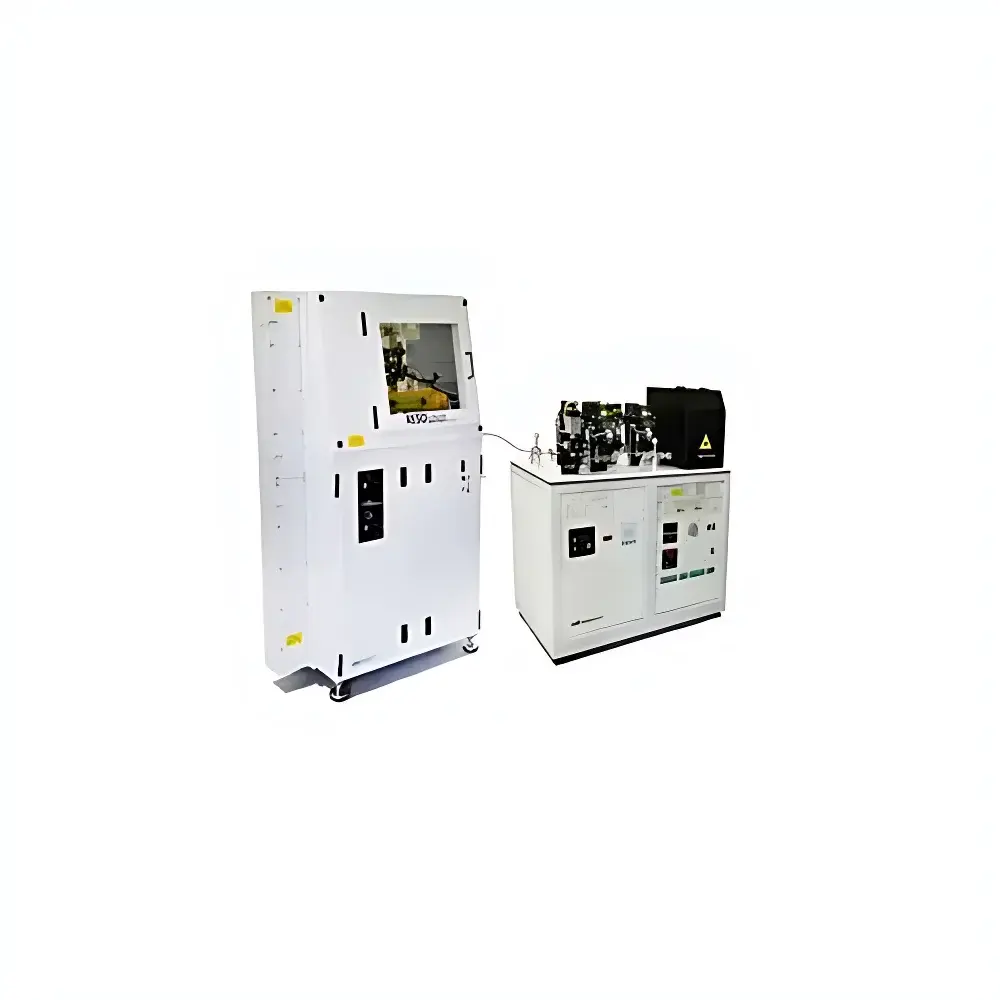
ASI RESOlution-11 Laser Ablation System
| Brand | ASI |
|---|---|
| Origin | USA |
| Type | Benchtop |
| Configuration | Modular |
| Laser Wavelength | 193 nm (Excimer) |
| Pulse Energy | 200 mJ (typical, at laser output) |
| Fluence | >20 J/cm² |
| Sample Stage Travel Range | 155 mm × 105 mm |
| Sample Capacity | 20 × 1-inch targets or 6 thin sections |
| Dimensions (W×D×H) | 119 × 89 × 195 cm |
| Weight | 750 kg (1600 lbs.) |
| Flush Time | Optimized for rapid washout (<30 s typical for standard ablation cells) |
Overview
The ASI RESOlution-11 Laser Ablation System is a high-precision, excimer-based laser ablation platform engineered for seamless integration with inductively coupled plasma mass spectrometry (ICP-MS) and optical emission spectrometry (ICP-OES). Operating at 193 nm, the system delivers deep-ultraviolet photon energy optimized for stoichiometric ablation of dielectric and conductive geological, environmental, and materials science samples. Its core design adheres to the principles of controlled micro-volume sampling—minimizing thermal effects, suppressing elemental fractionation, and preserving spatial integrity across heterogeneous matrices. Unlike broadband or IR-laser systems, the 193 nm excimer source enables consistent ablation thresholds across silicates, carbonates, sulfides, and oxide phases, making it especially suitable for high-resolution geochemical mapping, inclusion analysis, and U–Pb zircon geochronology. The RESOlution-11 is not a standalone spectrometer but a sample introduction subsystem—its performance is intrinsically linked to ICP interface stability, aerosol transport efficiency, and temporal signal fidelity.
Key Features
- Sub-micron stage positioning accuracy enabled by integrated real-time visual alignment—optical feedback loop synchronizes camera view with ablation coordinates for precise targeting of inclusions, growth zones, or textural boundaries.
- Rotating rectangular slit optics for dynamic linear scanning, supporting high-fidelity line profiles and raster mapping without mechanical stage drift or signal discontinuity.
- Automated gas flow control architecture: All carrier, makeup, and cell purge gases are regulated via software-commanded mass flow controllers (MFCs), eliminating manual valve adjustments and ensuring reproducible aerosol delivery to the ICP torch.
- On-the-fly laser fluence calibration: Integrated photodiode and beam profiling ensure consistent energy density (>20 J/cm²) across the full ablation field—critical for quantitative depth profiling and inter-laboratory comparability.
- Rapid-flush ablation cell design: Achieves complete aerosol clearance in under 30 seconds (dependent on cell geometry and gas flow), minimizing memory effects and enabling high-throughput multi-spot analysis without cross-contamination.
- Modular sample handling: Supports interchangeable holders for 20 × 1-inch targets, 6 petrographic thin sections, or custom-configured substrates—including large-area wafers or irregularly shaped specimens—via adaptable clamping and leveling mechanisms.
Sample Compatibility & Compliance
The RESOlution-11 accommodates a broad range of solid samples relevant to geochemistry, metallurgy, nuclear forensics, and semiconductor metrology. It maintains compatibility with ASTM D7574–22 (Standard Guide for Laser Ablation–Inductively Coupled Plasma–Mass Spectrometry Analysis), ISO/IEC 17025–2017 (for accredited testing laboratories), and USP / (elemental impurities in pharmaceuticals). Its closed-loop gas management and automated safety interlocks meet IEC 61000-6-2/6-4 EMC requirements and comply with OSHA 29 CFR 1910.1200 (Hazard Communication) for laser operation in shared laboratory environments. No user-accessible optical paths exist outside Class 1 enclosures; all laser emissions are fully interlocked per ANSI Z136.1–2022.
Software & Data Management
Control and acquisition are unified within GeoStar v5.x—a dedicated, Windows-based application developed by ASI for laser ablation workflows. GeoStar provides full scriptable automation (Python API available), audit-trail logging compliant with FDA 21 CFR Part 11 (electronic signatures, user access levels, change history), and native export formats compatible with ICP-MS vendor software (e.g., Thermo Fisher Qtegra, Agilent MassHunter, Nu Instruments NuInstrument). All calibration parameters—including laser energy, stage position, gas flows, and dwell times—are stored as metadata alongside raw intensity time-series data (.csv and .raw formats). Data integrity is enforced through SHA-256 hashing of acquisition sessions and timestamped operator authentication.
Applications
- High-spatial-resolution trace element mapping in zircon, monazite, and apatite for geochronology and petrogenetic modeling.
- In situ sulfur isotope ratio analysis (δ³⁴S) in sulfide minerals using multi-collector ICP-MS.
- Quantitative analysis of rare earth elements (REEs) in lunar regolith simulants and meteoritic breccias.
- Depth-resolved impurity profiling in silicon wafers and GaN epitaxial layers.
- Micro-domain analysis of fluid inclusions in quartz and calcite for paleofluid chemistry reconstruction.
FAQ
Is the RESOlution-11 compatible with my existing ICP-MS system?
Yes—the system interfaces via standard 1/4″ Swagelok fittings and supports both continuous and time-resolved acquisition modes. Compatibility has been verified with Thermo Fisher, Agilent, Nu Instruments, and Element series instruments.
Does the system require external water cooling or compressed air?
No—it operates with internal thermoelectric cooling for the excimer laser head and uses ambient air for purge gas; only argon (or helium) carrier gas is required from an external cylinder.
Can I perform depth profiling on layered thin films?
Yes—real-time fluence control, adjustable repetition rate (1–20 Hz), and programmable stage motion enable controlled ablation through multilayer stacks with sub-micron depth resolution.
What maintenance is required for long-term operational stability?
Annual laser gas replenishment and quarterly MFC calibration are recommended. No consumable optics are used; the fused silica beam delivery path is sealed and maintenance-free for >10⁹ shots.





