
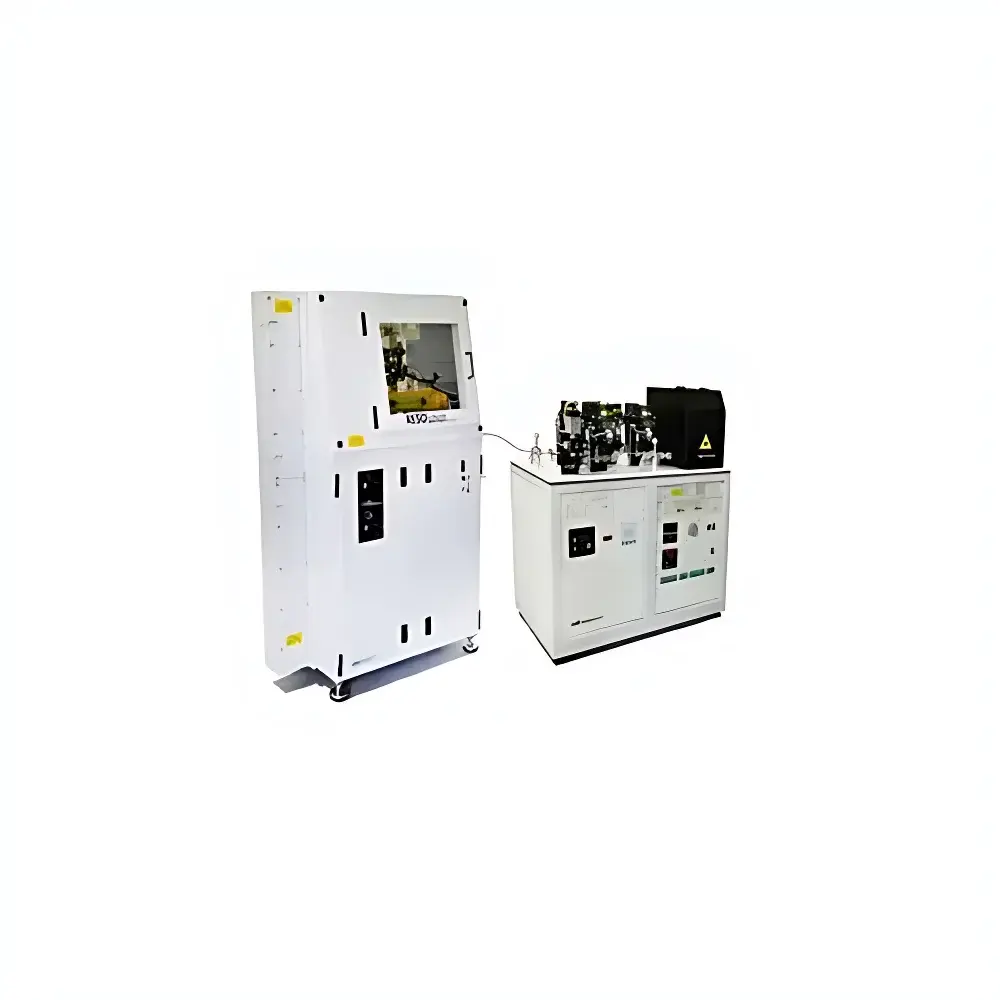
ASI RESOlution-5 Laser Ablation In-Situ Isotope Analysis and Geochronology System
| Brand | ASI |
|---|---|
| Origin | USA |
| Manufacturer Type | Authorized Distributor |
| Origin Category | Imported |
| Model | RESOlution-5 |
| Quotation | Upon Request |
| Laser Pulse Width | 5–7 ns |
| Pulse Energy | 12 mJ |
| Pulse Energy Stability | <2% RSD |
| Repetition Rate | 300 Hz |
| Fluence | >20 J/cm² |
| Sample Stage Travel Range | 155 × 105 mm |
| System Weight | 750 kg (1600 lbs.) |
Overview
The ASI RESOlution-5 Laser Ablation In-Situ Isotope Analysis and Geochronology System is a high-precision, dual-dating platform engineered for microscale in-situ isotopic analysis of geological materials. It integrates a Q-switched Nd:YAG laser source with a modular inert-gas sample cell and couples directly to multi-collector or single-collector mass spectrometers via flexible bellows interface. Operating on the principle of laser ablation multi-collector inductively coupled plasma mass spectrometry (LA-MC-ICP-MS) and laser ablation noble gas mass spectrometry (LA-NGMS), the system enables simultaneous acquisition of (U-Th)/Pb and (U-Th-Sm)/He chronometric data from individual mineral grains—without chemical digestion, acid leaching, or physical separation. This eliminates contamination risks associated with wet chemistry protocols and preserves spatial context critical for petrochronology, thermochronology, and provenance studies.
Key Features
- Q-switched Nd:YAG laser with pulse width tunable between 5–7 ns, delivering stable 12 mJ pulses at 300 Hz repetition rate and fluence exceeding 20 J/cm²—optimized for efficient ablation of refractory silicates including zircon, monazite, apatite, and titanite.
- Dual-sample-stage architecture: includes one standard conical-sample holder (43-position) and one multi-dimension flat-bottom sample holder, both compatible with GeoStar software-controlled positioning and automated rastering.
- Motorized off-axis observation system with high-resolution digital camera enables real-time, sub-micron-scale imaging of ablation sites inside the inert-gas sample cell—critical for targeting specific growth zones, inclusions, or metamorphic overgrowths.
- Integrated laser energy monitoring: real-time photodiode-based feedback ensures consistent ablation conditions across analytical sessions, supporting long-term reproducibility required for inter-laboratory age comparisons.
- Modular inert-gas sample cell design facilitates rapid exchange of sample holders and accommodates custom geometries—enabling user-defined configurations for He diffusion experiments, thermal history reconstruction, or fluid inclusion analysis.
Sample Compatibility & Compliance
The RESOlution-5 supports analysis of polished thin sections, grain mounts, and epoxy-embedded mineral separates. Its open-cell architecture complies with ASTM D7279-22 (Standard Practice for Laser Ablation Sampling for Elemental and Isotopic Analysis) and aligns with ISO/IEC 17025:2017 requirements for measurement traceability in geochronological laboratories. When operated with certified reference materials (e.g., NIST SRM 610, Temora-2, Fish Canyon Tuff), the system meets USP and GLP audit criteria for data integrity. Full electronic audit trail, instrument parameter logging, and user-access controls are embedded within GeoStar software to satisfy FDA 21 CFR Part 11 compliance for regulated research environments.
Software & Data Management
GeoStar software provides an intuitive, structured graphical interface for method setup, stage navigation, laser firing control, and offline ablation site selection. The platform supports remote collaboration through secure cloud-based project sharing, enabling distributed teams to review, annotate, and reprocess raw signal files (.raw, .csv) without instrument access. All acquisition parameters—including laser energy, spot size, dwell time, and cell gas flow—are timestamped and archived alongside raw intensity data. Integrated peak-stripping algorithms and common-Pb correction models (e.g., Stacey-Kramers, 207Pb-corrected 206Pb/238U) facilitate rapid age calculation, while batch processing tools enable high-throughput (U-Th)/Pb and (U-Th-Sm)/He age generation from multi-grain datasets.
Applications
- Thermochronology: High-resolution (U-Th)/He and (U-Th-Sm)/He dating of apatite and zircon to constrain cooling histories, exhumation rates, and basin evolution.
- Petrochronology: In-situ U-Pb dating of zoned accessory minerals to resolve magmatic crystallization sequences and crustal contamination events.
- Detrital geochronology: Rapid screening of >50 detrital grains per session for provenance analysis and sedimentary basin modeling.
- Diffusion kinetics: Controlled-heating experiments combined with He depth-profiling to calibrate closure temperatures and retentivity models.
- Metamorphic overgrowth dating: Targeted ablation of rim domains in monazite and xenotime to reconstruct P-T-t paths in high-grade terranes.
FAQ
Can the RESOlution-5 be coupled to my existing MC-ICP-MS or noble gas MS?
Yes—the system uses standardized vacuum flanges and bellows interfaces compatible with Thermo Scientific Neptune, Nu Instruments Apex, and Argus VI platforms.
Is GeoStar software compatible with Windows 10/11 and networked lab environments?
Yes—GeoStar is built on Microsoft .NET Framework and supports domain authentication, centralized license management, and SQL Server-based project databases.
What sample preparation standards are recommended for optimal (U-Th-Sm)/He analysis?
Polished grain mounts with 1–2 µm diamond paste finishing and carbon coating are advised; all samples must be pre-annealed under vacuum to remove atmospheric He contamination.
Does the system support automated calibration against matrix-matched reference materials?
Yes—GeoStar includes a dedicated calibration workflow that applies time-resolved sensitivity corrections using bracketing standards such as FC-1, Plešovice, and Durango apatite.
How is laser stability maintained during extended multi-day analytical campaigns?
The integrated photodiode monitor feeds back to the laser power supply in real time, compensating for thermal drift; routine recalibration is recommended every 8 hours using a NIST-traceable energy meter.






