
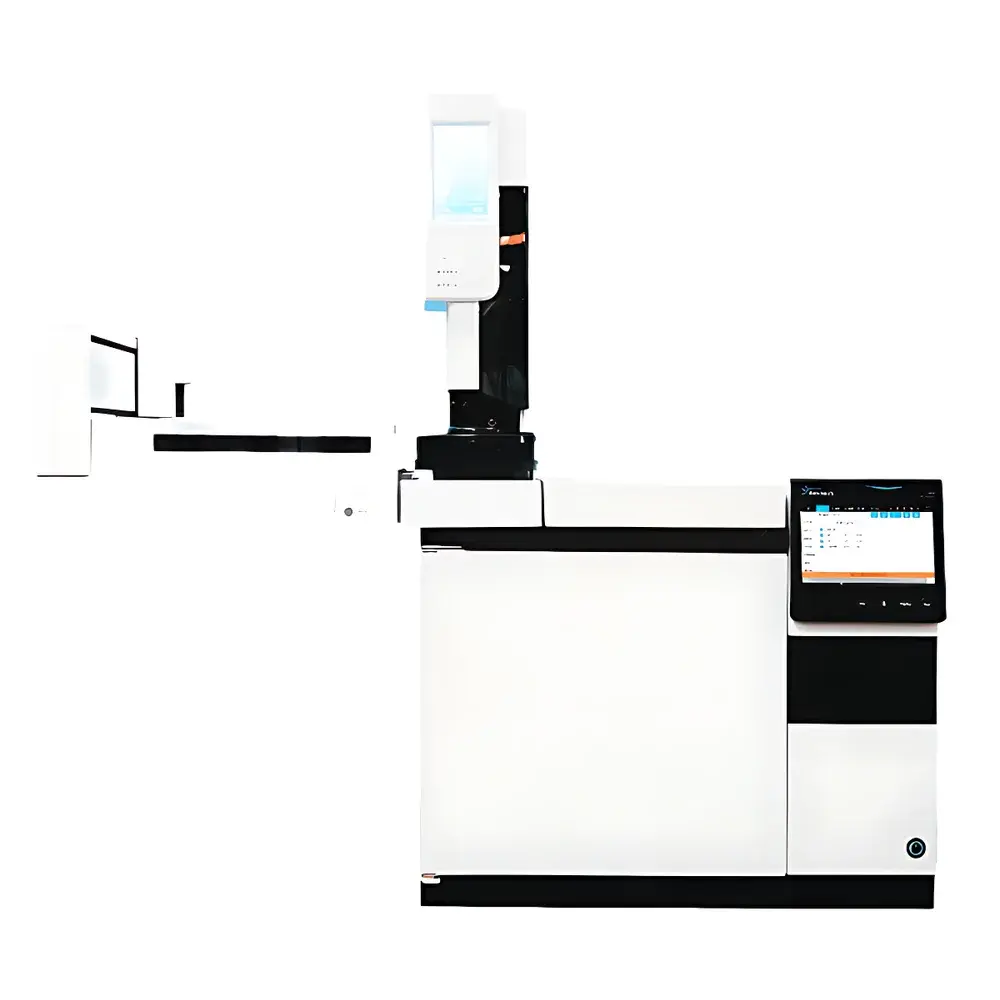
Asicotech M6 IoT-Enabled Gas Chromatography Platform
| Brand | Asicotech |
|---|---|
| Origin | Shanghai, China |
| Manufacturer Type | OEM Manufacturer |
| Regional Classification | Domestic (China) |
| Model | Asicotech M6 GC System |
| Price Range | USD 21,000 – 280,000 |
| Instrument Type | Laboratory Gas Chromatograph |
| Application Scope | General-Purpose |
| Oven Temperature Range | −30 °C to 460 °C |
| Oven Ramp Rate | 0–200 °C/min |
| Oven Cool-Down Rate | 0–150 °C/min |
| Carrier Gas Flow Range & Control | 0–100 mL/min |
| Carrier Gas Pressure Range & Control | 0–150 psi |
| Injector Maximum Operating Temperature | 460 °C |
| Injector Pressure Setting Range | 0–150 psi |
| Injector Total Flow Setting Range | 0–2000 mL/min |
Overview
The Asicotech M6 IoT-Enabled Gas Chromatography Platform is a modular, laboratory-grade gas chromatograph engineered for precision, scalability, and digital integration in modern analytical laboratories. Built upon core gas chromatographic principles—separation of volatile and semi-volatile compounds via differential partitioning between a mobile phase (inert carrier gas) and a stationary phase (capillary column)—the M6 platform extends traditional GC functionality through embedded Ethernet and cloud-ready architecture. Unlike conventional benchtop GC systems, the M6 integrates hardware-level electronic pressure control (EPC), fourth-generation digital flow management, and distributed module-level data acquisition into a unified data processing ecosystem. Its design supports multi-zone thermal control, real-time instrument health monitoring, and bidirectional communication with enterprise LIMS, MES, or centralized environmental monitoring databases—enabling traceable, auditable, and scalable chromatographic analysis across R&D, QC, and production environments.
Key Features
- Modular architecture with hot-swappable functional units: injection modules (split/splitless, high-pressure liquid, gas valve, and pressure-controlled), oven modules (isothermal and programmable ramp configurations; up to four independent ovens configurable in parallel or cascade), and detector modules (FID, TCD, FPD, ECD, EPD, SCD).
- Fourth-generation EPC system delivering <0.01 psi pressure resolution and <0.1 mL/min flow stability across full operating range—ensuring retention time reproducibility ≤0.02% RSD over 24-hour sequences.
- Ultra-fast thermal management: −30 °C to 460 °C oven range with ramp rates up to 200 °C/min and cool-down rates up to 150 °C/min—optimized for rapid method development and high-throughput screening.
- Integrated IoT gateway supporting MQTT/HTTP(S) protocols, TLS 1.2 encryption, and OPC UA-compliant device abstraction—enabling secure remote access, firmware updates, and predictive maintenance alerts.
- Embedded 10.1″ capacitive touchscreen HMI with customizable UI templates, role-based access control (admin/operator/auditor), and dual-mode operation (standalone or networked).
- Onboard data processing engine compliant with ASTM D3612, ISO 6416, USP , and EPA Method 8260D workflows—including automatic peak integration, retention time locking, and calibration curve generation with forced quadratic fitting.
Sample Compatibility & Compliance
The M6 platform accommodates gaseous, liquid, and solid-phase samples via compatible auxiliary modules—including purge-and-trap concentrators, headspace samplers, SPME autosamplers, and cryo-focused preconcentrators. It meets regulatory requirements for GLP and GMP environments through built-in audit trail logging (21 CFR Part 11–compliant electronic signatures, immutable event records, and user action timestamps). All firmware and software components are validated per IQ/OQ/PQ protocols and support ISO/IEC 17025 documentation packages. Detector sensitivity specifications align with ICH Q2(R2) guidelines for specificity and detection limit verification—e.g., FID LOD ≤1 pg C/sec for n-decane; ECD LOD ≤0.01 pg/mL for γ-HCH.
Software & Data Management
The Asicotech ChromaCloud™ software suite serves as both acquisition workstation and enterprise analytics hub. It features native support for CSV, CDF, and ANDI-MS export formats; batch processing with method sequencing and conditional logic; and automated report generation with configurable templates (PDF, Excel, HTML). Data integrity safeguards include SHA-256 hashing of raw acquisitions, encrypted local storage (AES-256), and synchronized backup to on-premise NAS or AWS S3 buckets. Cloud analytics modules perform multivariate statistical analysis (PCA, PLS-DA), drift correction, and anomaly detection using time-series modeling—outputting actionable insights directly to dashboards accessible via web browser or mobile app (iOS/Android).
Applications
- Petrochemical & Coal Chemistry: Full-component analysis of MTO/MTA/GTO effluents, aromatic process streams, refinery gases, syngas-to-EG intermediates, and tail-gas sulfur speciation.
- Semiconductor & High-Purity Gases: Sub-ppb impurity profiling in electronic-grade N₂, Ar, He, H₂, and specialty etchant gases (NF₃, ClF₃, WF₆) per SEMI F57 and ASTM D7622 standards.
- Environmental Monitoring: Quantification of ambient methane, NMHC, BTEX, halocarbons, carbonyls, and amine derivatives in ambient air and stack emissions—validated against EPA TO-15, TO-17, and EN 13649-1.
- Specialty Fuels & Consumer Products: Trace hydrazine, monomethylhydrazine, and deuterium analysis in aerospace propellants; volatile organic compound (VOC) profiling in tobacco smoke condensate and food packaging headspace.
FAQ
Is the M6 platform compatible with existing LIMS or SCADA infrastructure?
Yes—the system supports standard HL7, ASTM E1384, and OPC UA interfaces, with optional middleware for Siemens Desigo, Rockwell FactoryTalk, or Thermo Fisher SampleManager integration.
Can detector modules be changed without recalibrating the entire system?
Yes—each detector module retains its own calibration coefficients and spectral response profiles; hot-swap operations preserve baseline stability and require only post-installation validation checks.
Does the platform support 21 CFR Part 11 compliance out-of-the-box?
Yes—audit trails, electronic signatures, and role-based permissions are enabled by default; full validation documentation and IQ/OQ/PQ test scripts are provided with shipment.
What level of cybersecurity certification does the embedded IoT gateway hold?
The gateway complies with IEC 62443-3-3 SL2 requirements and has undergone penetration testing per NIST SP 800-115; firmware updates are cryptographically signed and verified at boot.
Is remote diagnostics and firmware update capability available globally?
Yes—cloud-based remote support is accessible via secure tunneling (WireGuard VPN); firmware updates are delivered in delta format to minimize bandwidth usage and support offline staging.
Related Products






