
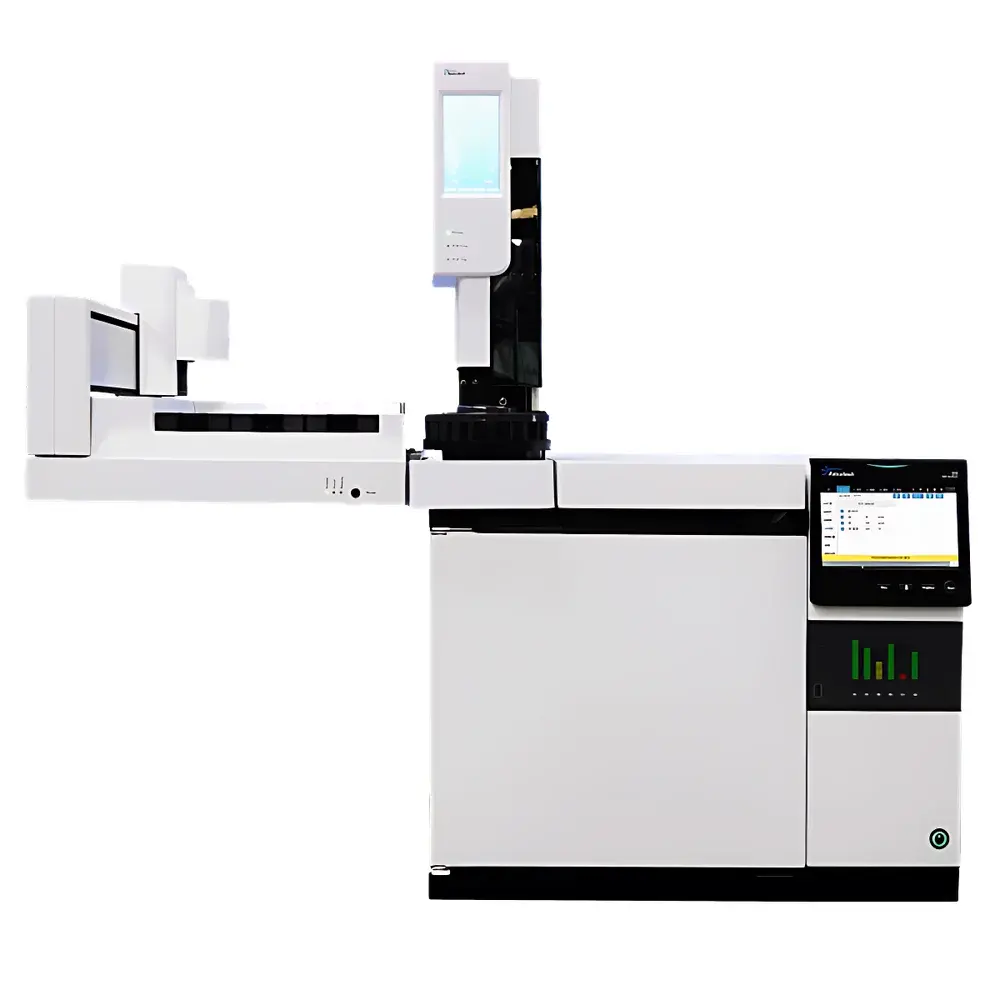
Asicotech M8 GC – Artificial Intelligence-Enabled Laboratory Gas Chromatograph
| Brand | Asicotech |
|---|---|
| Origin | Shanghai, China |
| Manufacturer Type | Direct Manufacturer |
| Regional Classification | Domestic (China) |
| Model | M8 |
| Instrument Type | Laboratory Gas Chromatograph |
| Application Scope | General-Purpose |
| Temperature Control Range | Ambient +4 °C to 450 °C |
| with Liquid Nitrogen Cooling | −80 °C to 450 °C |
| with CO₂ Cooling | −40 °C to 450 °C |
| Oven Ramp Rate | Up to 120 °C/min |
| Oven Cool-Down | 450 °C → 50 °C in 3.5 min |
| Carrier Gas Flow Range & Control | N₂: 0–200 mL/min (optional 500 mL/min) |
| He/H₂ | 0–1250 mL/min |
| Carrier Gas Pressure Range & Control | 0–150 PSI |
| Injector Maximum Operating Temperature | 450 °C |
| Injector Pressure Setting Range | 0–150 PSI |
| Injector Total Flow Setting Range | N₂: 0–200 mL/min (optional 500 mL/min) |
| He/H₂ | 0–1250 mL/min |
Overview
The Asicotech M8 GC is a next-generation laboratory gas chromatograph engineered for precision, reproducibility, and intelligent operation in regulated and research-driven environments. Built upon the proven thermal and fluidic architecture of the M3 and M6 platforms, the M8 integrates real-time AI-assisted control logic into core chromatographic functions—including oven temperature programming, carrier gas dynamics, and injector parameter optimization—without compromising method traceability or analytical rigor. Its column oven employs high-stability PID-controlled heating elements and dual-zone insulation, enabling rapid, linear ramping up to 120 °C/min and sub-4-minute cool-down from 450 °C to 50 °C. Optional cryogenic cooling modules (liquid nitrogen or CO₂) extend operational low-temperature capability to −80 °C, supporting volatile compound retention and cryo-focusing applications. The system operates on standard carrier gases (N₂, He, H₂) with fully digital electronic pressure and flow control (EPC/EFC), ensuring consistent retention time stability across multi-day sequences.
Key Features
- Modular, field-upgradable hardware platform with hot-swappable detector interfaces and configurable inlet types (split/splitless, PTV, cool-on-column)
- Integrated dual-display interface: 7-inch color capacitive touchscreen for real-time instrument control + auxiliary OLED status panel for at-a-glance diagnostics
- uniSeries firmware with embedded self-diagnostic engine, predictive maintenance alerts, and automated calibration verification workflows
- Fully remote operation via secure TLS-encrypted web interface—compatible with tablets, laptops, and enterprise LIMS integration
- UniMeta cross-platform chromatography data system (CDS), validated for Windows, Linux, and domestic OS environments (e.g., Kylin, UOS) on LoongArch and Phytium CPU architectures
- Compliant with ASTM D3606, ISO 10301, and USP for method execution; supports 21 CFR Part 11-compliant audit trails and electronic signatures when deployed with UniMeta in validated configurations
Sample Compatibility & Compliance
The M8 GC accommodates a broad spectrum of sample matrices—including petrochemicals, environmental extracts, food volatiles, pharmaceutical residuals, and polymer additives—through programmable inlet temperature (up to 450 °C), pressure-tolerant septum purge, and inert flow path design. All wetted surfaces utilize silanized stainless steel or quartz-lined components to minimize active site adsorption. The system meets IEC 61000-6-3 (EMC) and IEC 61010-1 (safety) standards. When configured with optional FID, TCD, ECD, or PID detectors, it supports routine compliance testing per EPA Method 8260D, ASTM D5504, and ISO 17025-accredited laboratory requirements.
Software & Data Management
UniMeta CDS provides full acquisition, processing, reporting, and archival functionality with version-controlled method templates, peak integration rule libraries, and customizable report generation (PDF, CSV, XML). Raw data files are stored in open-format .cdf (NetCDF-based) containers, ensuring long-term readability independent of proprietary software. Audit trail logs record all user actions, parameter changes, and firmware updates with timestamped, immutable entries. Over-the-air (OTA) firmware upgrades preserve method integrity through cryptographic signature validation and rollback-safe deployment protocols.
Applications
- Residual solvent analysis in APIs and excipients (ICH Q3C)
- VOC monitoring in ambient air and indoor environments (ISO 16000-6)
- Fatty acid methyl ester (FAME) profiling in biodiesel (ASTM D6751)
- Hydrocarbon fingerprinting in crude oil and refined products (ASTM D5292)
- Off-gas screening in battery electrolyte and semiconductor precursor materials
- Method development and transfer for GLP/GMP-regulated QC laboratories
FAQ
Does the M8 GC support 21 CFR Part 11 compliance?
Yes—when operated with UniMeta CDS in a validated configuration, the system delivers role-based access control, electronic signatures, and tamper-evident audit trails meeting FDA requirements.
Can the M8 operate without continuous network connectivity?
Yes—local acquisition and data storage occur independently on the onboard SSD; network connection is required only for remote access, OTA updates, or LIMS synchronization.
What detector options are available for the M8 platform?
Standard configurations include FID and TCD; optional detectors include ECD, PID, and micro-TCD, all featuring plug-and-play electrical and pneumatic interfaces.
Is method transfer from legacy GC systems supported?
UniMeta includes built-in method conversion utilities for Agilent, Shimadzu, and Thermo instruments, preserving retention indices, integration parameters, and calibration curves during migration.
How is temperature accuracy verified across the oven’s full range?
Each unit undergoes factory calibration using NIST-traceable platinum RTD sensors at five points (−80 °C, 50 °C, 200 °C, 350 °C, 450 °C); users may perform periodic verification using the integrated diagnostic mode and external reference thermometers.





